Midnight Phase 2: Why Privacy in Crypto Actually Matters
Lately, I keep seeing @MidnightNetwork pop up in crypto discussions. At first, I didn’t pay much attention crypto is full of projects making big promises, and honestly, many of them sound the same.
But the more I looked into Midnight, the more I realized it’s tackling a real problem: privacy.
Most blockchains today are completely transparent. Anyone can see every transaction between wallets. That’s great for trust, but it also means your financial activity is out there for everyone to see. For individuals and businesses, that can be uncomfortable.
Some projects tried fixing this by hiding everything. But hiding too much brings its own problems: it makes transactions harder to verify, harder to connect with other systems, and harder for developers to build useful apps.
Midnight’s approach is different. Instead of hiding everything, it protects sensitive info while still letting transactions be verified. In other words, you can keep your private data safe but still prove your actions are legitimate. That balance really matters.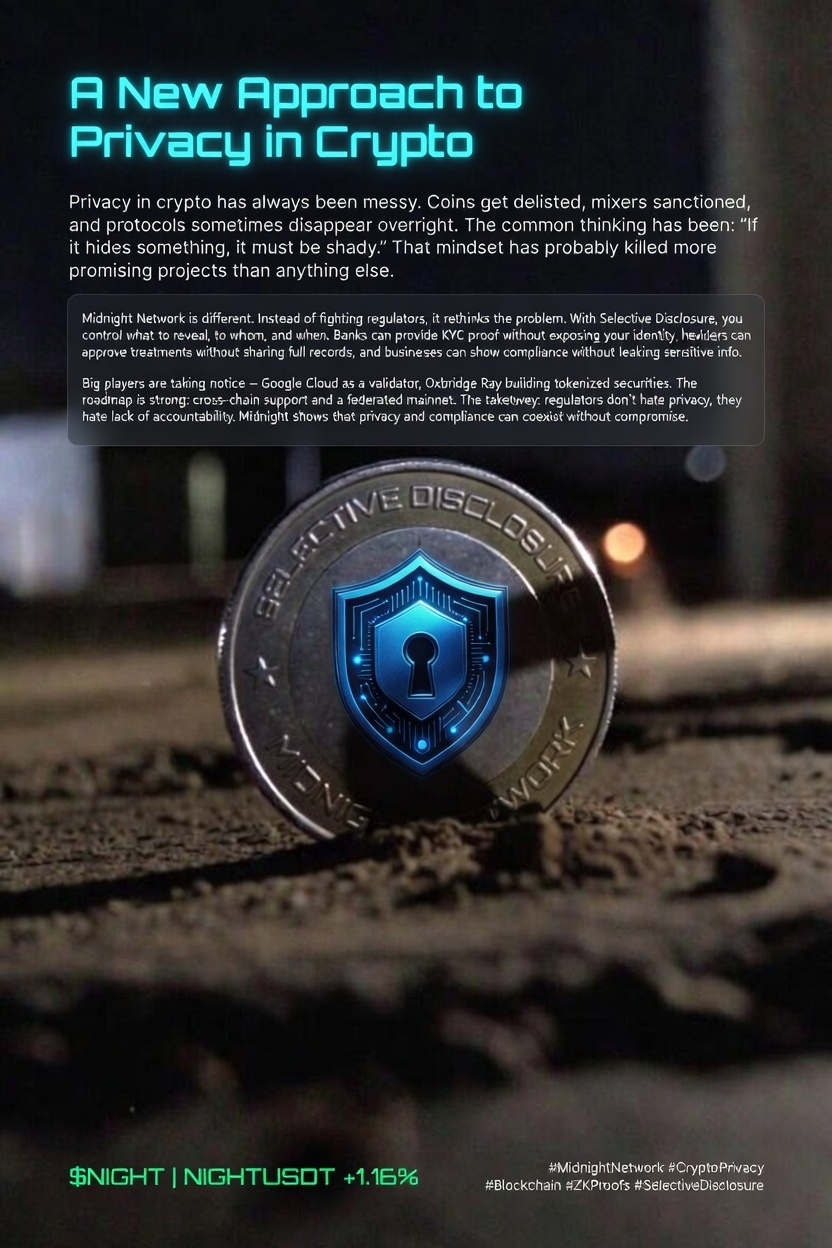
If crypto wants to grow beyond just trading and speculation, it needs to work for real industries finance, healthcare, identity systems. These fields deal with sensitive data and can’t function on fully public systems.
Timing also plays a role. As Midnight moves closer to launch, people are asking the real questions:
Will developers actually build on it?
Can the privacy model scale?
Will users stick around?
We’ve seen many exciting ideas in crypto disappear. Hype is easy, but long-term adoption is tough. Phase 2 could be the moment when Midnight proves itself when technology meets real users and developers.
It’s still early, but I find this project interesting. If Midnight can successfully combine privacy and transparency, it could become a meaningful part of the blockchain world.
For now, it’s definitely worth keeping an eye on.