
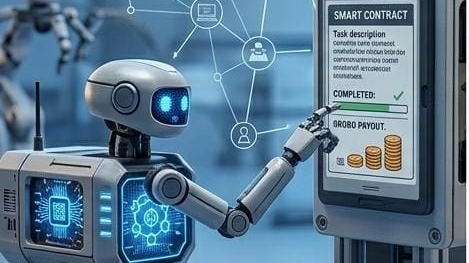

It was around 2 a.m. I was literally about to put my phone down and sleep when I saw this random thread on X. Something about “Fabric Protocol” and robots working on a public network.
I almost ignored it.
But I didn’t.
Maybe it was the timing. Maybe it was the wording. Or maybe I’ve just seen enough “AI + crypto” ideas to get curious when something feels slightly… off.
In a good way.
At first, I didn’t get it.
Robots… on a shared protocol?
I mean, seriously?
That usually sounds like one of those ideas that looks cool in theory but falls apart the second you think about real-world use. Suna sunaya lagta hai na?
But I kept reading.
And somewhere in the middle of that thread, I paused.
Because it wasn’t talking about robots the way I’m used to hearing about them.
No hype. No “future is here” tone. Just this quiet idea that robots shouldn’t be locked inside companies. That they could exist on an open network… like participants.
That’s where things got weird in my head.
In a good way.
I’ve always thought of robots as tools. Owned. Controlled. Contained.
Factory robots. Warehouse bots. Delivery machines.
All working but all invisible to each other.
No shared system. No shared memory.
Just silos.
Ajeeb baat hai, lekin I never really questioned that before.
Fabric kind of forces you to.
It’s like what if a robot wasn’t just “owned” by someone, but could show up, take a task, complete it, prove it, and get paid without needing a central authority to confirm everything?
That’s when I leaned back a bit.
Because now it’s not just robotics anymore.
It starts to feel like a marketplace.
Not for people.
For machines.
And here’s where I got slightly skeptical.
Yahan mujhay thoda shak hua…
Because we’ve seen this before in crypto. “Decentralized marketplaces,” “open networks,” all that. Most of them struggle because, in the end, someone still controls the data or the validation.
But Fabric is trying to anchor everything in proof.
Not promises. Proof.
Like, a robot doesn’t just say “I did the job.”
It has to show it. Verify it. Record it.
And that record lives on a public system.
That part I couldn’t ignore.
Because honestly, one of the biggest problems I keep noticing in AI and robotics right now is trust.
Everything is a black box.
You don’t know what data trained the system.
You don’t know if the output is accurate.
You don’t even know if the machine actually did what it claims.
You just trust the company behind it.
And that’s starting to feel outdated.
Fabric seems to be attacking that exact gap.
Quietly.
No big slogans. Just: “prove what happened.”
Then I started thinking about the token.
At first, I brushed it off. I always do. Feels like every project just adds a token because it has to.
But here, it actually connects to something real.
Work.
Not abstract staking. Not passive holding.
Actual tasks.
A robot does something → proves it → earns value.
Simple.
Almost too simple.
And yet that simplicity is what makes it interesting.
It’s tying digital value to physical action.
That’s not easy to fake.
Still, questions kept popping up in my head.
What if the robot messes up?
What if the data is wrong but still “verified”?
Who decides what counts as valid work?
No clear answers yet.
And maybe that’s okay.
Because this doesn’t feel finished. It feels early.
Like I’ve walked into a construction site instead of a polished building.
But the direction is clear.
Very clear.
We’re moving toward a world where machines don’t just work for companies they participate in systems.
Open systems.
And if that actually works, even partially, it changes something fundamental.
Not overnight. Not dramatically.
But quietly.
Because the moment machines can prove what they’ve done and get rewarded for it without needing permission, control stops being something you own and starts becoming something the system enforces.
