
I’m waiting with a bit of skepticism, watching how Midnight Network actually behaves beyond its pitch, looking for the usual cracks I’ve seen in other crypto
AI projects, and I’ve gone through enough whitepapers, docs, and scattered interviews to know when something is just rearranging old ideas.
I focus on what’s missing, not what’s promised, and honestly I came into this expecting another system that claims to coordinate work and payments but quietly depends on trust somewhere offchain.
Most of them can process tasks, some can simulate intelligence, but they don’t really solve identity, money, contracts, and accountability in one place.
That gap shows up the moment something goes wrong. Midnight, at least on paper, is trying to sit exactly in that gap, which is why it feels different, but also why it’s harder to evaluate cleanly.
What stood out first wasn’t speed or scale, it was the way identity is treated as something you don’t expose. Instead of accounts holding data, you get this model where you prove something about yourself without revealing the underlying information.
I’ve seen zero-knowledge ideas before, but here it’s not just a feature, it’s the default assumption. The contract doesn’t “know” you, it just verifies a condition.
That sounds clean until you start thinking about edge cases. If identity never sits on-chain, then where does trust accumulate over time? Reputation becomes abstract, almost fragmented, and I’m not fully convinced yet how persistent identity behaves under pressure like disputes or fraud.
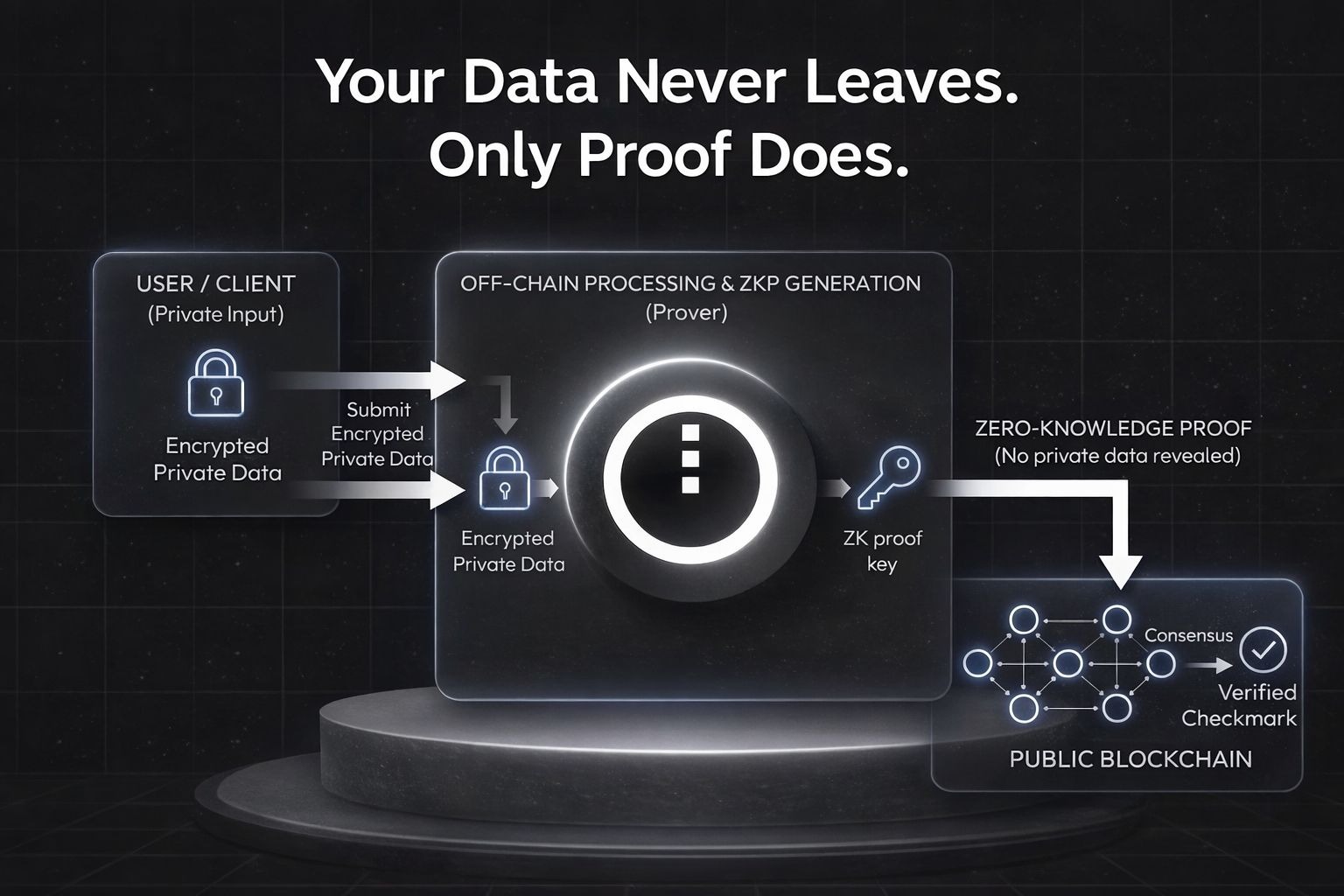
OM1 is where things start getting more concrete, or at least more interesting. The way I understand it, it’s positioned as a coordination layer where tasks, proofs, and payments connect.
Not in a theoretical sense, but in a way that tries to make work verifiable end-to-end. I kept going back to one scenario while reading: imagine a night shift courier picking up sensitive medical supplies. In a normal system, you’d log identity, track location, confirm delivery, and settle payment, all across different systems that don’t fully trust each other. Here, the courier proves eligibility without revealing identity, completes the task, generates a proof of completion, and the system verifies it before releasing payment. No raw data gets exposed, just the fact that conditions were met.
It’s elegant, but only if every piece of that chain is reliable, which is where things start to feel less settled.
The stack itself reads like an attempt to separate concerns that are usually tangled. There’s an off-chain layer where the actual computation and logic run, and an on-chain layer that only verifies proofs. In theory, this reduces cost and preserves privacy.
In practice, it shifts a lot of responsibility offchain, which introduces a different kind of risk. Verifiable computing sounds strong until you consider who generates the proof and what incentives they have to be honest. Proof-of-work style incentives show up here in a modified form, rewarding participants for doing useful computation rather than arbitrary hashing, but incentives don’t eliminate manipulation, they just reshape it.
I couldn’t ignore the oracle problem while reading. Anytime you rely on external input to validate real-world events, you open a surface for attack. If a task completion depends on data coming from outside the chain, someone controls that data.
Midnight seems aware of this, but I didn’t find a fully convincing closure to that loop. You can bond participants, slash them for bad behavior, and create economic penalties, but coordinated attacks or subtle manipulation can still slip through, especially in early stages when participation is low and incentives are uneven.
Token economics here feel functional rather than decorative, which I appreciate, but they also raise familiar concerns.
Supply, emissions, and sinks are structured to keep the system running, with fees for verification, bonds to ensure honesty, and governance locks that give long-term participants more influence.
The ve-style locking mechanism suggests a tilt toward committed stakeholders, but that also means early participants can accumulate disproportionate control. I kept asking myself who really benefits if this works at scale. Is it the workers doing tasks, the validators verifying proofs, or the early holders shaping
governance? The answer isn’t clean, and that ambiguity matters because it affects how the network evolves.
When I looked at partnerships and adoption signals, I tried not to read too much into announcements.
Early collaborations often look stronger on paper than in reality. There are hints of interest, some funding momentum, but nothing that clearly proves real-world dependency yet. That’s not unusual at this stage, but it means most of the value is still speculative.
Comparing this to systems like Virtuals or Fetch, the difference feels less about capability and more about focus. Those systems lean heavily into agent coordination and automation, while Midnight is trying to anchor that coordination in verifiable identity and payment.
The tradeoff is complexity. Midnight feels heavier, more constrained, but potentially more grounded if it works. The others feel faster to experiment with, but easier to break when trust becomes critical.
The failure modes here are not abstract. Malicious actors can fake skills if verification is weak. Collusion between participants can bypass checks if incentives align that way. Slashing mechanisms can be gamed or avoided if detection is inconsistent.
Fragmentation is another concern, especially if different parts of the ecosystem adopt slightly different standards for proofs and verification. Regulatory pressure is hard to ignore too. A system built around private identity and verifiable work sits in a grey area where compliance expectations are unclear.
And then there’s the question of jobs. If work becomes fully programmable and verifiable, who gets excluded, and who sets the criteria?
What I’m left with isn’t a clear conclusion, more a set of tensions that don’t resolve easily. If identity stays private, how does reputation persist? If verification is decentralized, who ultimately defines truth in edge cases? If governance concentrates, does the system drift away from its original intent?
And maybe the most practical question, what happens the first time a high-value task is verified incorrectly and someone loses money, who is accountable in a system designed to minimize exposure? These are the points I keep coming back to, and none of them feel like they can be answered just by reading more documents.
@MidnightNetwork $NIGHT #night
