
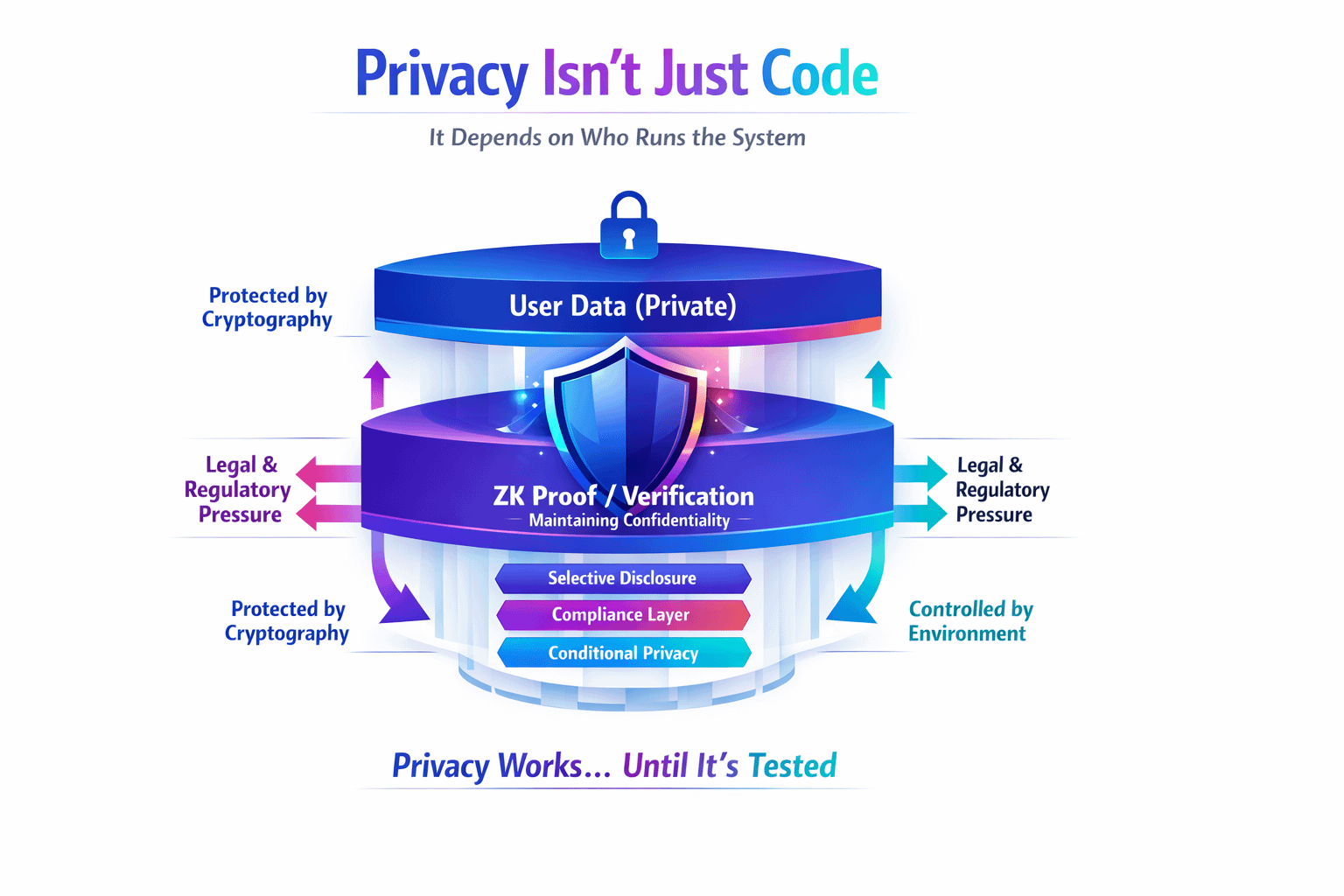
The more I think about the “regulated privacy” angle of @MidnightNetwork , the more it feels like a very practical idea… at least on paper.
Privacy where it matters, compliance where it’s required. That sounds a lot easier for institutions to accept compared to the old “full anonymity” narrative.
So I get why they’re going this route.
In fact, it might be one of the few ways a privacy-focused blockchain can realistically plug into finance, identity, or anything with legal constraints.
But the more I think about it, the less I see the challenge as cryptography.
It feels more like a question of who is actually running the system.
Because if the network depends on companies, validators, or infrastructure providers that operate under regulation, then the privacy story starts to shift a bit.
Not fake.
Just… conditional.
The data might be protected mathematically, sure. But the system around it still exists in a world where organizations can be pressured, regulated, or forced to cooperate.
And that’s where the friction is.
Crypto often assumes that solving the technical layer is enough. But in reality, networks don’t exist in a vacuum.
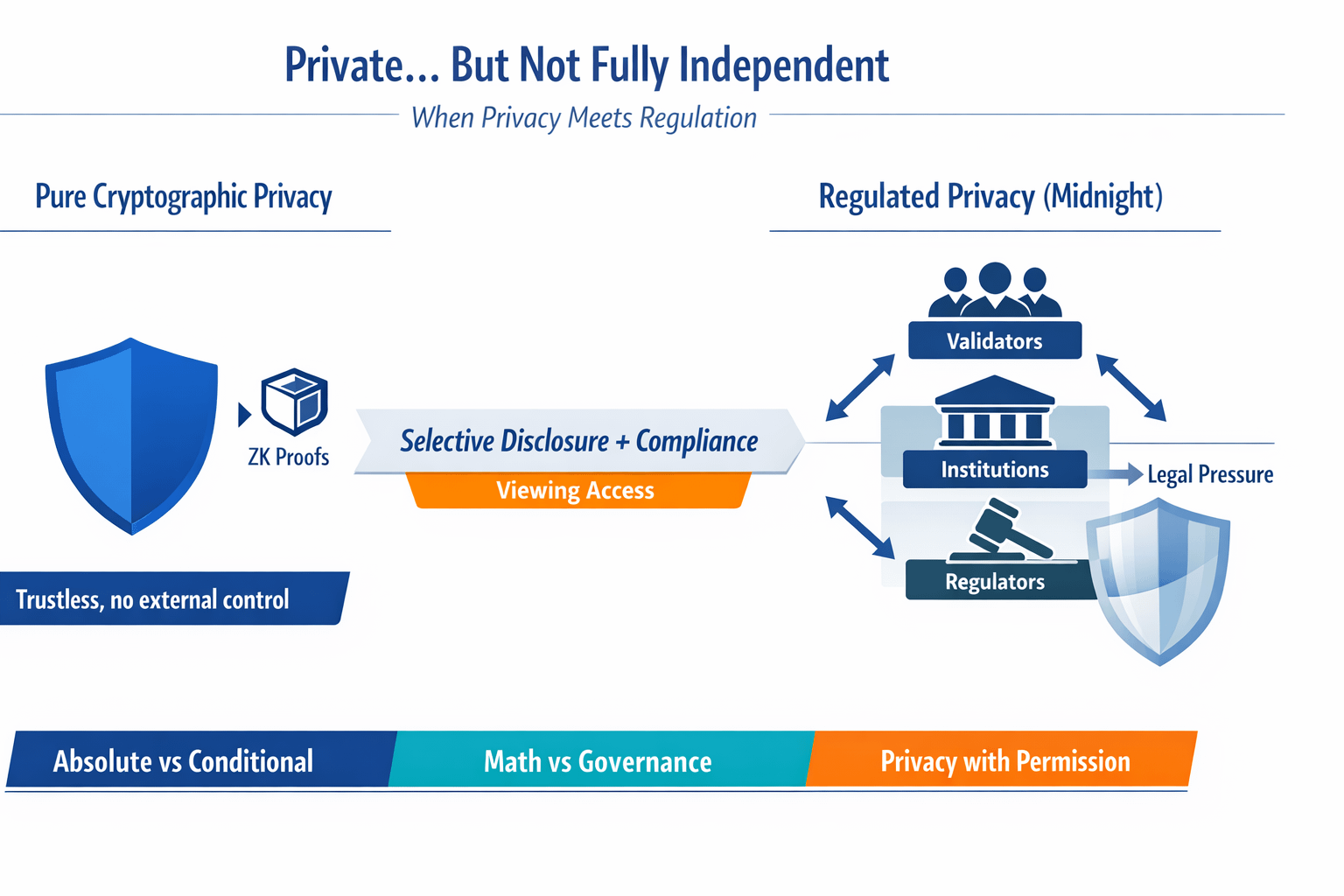
They sit inside legal systems, jurisdictions, and human incentives.
So even if the data layer is private, the control layer might not be.
At that point, the promise quietly changes.
It’s no longer “this system is resistant to outside control.”
It becomes something closer to “this system protects you, unless the entities behind it are required not to.”
That’s a very different kind of guarantee.
I think @MidnightNetwork is trying to balance both sides: enough privacy to enable real use cases, but enough compliance to make institutions comfortable.
And honestly, that’s a more realistic approach than most crypto narratives.
But realism comes with trade-offs.
Once privacy is designed to work with institutions, it also becomes something institutions can influence, supervise, and potentially limit.
And if the infrastructure depends on actors who need to follow legal frameworks, then the system’s resilience under pressure is always going to have a ceiling.
That doesn’t make it useless.
It might actually open a much bigger market — enterprises that want privacy, but not the kind that breaks compliance.
Still, I think it’s important to be clear about what’s being built here.
This may not be “trustless privacy” in the pure sense.
It’s closer to privacy that depends on the behavior and constraints of the people running it.
And historically, that kind of dependency matters more than we like to admit.
So for me, the real question isn’t whether the cryptography works.
It’s whether @MidnightNetwork can maintain meaningful privacy when real-world pressure shows up.
I’m still watching this closely, because that tension between technology and reality is probably where the outcome gets decided.