
It’s getting harder to walk into anything in this market with real conviction. Not because nothing interesting is being built, but because everything starts to sound familiar after a while. The same ideas keep showing up, just rearranged with better wording and cleaner presentation. Infrastructure, coordination, future systems, things that are supposed to matter more than what we see today. You read enough of it and it all begins to blur together. So instead of looking for reasons to believe, you start looking for where something might fall apart. It’s a quieter way of paying attention, but it feels more honest.
That’s how I ended up looking at Fabric. Not with excitement, not with immediate skepticism either. Just trying to see where the story holds and where it stretches too far. And to be fair, it doesn’t immediately break. There’s something about it that resists being dismissed too quickly. It’s not loud in the usual way, not just another recycled idea dressed up to catch attention. It’s aiming at something heavier, something that sits beneath the surface rather than trying to shine on top of it.
The space it’s pointing to is real. If machines are going to operate across open environments in any meaningful way, trust becomes a hard problem, not an abstract one. Not the kind that’s solved with reputation or assumptions, but the kind that demands clarity. Who performed an action, what data can be relied on, how interactions are verified, how value moves, who is accountable when something goes wrong. These are not small questions, and they don’t disappear as systems scale. If anything, they get sharper.
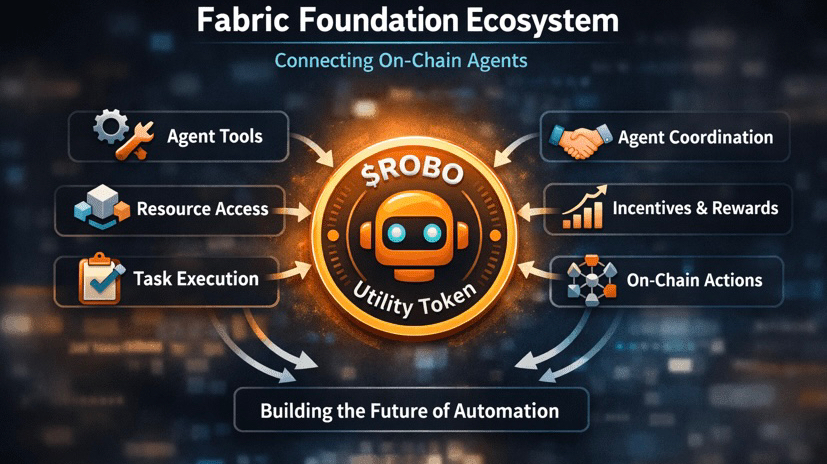
Fabric seems to be circling that layer. Not just talking about automation or agents in a vague sense, but trying to deal with the structure that would allow those systems to actually function in the real world. That alone makes it harder to ignore. Because most projects never even get that far in their thinking. They stay closer to the surface, where things are easier to describe and easier to sell.
But this is also where the hesitation sets in. Seeing a real problem doesn’t automatically make a solution necessary. And it definitely doesn’t guarantee that the solution needs to exist as a protocol with its own token and economic layer. That’s the part this market tends to rush. It finds something that feels inevitable and starts building financial narratives around it before the underlying need has fully revealed itself.
You can feel a bit of that here. The language carries weight, maybe even more than it should at this stage. Concepts like machine economies, verifiable identity, coordination layers — they sound important, and maybe they are. But sounding important and becoming essential are very different things. One lives in theory, the other has to survive contact with reality.
So the questions keep coming back, just in slightly different forms. Is this something systems will eventually depend on, or just something that fits nicely into how we imagine the future today? Does the token actually serve a purpose that can’t be removed later, or is it part of the standard structure we’ve grown used to? And most importantly, does this become unavoidable infrastructure, or does it remain optional, something that looks compelling but isn’t truly needed?
There’s no clear answer yet, and that uncertainty is doing most of the work right now. It leaves space for possibility, but it also leaves room for projection. And projection is something this market has always been generous with, especially when the narrative is big enough to carry it.
That’s probably why Fabric ends up in that middle zone. Not something to ignore, but not something to fully trust either. Just something to watch. To revisit over time. To see how it holds up when it has to prove itself beyond ideas and into actual use. Because that’s where most things reveal what they really are.
Maybe it turns into something meaningful. Maybe it becomes part of the infrastructure people are currently struggling to describe. That does happen occasionally. But it’s rare enough that it’s not worth assuming too early.
For now, staying uncertain feels like the most grounded position. Not cynical, not dismissive, just unwilling to turn interest into belief without something solid behind it. And in a space that constantly pushes for early conviction, holding onto that uncertainty might be the only way to stay close to what’s real.