
I was reading through the Sign whitepaper and the section on Hyperledger Fabric X stopped me completely. most people hear "blockchain for governments" and assume it means a slow, heavy system built for compliance, not performance. what i found was the opposite.
From what i understand, Fabric X is a fundamental re-architecture of the original Hyperledger Fabric. the original design had a monolithic peer — everything ran as one big unit. Fabric X breaks that apart. the peer is decomposed into independently scalable microservices, each handling one specific job. the Coordinator manages overall flow. Signature Verifiers handle cryptographic checks. Validator-Committers confirm and write transactions to the ledger. because each service is independent, you can scale whichever part is under load without touching the rest. the backend storage is also distributed across multiple database shards, so no single database becomes a bottleneck as the network grows.
On top of that, Fabric X introduces a transaction dependency graph for parallel validation. traditional systems validate transactions one after another in sequence. Fabric X maps which transactions are independent and validates them simultaneously. this is one of the core reasons the system reaches the throughput numbers it does.
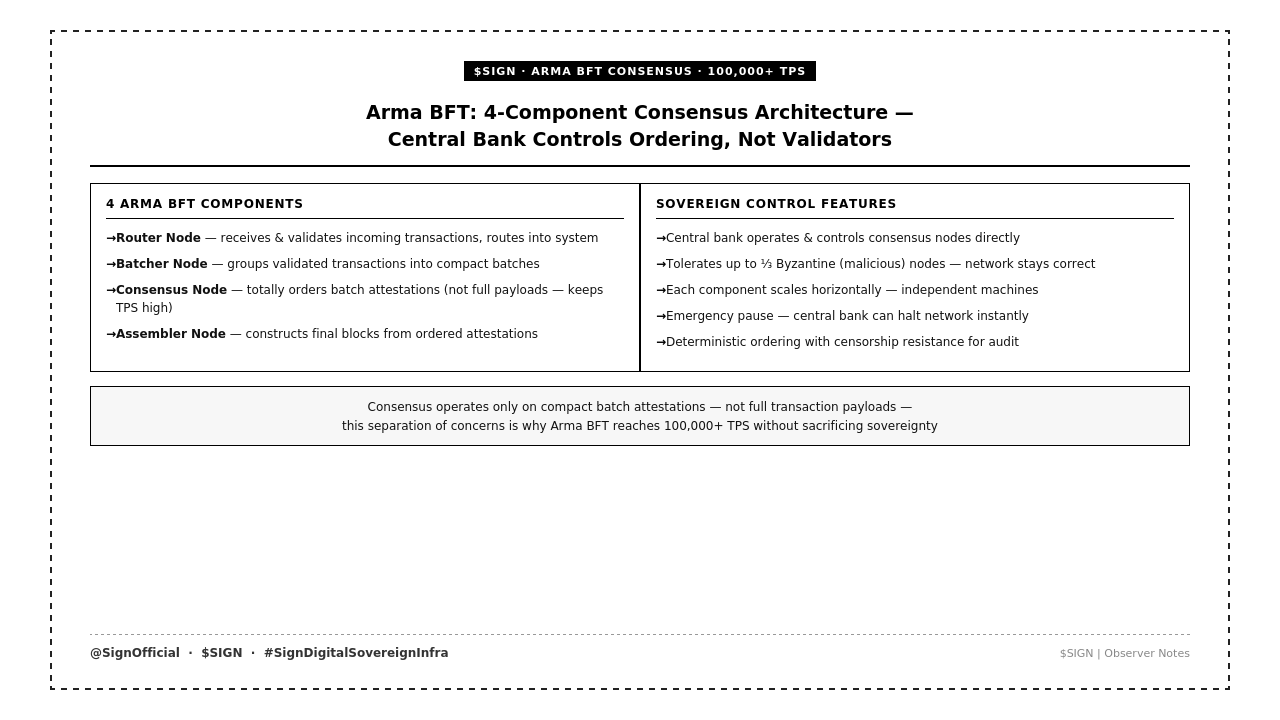
Then theres the consensus layer — Arma BFT — which is also broken into four separate components. the router node receives and validates incoming transactions. the batcher node groups them into batches. the consensus node orders compact batch attestations, not full transaction payloads, which keeps throughput high. the assembler node constructs the final blocks. each component scales horizontally across multiple machines independently, which is how the system reaches 100,000+ transactions per second.
What caught my attention most is who controls the consensus nodes. the central bank. not a decentralized validator set. the central bank operates and controls the consensus layer directly, meaning transaction ordering and network governance stay under sovereign authority at all times. the system also tolerates up to one third Byzantine nodes — even if some participants behave maliciously, the network continues correctly. and if a security incident occurs, the central bank can pause the entire network immediately.
Thats a very specific design — high performance, sovereign control, and fault tolerance all built into one architecture. do you think this level of central bank control over digital infrastructure is the right balance, or does it give governments too much power over money?