

I keep circling back to the same frustration.
We’ve made machines faster, cheaper, and undeniably smarter. Yet somehow, they still don’t work together in any meaningful way. Not really. What we call “integration” today is often just a fragile patchwork custom APIs, vendor agreements, and layers of software that feel more like duct tape than design.
Take something as simple as a warehouse robot needing to communicate with a routing system from another vendor. If that works smoothly, it’s more luck than standard practice. Most systems are closed by design restricted data formats, tight permission controls, and ecosystems built to keep you locked in. At this point, the barrier isn’t technical anymore.
It’s structural.
That’s where Fabric steps in or at least, tries to.
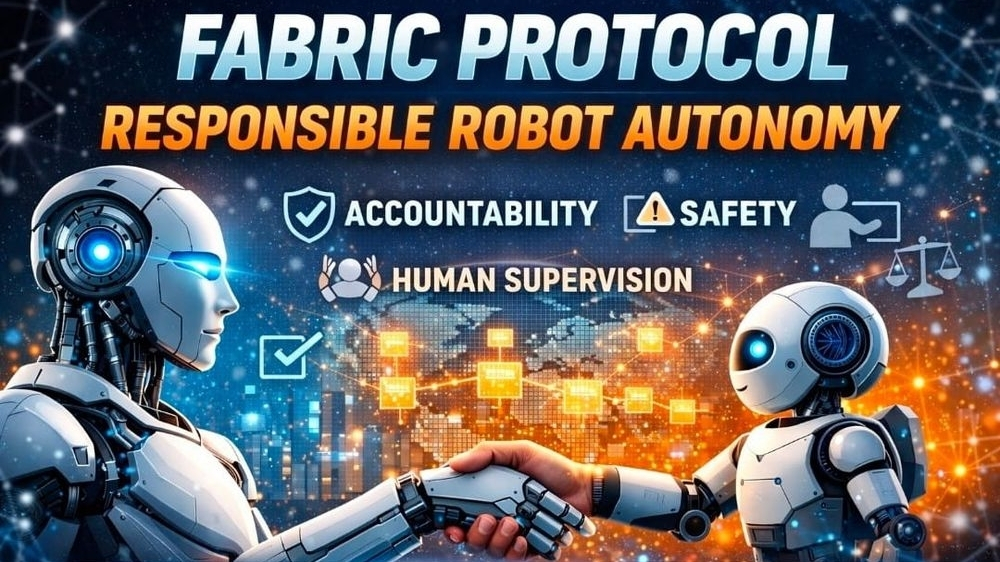
Fabric isn’t pitching itself as another robotics platform or AI stack. It’s aiming to be something more foundational: a coordination layer that no single company controls. A neutral ground where machines, data providers, and compute systems can interact without asking for permission.
On paper, it sounds idealistic. But some of the design choices feel grounded in reality.
Instead of treating machines as entries in a centralized database, each one gets a verifiable identity rooted in the network itself. Tasks aren’t handed down in a top-down manner—they’re defined as contracts, with clear expectations, outcomes, and rules for settlement. When a robot completes a task, it doesn’t just report success. Its work is recorded, validated, and made verifiable by others.
That alone could eliminate a huge amount of ambiguity the kind that usually breaks coordination between systems.
But what really stands out is the economic layer.
$ROBO isn’t just another token for speculation it introduces risk. If you want to deploy a machine into the network, you stake value. You’re no longer flipping a switch and hoping everything works out. You have skin in the game.
If your machine performs well, you earn. If it fails or behaves unpredictably, you lose that stake. No support tickets. No escalation chains. Just immediate consequences.
That’s a sharp contrast to how things work today.
Right now, accountability in automation is often blurry. Contracts get renegotiated. Failures are absorbed or quietly shifted elsewhere. Costs are redistributed instead of resolved. Fabric flips that dynamic—behavior and economics are directly linked, and feedback is immediate.
Zooming out, this has bigger implications.
We’re already seeing automation trend toward consolidation. Companies are building vertically integrated stacks hardware, software, data, and distribution all under one roof. If that continues, we won’t end up with an open machine economy. We’ll end up with a handful of dominant systems deciding how machines operate, what they can access, and who gets paid.
Fabric feels like a counterweight to that future.
By acting as an open coordination layer, it redistributes power. It creates space for smaller players independent developers, niche hardware makers, operators to participate without being swallowed by a single ecosystem. It’s less about idealism and more about avoiding infrastructure-level lock-in.
Still, there’s a gap between design and reality.
Real-world machines are messy. Sensors drift. Environments shift. Data is noisy and inconsistent. You can write perfect contracts on-chain, but the inputs feeding those contracts are anything but clean. That’s where most systems fail not in theory, but in edge cases.
So the real question isn’t whether Fabric is conceptually sound.
It’s whether it can handle that mess.
If it can if machines from different vendors can truly coordinate, verify each other’s work, and exchange value without slipping back into centralized control—then we’re looking at a genuine shared infrastructure for automation.
If it can’t, the more likely outcome is already taking shape: a world where a small number of companies quietly end up owning and controlling most of the machines around us.
And honestly, that future feels closer than most people are willing to admit.
@Fabric Foundation #ROBO $ROBO
