
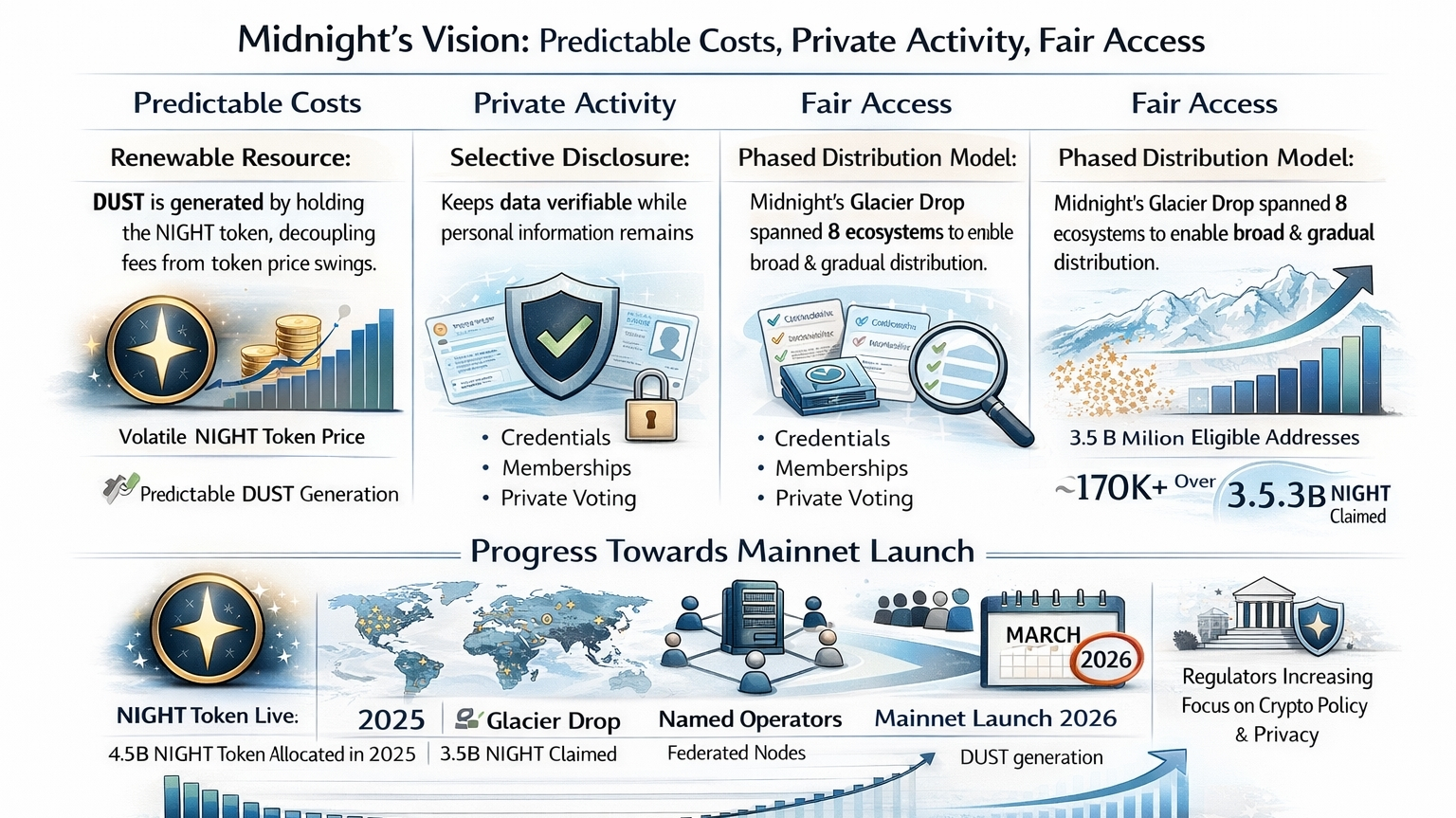

@MidnightNetwork I keep coming back to one simple reason Midnight feels relevant right now. It is trying to solve three practical problems that most blockchains still treat as trade-offs. The project is drawing more attention because its mainnet is scheduled for late March 2026. At the same time privacy has returned to the crypto policy conversation in a more serious way. In recent months the SEC’s Crypto Task Force has held a public roundtable on financial surveillance and privacy. Regulators have also signaled a stronger push toward clearer crypto rules. That matters because privacy is no longer being discussed only as ideology. It is now being discussed as infrastructure, governance, and market design.
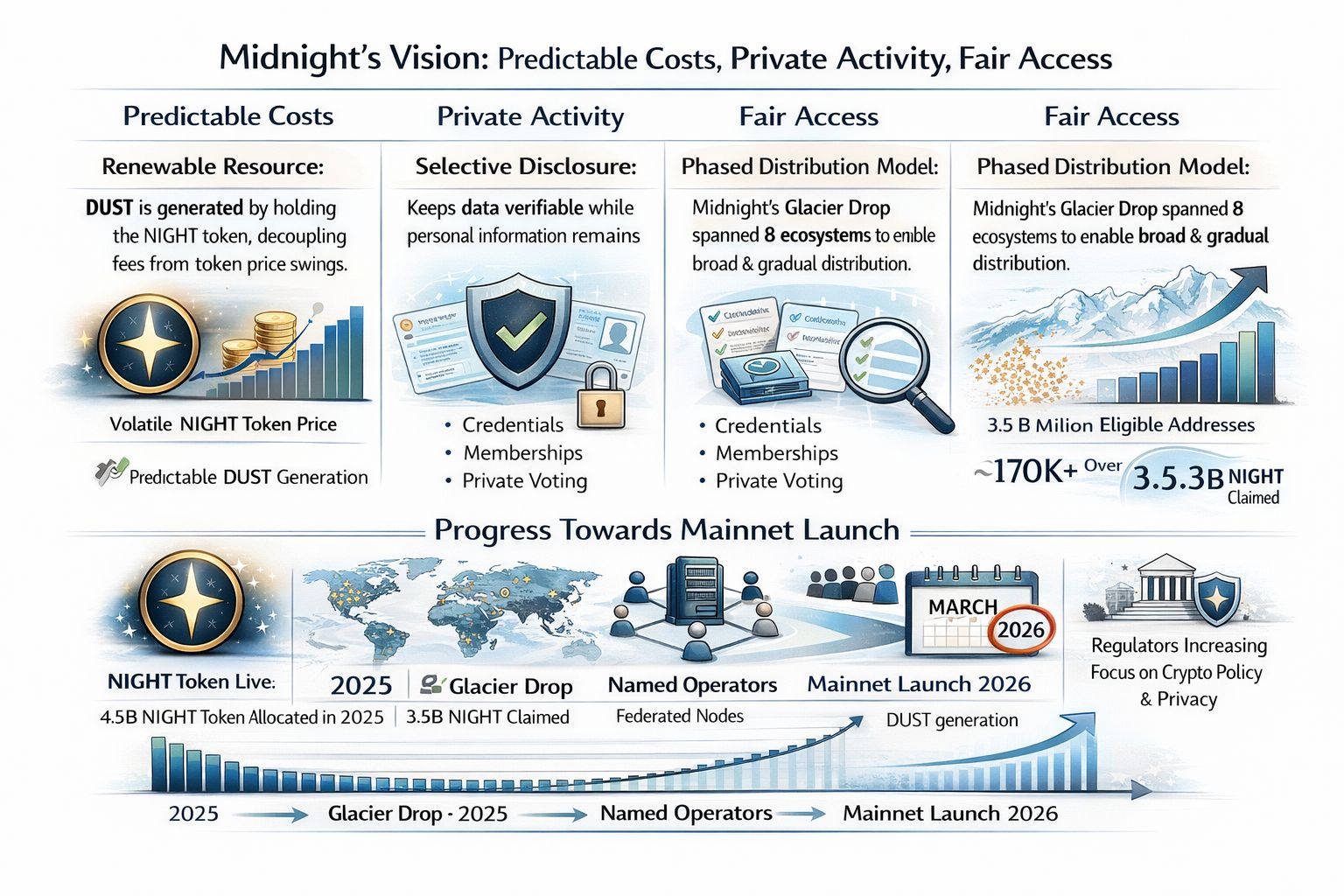
What I find most interesting is Midnight’s attempt to make costs feel stable in a market that is usually anything but. Instead of relying on one volatile token for everything, Midnight separates its governance asset, NIGHT, from DUST, the replenishing resource used to pay for activity on the network. The idea is simple. If DUST is generated from holding NIGHT, then the cost of running an application does not swing as sharply with token price moves. I think that idea deserves attention because predictable operating costs are not glamorous. They are the kind of detail users need before they trust a system with real work.
The second part of the vision is private activity. That is where Midnight becomes more than a fee model. Its promise is not total invisibility. It is selective disclosure. That means being able to prove something is true without exposing everything around it. Midnight’s documentation points to use cases like credentials, membership checks, and private voting. In those cases results can remain publicly verifiable while personal identity or transaction history stays hidden. I think that framing is healthier than the old all or nothing privacy debate. Most people do not want a world where every action is public forever. They also do not want systems that make accountability impossible. Midnight is trying to work in that middle ground. That is where most real institutions live too.
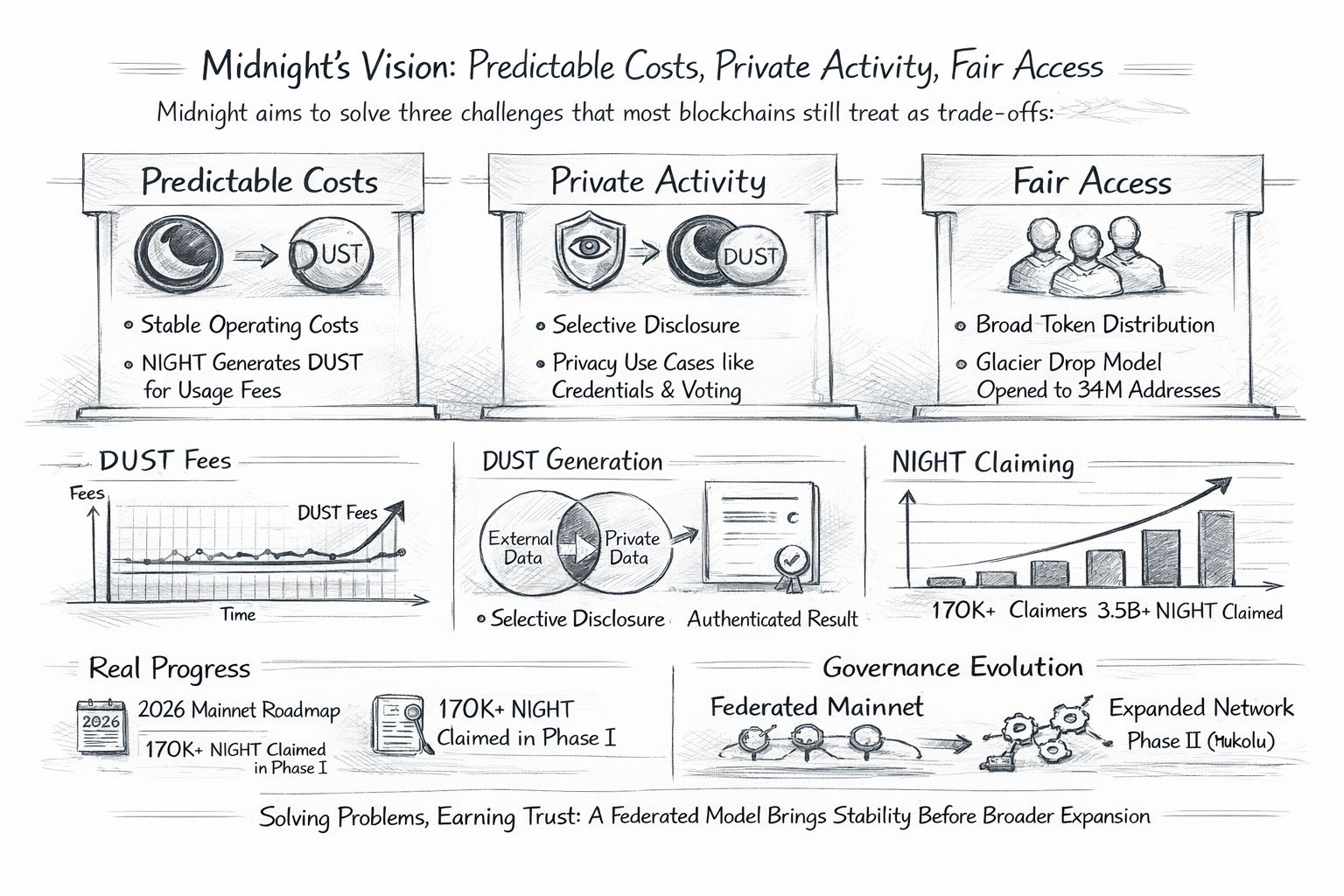
Fair access is the third claim and it is the one I approach with the most caution. Crypto projects love the language of fairness, yet distribution often rewards insiders, speed, or capital. Midnight’s answer has been the Glacier Drop. It is a multi-phase distribution model that opened claims to nearly 34 million eligible addresses across eight blockchain ecosystems and used gradual unlocking to slow down extraction and abuse. By October 2025 the project said more than 3.5 billion NIGHT had been claimed by over 170,000 addresses in the first phase. I would not call that proof of fairness forever because no launch design can fully control what happens once trading and governance begin. Still, it is a more deliberate attempt at broad access than the usual rush and dump playbook.
There is also real progress behind the story. That is another reason the topic is trending now. Midnight has moved from abstract privacy language into visible execution. It has a published 2026 roadmap, a shift toward the Kūkolu phase, and named mainnet node operators, with more operators added in February. None of that guarantees success. The early federated mainnet model will still invite debate from people who want decentralization on day one. I think that criticism is fair. But I also think it is healthier to judge a network by the honesty of its trade-offs than by grand promises. Midnight seems to be saying that stability and coordination come first. Broader expansion comes after that.
My view is that Midnight matters less as a brand and more as a signal. It reflects a growing belief that the next phase of crypto will not be won by loudness. It will be shaped by systems that solve ordinary problems well. That means budgetable fees, privacy that can survive scrutiny, and access models that feel less extractive. That does not make the project inevitable. I am also not convinced that any chain has fully solved the tension between privacy and openness and power. Even so I understand why people are watching Midnight so closely in March 2026 because it is not selling an escape from the real world. It is trying to build a version of on-chain life that feels practical enough for more people to actually live with.
@MidnightNetwork $NIGHT #night #Night