

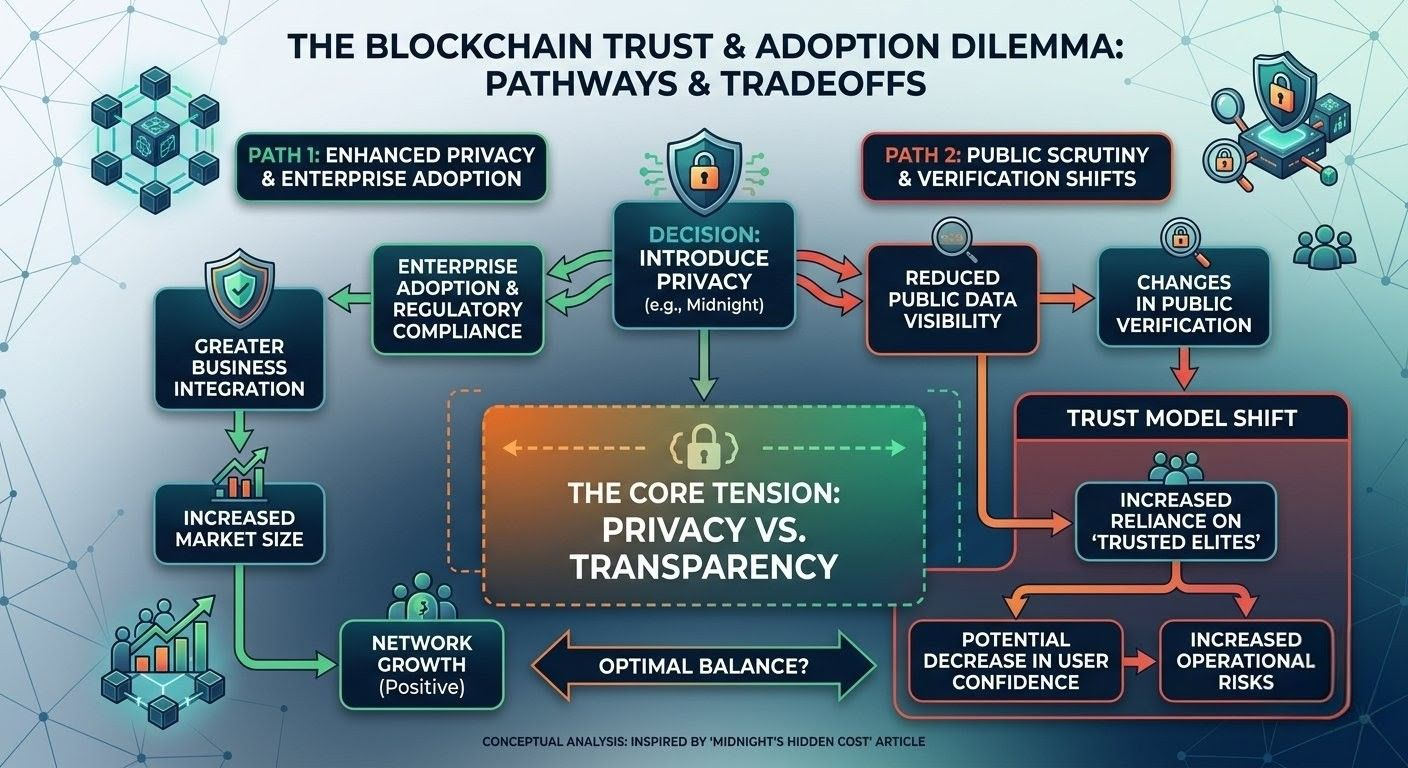
 You know, the more I sit with this Midnight idea, the more I realize the real tension isn’t privacy at all.
Privacy? That part actually feels pretty straightforward. Companies aren’t queuing up to slap their balance sheets and secret recipes on a public billboard. Public chains were built for that radical “everyone sees everything” vibe, but most serious businesses treat it like showing up to a meeting in their underwear. So when Midnight says “hey, we can hide what needs hiding while you still get blockchain benefits,” it clicks right away. I totally get why big institutions are nodding along. It’s practical. It’s overdue. It just makes sense.
But here’s what actually keeps tugging at me late at night.
The second you start closing the curtains on parts of the system, you’re also turning down the lights for everyone else who used to be able to watch what’s really going on. Blockchain’s whole magic trick has always been that anyone could just… look. Follow the money, spot the weird patterns, call bullshit before it snowballed. Midnight isn’t pretending that’s not happening — it’s deliberately trading some of that open-book honesty for real-world usability. On paper, yeah, fair trade.
Still, it leaves me uneasy.
Because once the inner workings go dark, the safety net quietly shifts onto a smaller group of people who actually can see inside. The proofs might be rock-solid. The auditors might be the best in the business. The team might be completely on the level. But bugs don’t read whitepapers. Exploits don’t announce themselves. And if something starts quietly rotting in those hidden layers — some subtle inflation glitch, a sneaky logic flaw, whatever — the rest of us are basically left waiting for someone behind the curtain to say “everything’s fine, trust us.”
It’s not paranoia. It’s just pattern recognition from too many past episodes in this space.
Crypto was born on the slogan “don’t trust, verify.” Midnight is kind of flipping that to “trust that the verification still works even when you can’t see the data.” Zero-knowledge tech is supposed to make it all square, and in theory it does. In real life, though? My actual confidence has never come from math proofs alone. It’s come from thousands of curious eyes stress-testing every block, devs poking around independently, the messy public noise of people spotting smoke before the fire starts.
Strip away too much of that open scrutiny and the trust model shifts, almost without you noticing, from “we can all read the code and it’s law” to something closer to “the smart folks in the room say it’s all good.” And let’s be honest — that line hasn’t exactly had a flawless track record around here.
Look, I’m not saying the whole experiment is doomed. Midnight might nail this balance beautifully. The privacy features could open doors public chains never touched. But let’s not act like the tradeoff is some minor technical footnote. It’s the whole damn point.
The easy question is whether enterprises will love the privacy. Of course they will.
The harder one is whether the rest of us — validators, users, the skeptics on the outside — will still feel like we can genuinely trust the network when we can’t watch the gears turning in broad daylight anymore.
Privacy might make blockchain feel more grown-up.
It might also make it a little harder to keep honest in the ways that actually matter.
And that’s the part no elegant whitepaper has quite answered yet.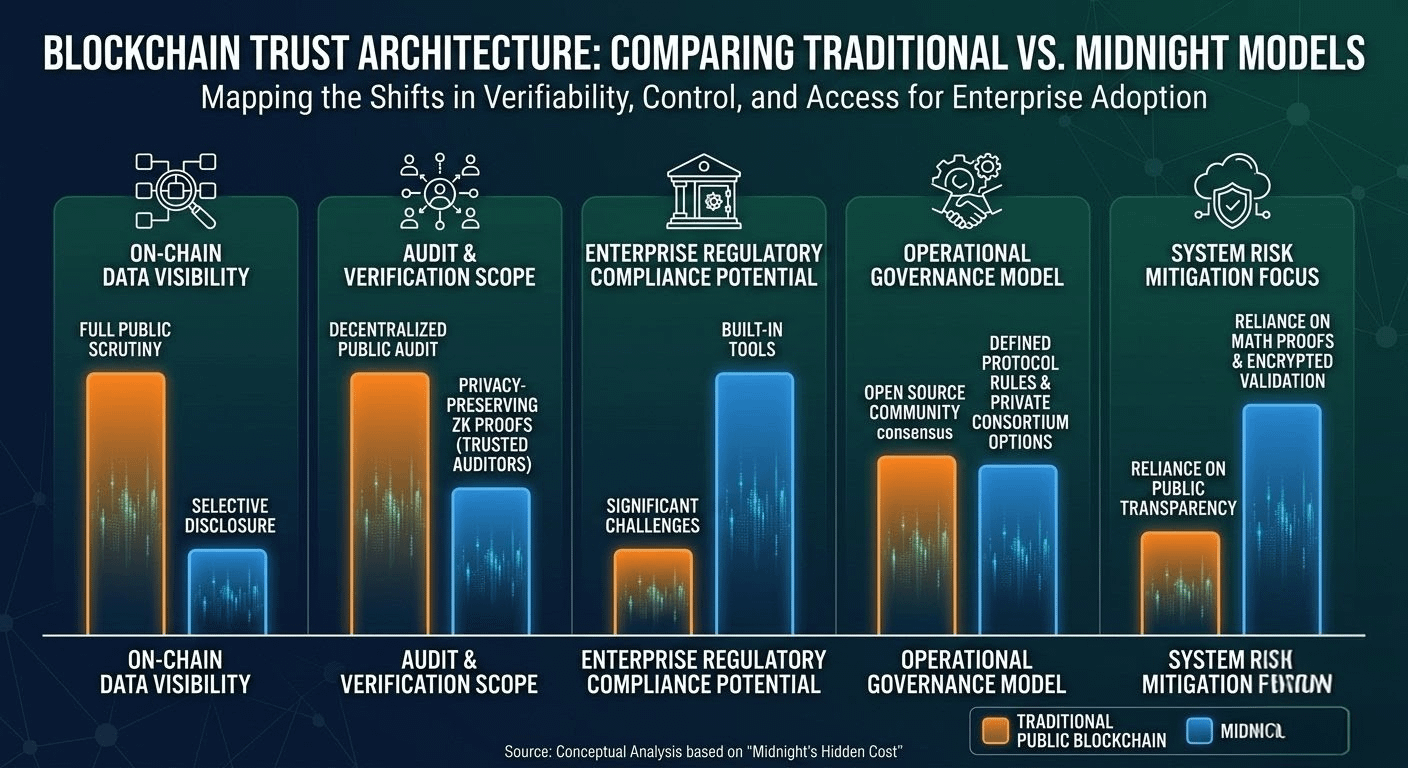
#night #NİGHT @MidnightNetwork $NIGHT
