
I oftenfound myself thinking: what does it really
mean to “verify” someone in a digital world where everyone has an incentive to exaggerate, forget, or simply mess up?
This question kept pulling me toward the Sign system, and I realized it was truly worth pondering.
Sign’s system isn’t flashy, nor does it try to summarize your identity or predict it. It works quietly: issuing credentials once, verifying them across a decentralized network, and ensuring they remain usable across different platforms.
At first glance, it may seem boring, but there’s an invisible intelligence hidden in that silent elegance.
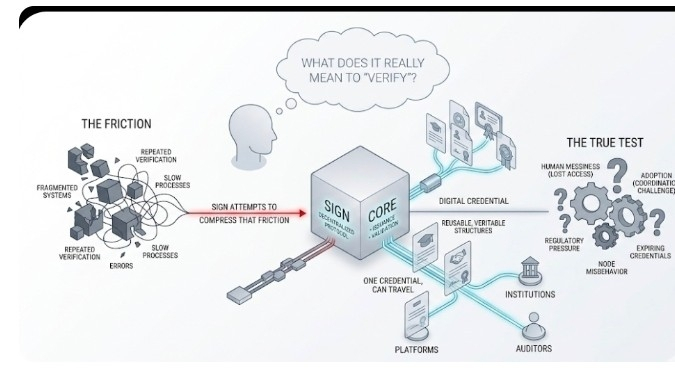
The project matters because the problem it addresses seems simple but is actually extremely complex. Today, proving credentials like degrees, work experience, or licenses requires dealing with fragmented systems, slow processes, and repeated verification.
This not only wastes time but also increases the chance of errors. Sign attempts to compress that friction into a reliable, verifiable structure.
One credential, once issued, can travel, be verified, and audited anywhere. This really feels smart, but I keep wondering: what if a credential expires, if a node misbehaves, or if a law changes? Humans are complicated, and complexity always finds gaps.
Another important aspect of Sign is adoption. Its design is modular and interoperable, but that only works if enough people actually use it.
Developers need to integrate it, institutions need to accept it, and users need to understand it. Hidden in this is the silent challenge of coordination and collaboration, and history shows that alignment at this scale rarely happens easily or quickly.
The user-centric aspect is also noteworthy. Individuals hold and present their own credentials rather than relying on a central authority. This provides freedom, but it also comes with responsibility.
Mistakes—lost access, mismanaged keys, or miscommunications—have real consequences.
Looking at the system, I am left with a mix of admiration and caution. Sign seems thoughtfully engineered, solving friction points that most people ignore. But the real test will be in the real world: true adoption, human error, and regulatory pressure.
It’s not clear whether it will succeed or stumble, and perhaps the intrigue lies precisely in that uncertainty.
Reflecting on all this, I realize that the future standard of identity won’t just be verification it will be trust, transparency, and a balance with human interaction. Sign is an early attempt at that balance: quiet but impactful, and that’s what impresses me the most.
What also stands out to me is how subtle the system feels. In a space where most projects compete for attention through hype and promises, Sign almost does the opposite.
It focuses on infrastructure rather than visibility, which is rare and, in a way, refreshing. But that also raises another question: can something so foundational succeed without strong visibility? Or does it risk being overlooked despite its importance?
There is also a philosophical layer to all of this. Verification is not just a technical problem; it is deeply human. Trust has always been built through relationships, context, and time. Translating that into code, credentials, and networks is not just engineeringit is an attempt to redefine how we understand identity itself. That’s a much bigger challenge than it first appears.
And maybe that’s where the real weight of Sign lies. Not just in solving verification, but in quietly challenging the way we think about trust in a digital world.
Whether it succeeds or not, it is part of a much larger shift that is still unfolding, and that alone makes it worth paying attention to.
@SignOfficial #signDigitalSovereignlnfra
