

I remember the first time I really questioned the idea of “trustless” systems. It wasn’t during a hack or a failure. It was during something much more ordinary. I was interacting with a protocol that worked exactly as designed, and yet something still felt off. Everything was technically correct, but the outcome didn’t feel aligned with reality. That’s when it hit me. Removing trust doesn’t automatically create understanding.
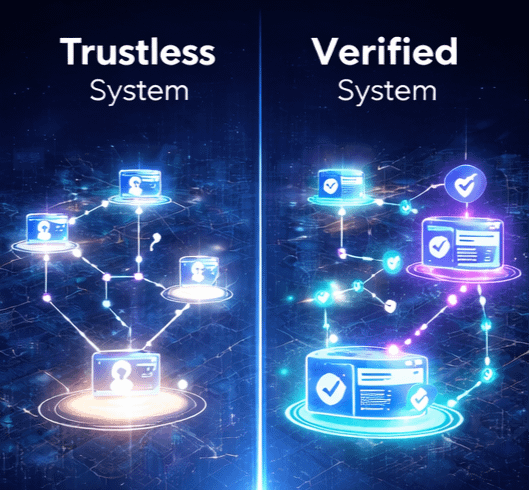
That’s the contradiction I keep coming back to in Web3. We’ve spent years trying to eliminate trust by replacing it with code. Smart contracts execute deterministically, transactions are transparent, and systems are designed to minimize reliance on human judgment. But in doing so, we’ve created a different kind of gap. We can verify that something happened, but we struggle to verify what it actually means.
Transparency gives us data. It doesn’t give us context. @SignOfficial
This is where most current solutions start to feel incomplete. A wallet address can show you a history of interactions, but it doesn’t tell you whether those interactions were meaningful. A transaction proves that value moved, but not whether it was earned, coordinated, or manipulated. In theory, everything is visible. In practice, very little is interpretable without making assumptions.
That’s the gap Sign Protocol is trying to address, and the more I look at it, the more it feels like a missing layer rather than an optional feature.
The simplest way I think about Sign Protocol is this. It allows someone to make a claim about an address in a way that others can verify without needing to trust the issuer blindly. Instead of trying to infer meaning from raw blockchain data, it introduces structured, verifiable statements.
If I had to explain it casually, I’d say it’s like proving you meet a condition without exposing everything behind it. You’re not handing over your entire history, just a credential that confirms something specific and relevant.

What makes this interesting is not just the idea of attestations, but the standardization behind them. Claims aren’t just arbitrary notes. They follow schemas, they can be verified, and they can be reused across different applications. Over time, that starts to look like a shared layer of verifiable context sitting on top of otherwise fragmented systems. $SIGN
And once that layer exists, the design space for applications changes. Protocols don’t have to rely solely on raw activity anymore. They can incorporate verified signals into how they operate, whether that’s access, rewards, or governance.
From a token perspective, the role of the SIGN token becomes important in how this system sustains itself. It’s not just a unit of exchange, but part of the mechanism that aligns participants in the network. Depending on how the protocol evolves, the token can be tied to validation, governance, and potentially the economic flows around issuing and verifying attestations.
What matters more than the exact mechanics is whether the token is actually connected to usage. If attestations become widely used and verification becomes a core part of how applications function, then the token has a reason to exist beyond speculation. It becomes tied to infrastructure demand. If that connection remains weak, then it risks drifting into the same pattern we’ve seen with many tokens that exist without strong utility.
Looking at the current market context, Sign is still early relative to the scale of the problem it’s targeting. The broader market tends to focus on narratives that are easier to visualize, things like AI, scaling solutions, or liquidity flows. Verification infrastructure is less visible. It doesn’t show up directly in charts, and it takes time before its impact becomes obvious.
Metrics like market cap, circulating supply, and trading volume can give a rough sense of positioning, but they don’t fully capture potential here. A lower valuation can mean room to grow, but it can also mean the market hasn’t yet recognized the importance of the problem. What I pay more attention to is whether this type of system starts appearing inside real applications, not just as an idea, but as something actively used.
The bull case for Sign is rooted in a simple progression. As Web3 systems become more complex, the need for reliable context increases. It’s not enough to know that something happened. Systems need to understand what qualifies as meaningful participation, valid contribution, or legitimate behavior.
If Sign becomes a standard way to encode and verify those signals, it starts to integrate across multiple layers of the ecosystem. DeFi protocols, NFT platforms, DAOs, and even identity systems could all rely on the same underlying structure for verification. And once that kind of dependency forms, it tends to persist.
But there are real challenges that could prevent that from happening.
The biggest one is adoption. Infrastructure only becomes valuable when it’s used. If developers don’t integrate these verification layers into their products, or if the process feels too complex or unnecessary, the system doesn’t reach critical mass.
There’s also the issue of trust in the issuers of attestations. Even if the system itself is trustless in execution, the quality of the inputs still matters. If low-quality or biased claims become widespread, the reliability of the entire layer is weakened. In a way, this shifts the problem rather than eliminating it.
Privacy is another area that can’t be ignored. A system designed to verify claims needs to balance transparency with user control. If users feel that participating exposes too much information, it could limit adoption. On the other hand, if too much is hidden, verification loses its strength. Finding that balance is not trivial.
From a market perspective, there’s also the possibility that this narrative takes time to develop. Traders often gravitate toward more immediate catalysts. Verification infrastructure is a slower build. It requires integration, iteration, and gradual adoption before it becomes visible in a meaningful way.
If I think about what would change my mind on this thesis, it comes down to a few signals. If over time there’s little evidence of real usage across major applications, that’s a concern. If developer activity around the protocol stagnates, it suggests the idea isn’t gaining traction. And if the token becomes increasingly disconnected from actual network usage, it weakens the economic argument.
I’d also watch how the system handles the quality of attestations. If there’s no clear mechanism to maintain standards, the value of verification itself starts to erode.
At the core of all this is the same contradiction that caught my attention in the beginning. Web3 systems aim to be trustless, but users still need to make decisions based on trust-like signals. We’ve removed intermediaries, but we haven’t fully replaced the role they played in providing context.
Sign Protocol doesn’t eliminate that tension, but it approaches it differently. Instead of asking users to trust entities, it allows systems to rely on verifiable claims. It doesn’t solve every problem, but it introduces a layer that feels necessary as the ecosystem matures.
Because in the end, being trustless isn’t the same as being understandable. And without a way to verify meaning, we’re left with systems that are technically correct, but practically incomplete. #SignDigitalSovereignInfra