
@MidnightNetwork #night $NIGHT
I still remember the knot in my stomach the first time I deployed a supply chain smart contract on a public ledger. My client, a mid-sized logistics firm, loved the automation but panicked when they realized that every single supplier payment was permanently visible to their competitors. That is the paradox of Web3: total transparency builds trust, but it absolutely kills enterprise adoption.
Enter the Midnight Network ($NIGHT).
As a developer tired of the "hide everything" narrative that puts crypto in the regulatory crosshairs, I actually sat down and read the Midnight whitepaper. No moonboy hype, just the underlying architecture. Midnight is a Cardano partner chain utilizing zero-knowledge (ZK) proofs to enable selective disclosure. You mathematically prove your contract executed correctly without broadcasting the sensitive data.
Here is a transparent, real-world review and beginner's guide on how to actually deploy smart contracts on $NIGHT.
The Ecosystem: $NIGHT, DUST, and the "Mining" Reality
Before you write a single line of code, you need to understand the network's operational fuel. The Midnight whitepaper outlines a brilliant dual-token model that solves a classic crypto trap: when a token's price moons, the network becomes too expensive to use.
$NIGHT: The unshielded native token used for network governance and staking.
DUST: A shielded, non-transferable, and decaying resource used exclusively to pay for smart contract execution and transaction fees.
Let us be fully faithful to the details regarding mining. You are not setting up loud, power-hungry ASIC rigs in your garage to mine $NIGHT. Midnight initially distributed its tokens via the "Scavenger Mine" phase and Glacier Drops. Moving forward, the network operates on a Proof-of-Stake model anchored to Cardano's security. By simply staking or holding $NIGHT, you automatically generate DUST. As a developer, this means you hold the core asset to organically "mine" the DUST required to run your decentralized applications, keeping your daily operational costs entirely predictable.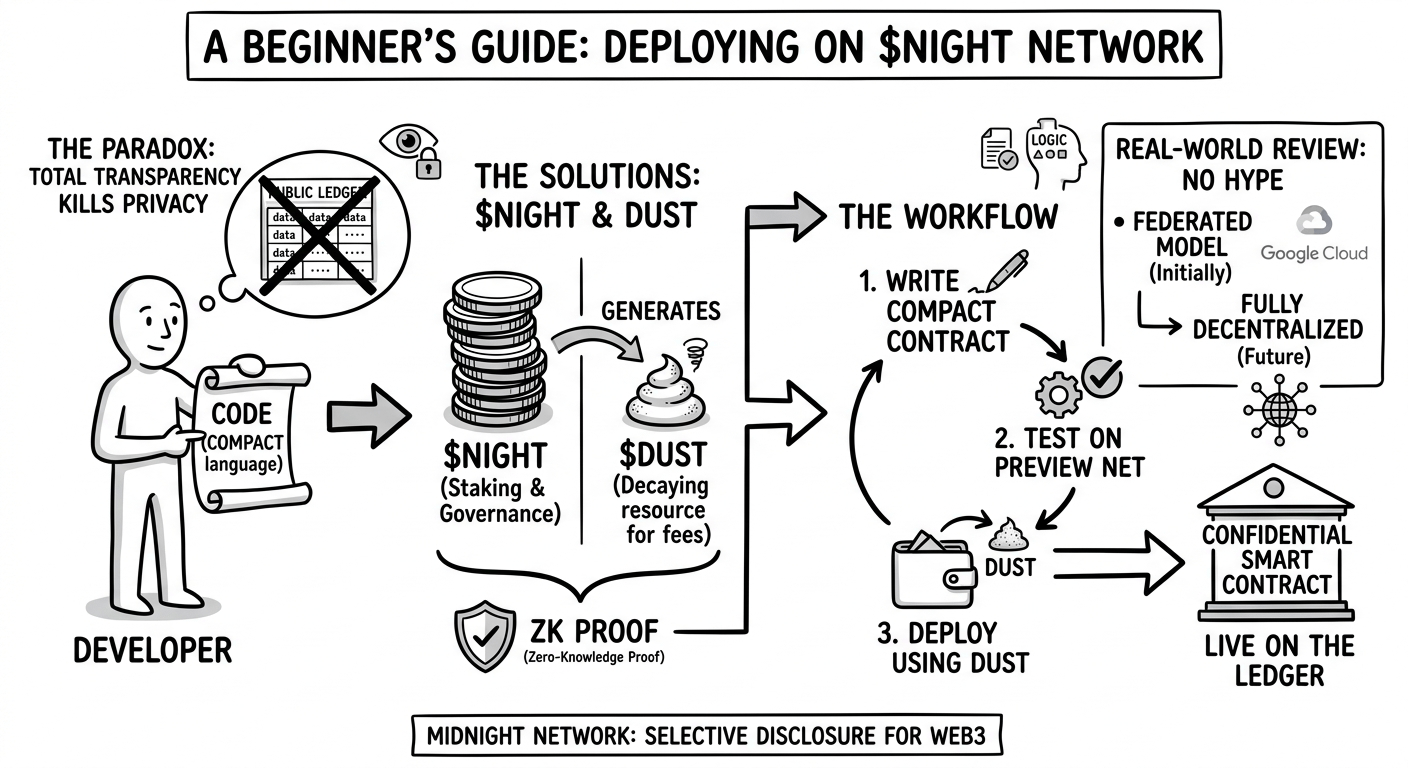
Step-by-Step: Deploying Your First Contract
Deploying on Midnight requires shifting your mindset from traditional Solidity to ZK-logic. The network uses a specialized programming language called Compact. Here is a human-level roadmap to getting your first confidential contract live.
Step 1: Set Up Your Development Environment
You will need Node.js installed. Midnight relies heavily on the midnight-js library for its testing and deployment framework. Initialize your project directory and pull in the latest Midnight developer packages.
Step 2: Write in Compact
Compact is designed specifically for ZK-SNARKs. It allows you to strictly define public states (visible on-chain) and private states (shielded). For example, if you are building an identity verification application, you can write logic that proves a user is over the age of eighteen without ever revealing their actual birthdate on the ledger.
Pro-tip from the trenches: Because Compact is highly niche, standard AI assistants will often hallucinate bad code. Do yourself a favor and install the Midnight Model Context Protocol (MCP) Server. It bridges your AI coding assistant directly to Midnight’s valid repositories, acting as a specialized ZK coding expert.
Step 3: Test on the Preview Network
Never deploy to mainnet blindly. Use the midnight-js testing frameworks to run local simulations. Recent updates have made it significantly easier to test block times and state changes. Ensure your ZK proofs are generating accurately and that your private data is not leaking into public variables.
Step 4: Fund with DUST and Deploy
Once your Compact code is solid, compile it into a prover key and verifier logic. To push it to the live network, your wallet needs DUST. Assuming you hold enough $NIGHT, your wallet will have generated the necessary DUST to cover the shielded gas fees. Execute your deployment script, and your confidential smart contract is officially live.
The Transparent Review: No Hype Allowed
Let's strip away the marketing. Is Midnight the absolute holy grail?
The core technology is undeniably robust. Being able to build compliant, enterprise-grade privacy applications is a massive leap forward. However, the current reality of the mainnet launch is that it relies heavily on a federated model. It is initially controlled by trusted operators like Google Cloud to ensure stability before fully decentralizing. If you are a hardcore blockchain purist, this phased rollout might annoy you. But if you are a developer looking for real institutional adoption, this compliance-friendly "safe port" is exactly what big businesses want to see.
Mastering ZK infrastructure is challenging but highly rewarding.