
I was reading the tokenomics whitepaper and came across a paragraph i had to read twice. not because it was complicated — because it was unexpectedly clear. the whitepaper uses a physical world analogy to explain the entire NIGHT-DUST relationship, and once you see it, you cant unsee it.
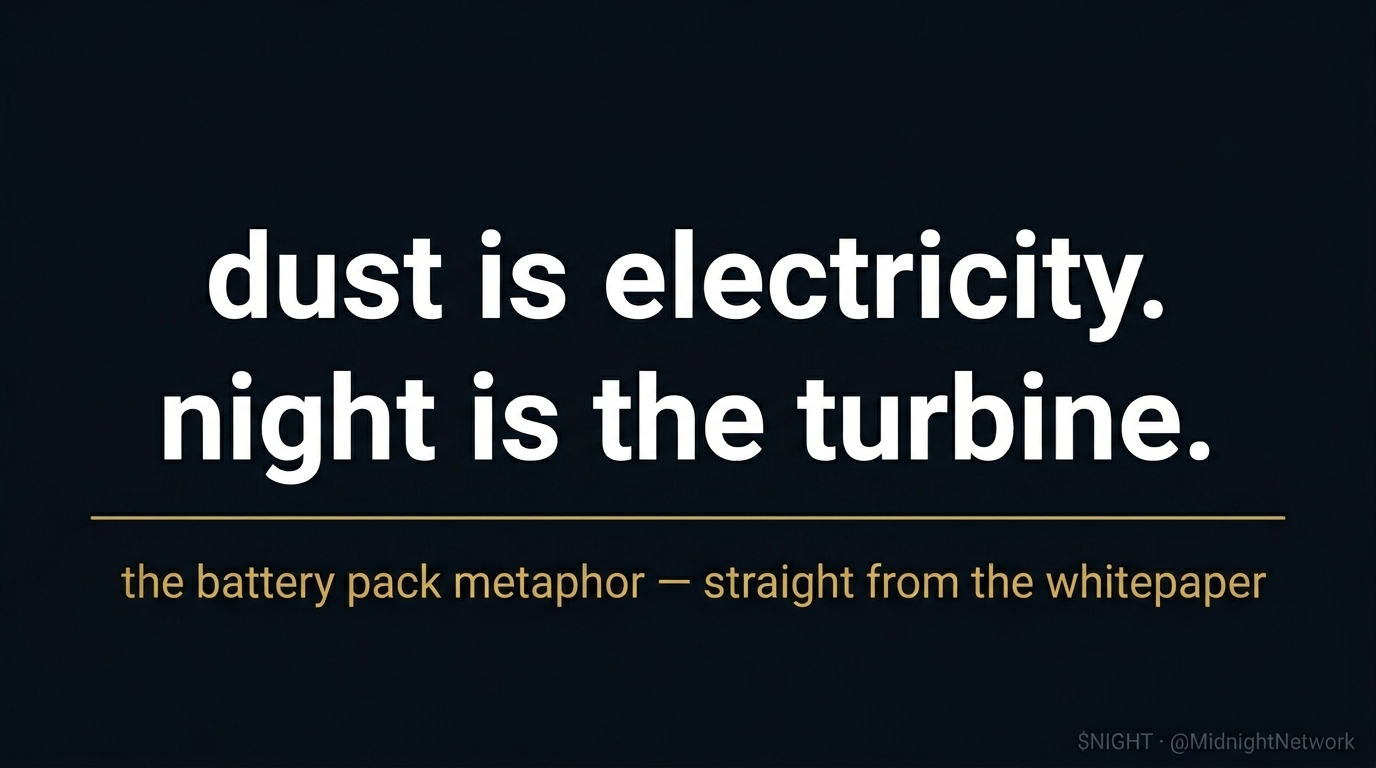
DUST is electrical energy. DUST addresses are battery packs. NIGHT tokens are wind turbines.
That's the model from the whitepaper directly. and it holds up across every property of the system if you follow it through properly.
A wind turbine generates electricity continuously. it doesnt run out of capacity to generate — it keeps producing as long as the wind blows. NIGHT works the same way. holding NIGHT generates DUST continuously, block by block, indefinitely. the whitepaper is explicit that NIGHT will generate DUST indefinitely. there is no lifetime cap on how much DUST can be generated from a NIGHT balance over time.
A battery pack stores that electricity up to a maximum capacity proportional to the size of the turbine connected to it. DUST addresses work the same way. the cap on how much DUST a given address can hold is proportional to the NIGHT balance generating into it. bigger NIGHT balance — bigger cap. smaller balance — smaller cap.
A turbine can charge any battery, regardless of who owns the battery. NIGHT works the same way. a NIGHT holder can designate any DUST address as the recipient of their generation — including addresses they dont own. a business can hold NIGHT and designate DUST generation to their users addresses. a developer can hold NIGHT and direct DUST to a DApp contract address. the turbine and the battery dont need to belong to the same person.
But once electricity is stored in a battery, it cant be moved to another battery. it can only power devices connected to that battery. DUST works exactly the same way — its non-transferrable. once DUST is in an address, it stays there until its used for transactions or decays. you cant send DUST to someone else. you cant sell it. it can only be consumed where it lives.
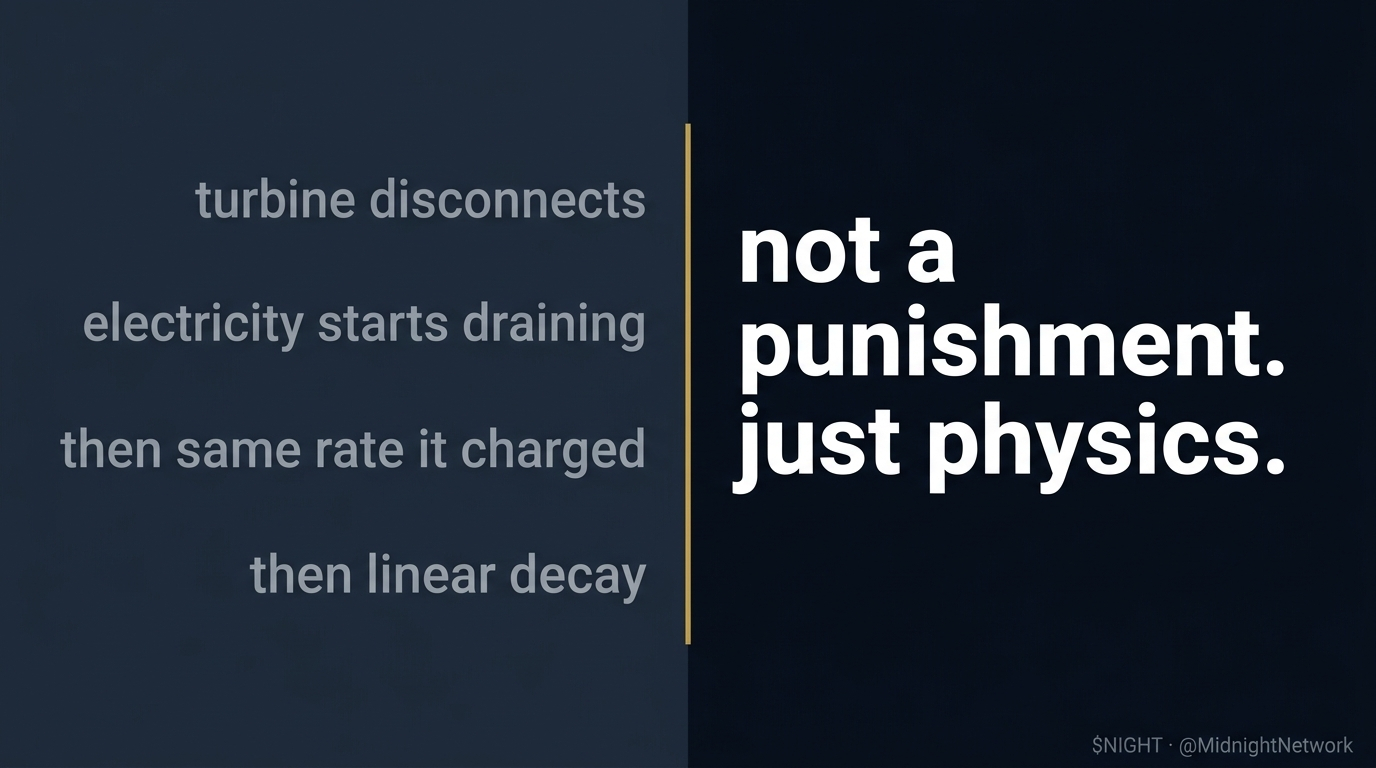
And when the turbine disconnects from the battery — when NIGHT is transferred away — the stored electricity starts to decay. it doesnt disappear instantly, it drains at the same rate it was being generated. the whitepaper describes this as a finite shelf life, decaying linearly at the same rate it was generated. this is the DUST decay mechanic — not a punishment, just physics.
What makes this analogy work beyond aesthetics is that it captures the regulatory intent too. DUST cant be transferred, so it cant function as a store of value, cant be listed, cant be traded. it has value in the sense that it enables transactions — but it cant retain that value or be moved around like a financial asset. the battery pack metaphor captures this perfectly. stored electricity is useful but immobile.
Most tokenomics explanations feel like reading a terms and conditions document. this one reads like understanding how power grids work. and once you understand the turbine-battery model, the mechanics of DUST designation, decay, caps, and non-transferability all follow naturally.
The whitepaper built an analogy that actually holds. that doesnt happen often.
How would you explain the NIGHT-DUST relationship to someone who has never used a blockchain before?
#night #NIGHT $NIGHT @MidnightNetwork