
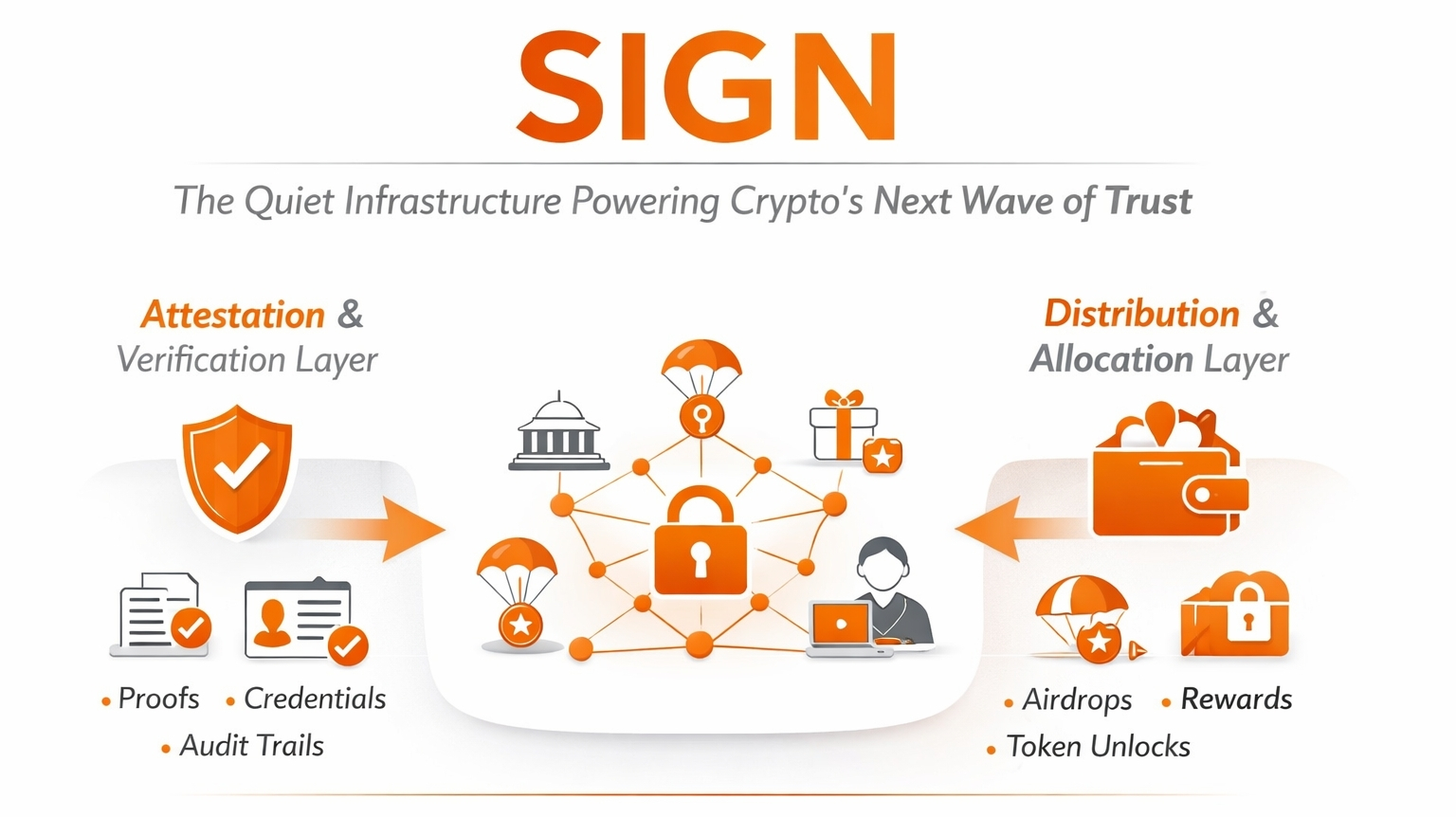
@SignOfficial $SIGN #signdigitalsovereigninfra
I’ve been watching SIGN for a while now, and something keeps striking me: most of crypto’s attention is on the flashy layers—the new chains, the high-yield protocols, the next meme coin. But underneath all that, the ecosystem actually runs on less visible infrastructure: proof of eligibility, verification, allocation, and accountability. These are the parts no one tweets about, but they dictate whether capital moves smoothly or chaos erupts. SIGN is staking a claim exactly in that space, and that makes it a very different kind of project.
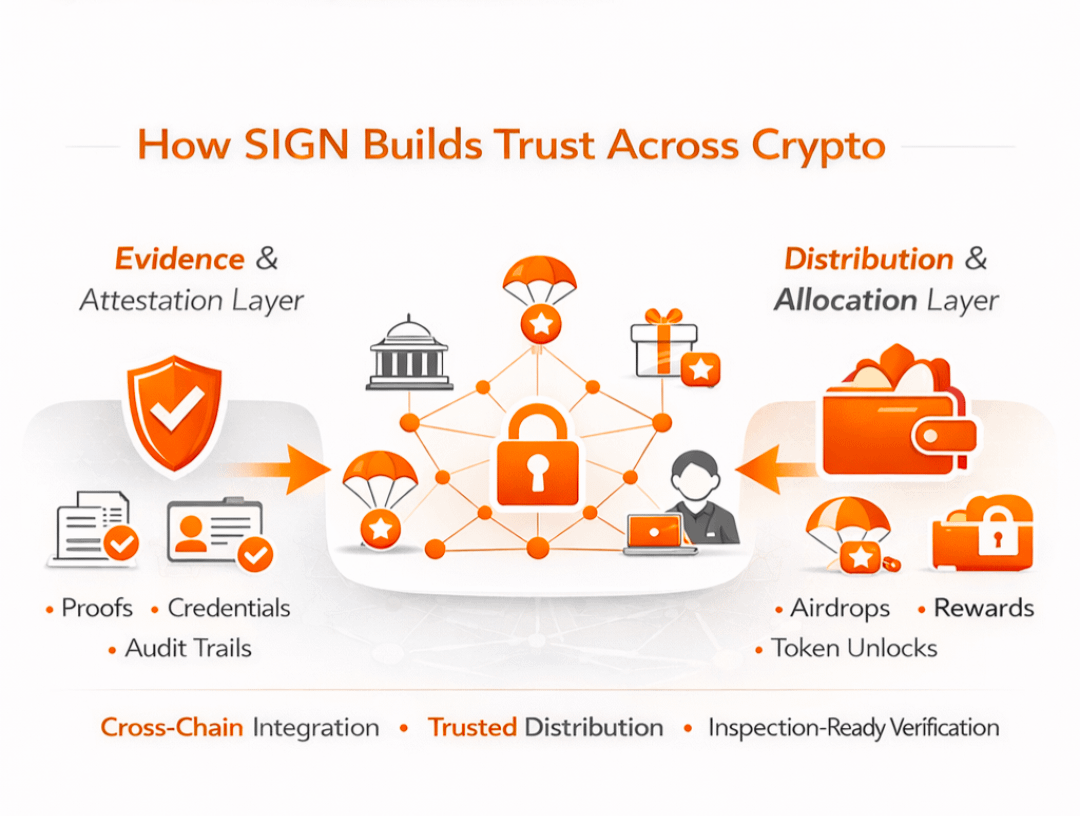
What fascinates me is how SIGN separates verification from distribution. Sign Protocol handles the attestation and evidence side, proving that something is real, valid, or true. TokenTable, on the other hand, is the engine that decides who gets what, when, and under what rules. It may sound subtle, but this modular approach is not trivial. A lot of projects try to lump these together and end up with messy token allocations, disputes, or governance headaches. By keeping these responsibilities distinct, SIGN is essentially saying: “We want this infrastructure to be reusable, reliable, and auditable.”
From a market standpoint, infrastructure tokens are tricky to price early. Unlike yield farming tokens or governance assets, usage doesn’t translate directly into hype. Instead, it’s about belief: does the market think this tool can become a backbone for multiple ecosystems? SIGN isn’t just a ledger or a wallet—it’s a platform for verifiable claims, hybrid attestations, and selective disclosure. To someone who follows the market closely, that reads as an attempt to standardize trust across workflows rather than solving one problem at a time.
I’ve noticed that durable crypto utility often lives in the “boring middle” rather than the flashy surface. Most people think of payments, lending, or swaps when they say utility. But infrastructure like SIGN quietly enables those layers to function. Sign Protocol isn’t a base ledger—it doesn’t compete with Ethereum or Solana. Instead, it sits on top, across chains and storage systems, providing a layer of trust that can be reused. In a multi-chain world, that positioning could be quietly strategic.
TokenTable is another piece that deserves closer attention. It’s designed for grants, airdrops, incentives, and unlock schedules, all with auditability baked in. Crypto participants often underestimate how painful distribution can be. Failed airdrops, disputes over eligibility, or mismanaged vesting schedules create trust issues fast. If TokenTable can consistently reduce that friction, it becomes more than an operational tool—it becomes part of the ecosystem’s heartbeat.
There’s also a psychological angle here. Traders and participants care deeply about fairness. Who got in early? Who qualified for the airdrop? Were rules followed? SIGN’s structured claims and inspection-ready evidence directly address this, which might sound like a small detail but matters when narrative and sentiment collide. Reliable infrastructure can quietly build trust in ways flashy projects cannot.
Operations, as usual, are where the rubber meets the road. SIGN’s primary users aren’t retail traders—they’re developers, institutions, and governments. Binance research even calls it a “global infrastructure layer for credential verification and token distribution.” That breadth of ambition makes reliability the true test. A good story can only carry you so far if the system isn’t dependable under real-world workloads.
The cross-chain dimension adds another layer of interest. SIGN supports cross-chain attestations, decentralized TEE verification, and signed verification results. That might not excite a casual trader, but it matters for adoption. Verification isn’t valuable if it’s trapped in one silo. As assets and users spread across chains, infrastructure like SIGN could quietly become indispensable.
There’s still risk. Infrastructure projects often struggle to attract attention. Traders gravitate toward simpler stories or high-momentum narratives. SIGN’s value proposition isn’t obvious at first glance. But the slow burn of credibility—repeat usage, auditability, adoption by other projects—can be a powerful, if underappreciated, market driver.
The tokenomics are worth a careful look. Total supply is 10 billion SIGN, with 1.2 billion circulating at launch and 350 million allocated to Binance HODLers. Numbers like these influence perception: early liquidity, initial airdrop coverage, and vesting schedules all shape how the market interacts with the token. But supply alone doesn’t define value. What matters is whether SIGN functions as a coordination layer for ecosystems—linking proof and distribution—or whether it ends up as a speculative token trading while the underlying infrastructure grows quietly.
For me, the most compelling aspect isn’t a promise of instant adoption. It’s that verification and distribution are becoming non-negotiable components of on-chain life. Projects that handle these reliably may not make headlines today, but they become harder to ignore over time. Schemas, attestations, eligibility checks, audit trails, and programmable allocations are not gimmicks—they’re operational necessities. That’s why SIGN feels like an infrastructure bet, not a hype bet.

Maybe the market still treats it as niche. Maybe it will take longer than anyone expects to catch attention. But history shows that infrastructure which quietly becomes essential often ends up as a foundational layer for more visible success. Trust, proof, distribution, and auditability might not be glamorous, but they are the rails on which crypto eventually moves at scale. That, to me, is where SIGN sits—and why I keep watching.