I’ve been spending a lot of time lately looking at the way we’ve tried to "fix" privacy in Web3, and honestly, most of it feels like putting a band-aid on a gunshot wound. We keep talking about zero-knowledge proofs like they’re some magical fairy dust you can just sprinkle on a blockchain to make the regulators go away, but the reality is much more complicated. I keep coming back to Midnight because it’s one of the few projects that seems to acknowledge the sheer weight of the infrastructure required to actually keep a secret on-chain. It’s not just about the math; it’s about the economics of who pays for that silence.
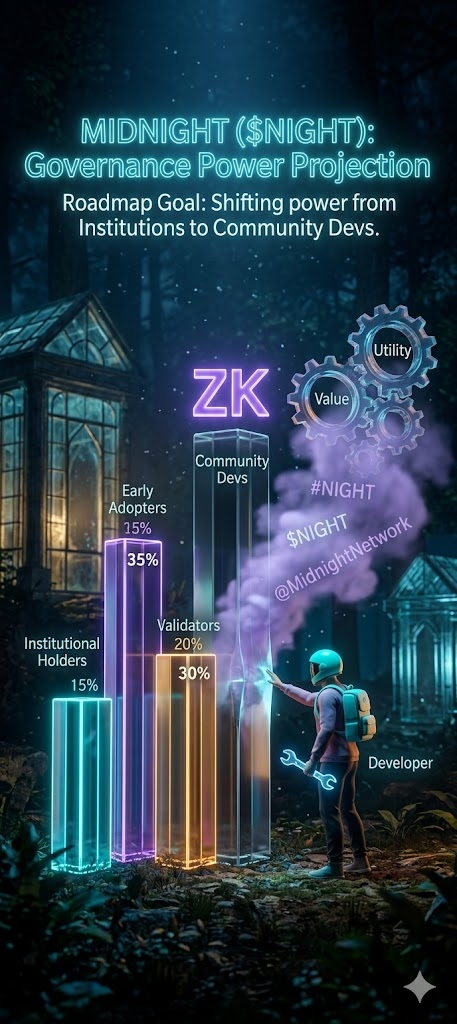
When I look at the dual-token model of $NIGHT and $DUST, I don’t see a simple gas mechanism. I see a massive experiment in developer psychology. In the standard world—the one we’re all used to—the user pays the price for their own transparency. You want to move money? You pay the gas. But Midnight flips the script. It suggests that if you want to provide a private environment for your users, you, the builder, have to be the one to anchor the value. You have to hold the $NIGHT to generate the $DUST. It’s a bold move, but it’s also a risky one. I’ve seen projects before that tried to abstract away the cost for the end-user, and they usually end up creating a barrier for the smaller devs who don’t have the capital to "pre-pay" for their users' privacy.
But maybe that’s the point. Maybe privacy isn't meant to be cheap. We’ve spent a decade treating data like it’s free, and we’ve seen where that got us—massive surveillance and total exposure. If we want a world where our financial history isn't a public spectacle, someone has to pay for the "Confidential Computing" power required to shield it. I’ve noticed a lot of cynicism in the market regarding whether Midnight can actually scale this without creating a new class of gatekeepers. It’s a valid concern. If the barrier to entry for a developer is too high, do we just end up with a more private version of the same centralized systems we already have?
I find myself thinking about the "Selective Disclosure" aspect more than anything else. It’s the most human part of the protocol. In my daily life, I don’t want to be a ghost. I don't want to be totally anonymous to the point where I can't interact with my bank or my government. I just want to be able to choose which parts of my story I share. Midnight’s Kachina protocol is trying to build that middle ground, but it’s a lonely path. The purists think it’s too compliant, and the regulators think it’s too private. Usually, when everyone is a little bit unhappy with you, it means you’re actually onto something real.
The real test won't be the launch; it will be the first time a major dApp on Midnight has to handle a massive spike in users. Can the state separation handle the load? Will the $DUST supply remain stable enough for the devs to keep the lights on? I don’t have the answers, and anyone who tells you they do is probably lying. But I’d rather watch a project struggle with these deep, structural questions than watch another meme-coin cycle burn itself out. We’re finally moving past the era of "transparency at all costs," and even if it's a messy transition, it's one we have to make. Privacy isn't a luxury; it's a functional requirement for a mature financial system. And right now, we're all just trying to figure out how to afford it.
What do you think? Is the developer-centric cost model a brilliant way to ensure stability, or is it a wall that will keep the most innovative "garage" devs away? 👇