
Multichain is one of the most overused words in blockchain. Most projects that claim multichain functionality mean they’ve deployed the same token on three different networks via a bridge. The cross-chain story usually ends there.
I went into Midnight’s multichain documentation expecting to find the same pattern. What I found was different enough to change my assessment.
The multichain architecture in @MidnightNetwork is built on three distinct technical components that work together: the Cardano Partner Chain framework, cross-chain observability, and multichain signatures. Each of these does something specific, and together they enable a genuinely different kind of cross-chain integration than token bridging alone.
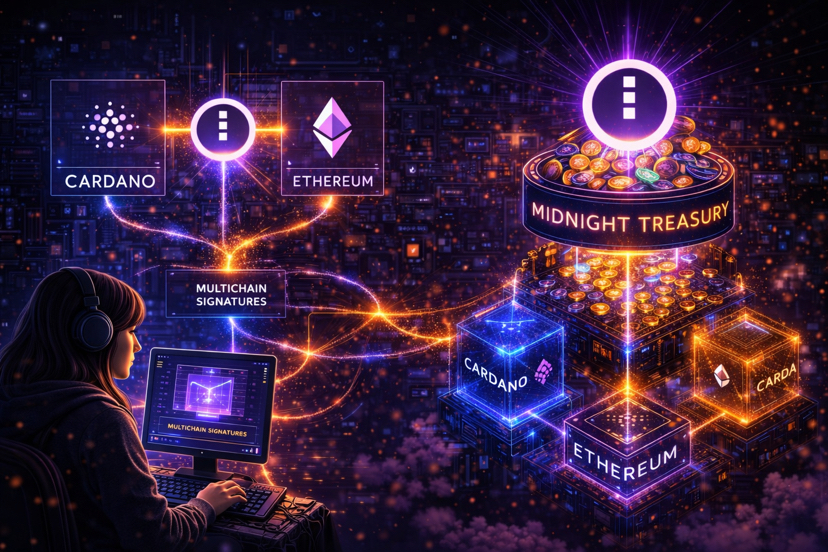
The Cardano Partner Chain framework is the foundational layer. It’s what allows Midnight to inherit Cardano’s proof-of-stake security layer for block production while operating as an independent chain. Cardano SPOs produce Midnight blocks using a selection mechanism weighted by delegated ADA stake. The NIGHT tokens exist natively on both Cardano — as a Cardano Native Asset — and on the Midnight mainnet, as the network’s native token. A cross-chain software protocol enforces token supply integrity across both chains through a set of mathematical invariants that prevent the same token from being unlocked on both chains simultaneously.
The invariant system is more sophisticated than a standard bridge. The protocol maintains six combinations of token states and locations — uncirculated reserve, locked, and unlocked on each of Cardano and Midnight — and enforces constraints that always err on the side of having fewer tokens unlocked than the idealized system would allow. This prevents double-spend exploits across the chain boundary even when one chain cannot observe the other’s state in real time. The constraint holds across all planned rollout stages, including during the transition from one-way to two-way bridging.
Cross-chain observability is the mechanism that enables action on one chain to trigger outcomes on another. When a user performs an action on Cardano, a cross-chain observer can detect that action and trigger a corresponding outcome on Midnight — and eventually vice versa. The practical implication for the capacity marketplace is significant. A user wanting to execute transactions on Midnight but pay with ETH on Ethereum could lock ETH on Ethereum, use cross-chain observability to access Midnight network capacity, and have that payment split between the DUST capacity provider, the cross-chain observer, and the Midnight Treasury via a protocol-level fee. The transaction happens on Midnight. The payment settles on Ethereum. The two chains interact without the user needing to manually bridge assets.
Multichain signatures extend this further by allowing the Midnight on-chain Treasury to receive inflows denominated in other tokens — building up reserves in smart contracts native to their respective blockchains. This transforms the Treasury from a single-asset NIGHT reserve into a potential multi-asset, multi-chain endowment. A fee levied on capacity leased or purchased with non-NIGHT tokens via protocol-level mechanisms flows to the Treasury in the token used for payment. Over time, the Treasury accumulates diverse assets across multiple chains, with governance control over those assets residing with $NIGHT holders through the on-chain governance mechanism.
The capacity marketplace is the commercial layer that brings these technical components together. In its simplest form, NIGHT holders designate DUST generation to third parties in exchange for off-chain payment — a peer-to-peer arrangement. More sophisticated versions include broker-managed leasing, where specialized operators aggregate DUST capacity from multiple NIGHT holders and distribute it to lessees at scale. The Babel Station model allows users to submit transactions without including DUST by offering non-NIGHT tokens or fiat as payment — the station operator covers the DUST cost and recovers the payment. Eventually, on-chain capacity exchanges could enable spot purchase of unused DUST generation with full on-chain settlement.
What makes this multichain approach substantively different from most cross-chain marketing is that each component serves a specific function in the economic model. Cross-chain observability isn’t a feature — it’s the mechanism that makes non-NIGHT payment for Midnight transactions possible. Multichain signatures aren’t decorative — they’re how the Treasury actually receives and holds assets from other chains. The Partner Chain framework isn’t just a partnership narrative — it’s the source of Midnight’s early network security.
Personally, I find the Treasury diversification trajectory the most strategically interesting long-term implication. A protocol Treasury that holds meaningful assets across Cardano, Ethereum, and other networks creates a governance stake that extends well beyond any single ecosystem. The community controlling that Treasury through on-chain governance controls cross-chain economic resources — which is a materially different kind of governance power than controlling a single-chain token reserve.
There are real uncertainties here. Cross-chain observability and multichain signatures are post-mainnet roadmap items — they’re designed and specified but not yet deployed. The transition from one-way to two-way bridging between Cardano and Midnight requires additional development after mainnet launch. The capacity marketplace evolution from off-chain peer-to-peer arrangements to sophisticated on-chain exchanges will take time and developer ecosystem development to materialize.
The multi-resource consensus system — which would eventually allow validators from blockchains other than Cardano to produce Midnight blocks — is in the “Beyond” phase of the roadmap, meaning it’s further out still. Until that mechanism is live, Midnight’s block production security remains dependent on Cardano’s SPO ecosystem, which is a real concentration of dependency even if it’s a well-chosen one.
The architecture is coherent. The economic logic connecting the components is sound. Whether the execution timeline delivers these capabilities in a sequence that maintains developer and user confidence through each transition — that’s the part that remains to be seen.