
#signdigitalsovereigninfra $SIGN @SignOfficial
Lately I have been noticing a change in how people talk about crypto.
Not that people suddenly became wiser or more disciplined. It feels more like exhaustion than maturity. People have seen too much nonsense. Too many inflated participation numbers. Too many airdrops that end in backlash. Too many teams talking about fairness and then hiding the real process behind spreadsheets, Discord screenshots, and vague eligibility logic.
The mood is different now.
The excitement is still there, but it is harder to impress people. There is more suspicion in the room. When a project says a distribution will be fair, people do not just nod anymore. They want to know how. They want to know who decides. They want to know what happens when someone gets left out.
That is part of why SIGN catches attention so fast.
It does not immediately feel like another chain fighting for relevance with speed, throughput, or some recycled ecosystem promise. It sits lower in the stack than that. It is focused on credentials, verification, and distribution. The less glamorous parts of crypto, basically. The parts people ignore when markets are hot, then suddenly care about when something breaks.
And those parts break all the time.
That is why I understand the appeal here.
A lot of crypto still runs on weak proof. Screenshots become evidence. Wallet activity becomes identity. Social engagement becomes reputation. Governance memory lives in scattered documents and private assumptions. Then when distribution gets messy or users start complaining, teams act surprised as if the system failed them, when really the system was barely structured in the first place.
That is the gap SIGN is trying to step into.
What makes it genuinely interesting to me is that it does not treat everything as one giant product. There is a separation in the design. One side handles attestations, evidence, and verifiable claims. The other side handles the actual distribution logic, who gets what, when, and under which rules. That split matters. It makes the whole thing feel more deliberate. More reusable. Less like a one-off tool and more like infrastructure.
And honestly, that is a smart place to build.
Because crypto does not just have a scaling problem or a usability problem. It has a proof problem. A coordination problem. A legitimacy problem. Who counts as a contributor. Who qualifies for access. Who deserves rewards. Who is excluded. Who defines the rules. These questions show up everywhere, from airdrops to governance to onchain identity to community incentives.
The industry talks endlessly about decentralization, but the second value has to be assigned, human discretion comes back very quickly.
That is why SIGN feels powerful at first.
But it is also exactly where the discomfort starts for me.
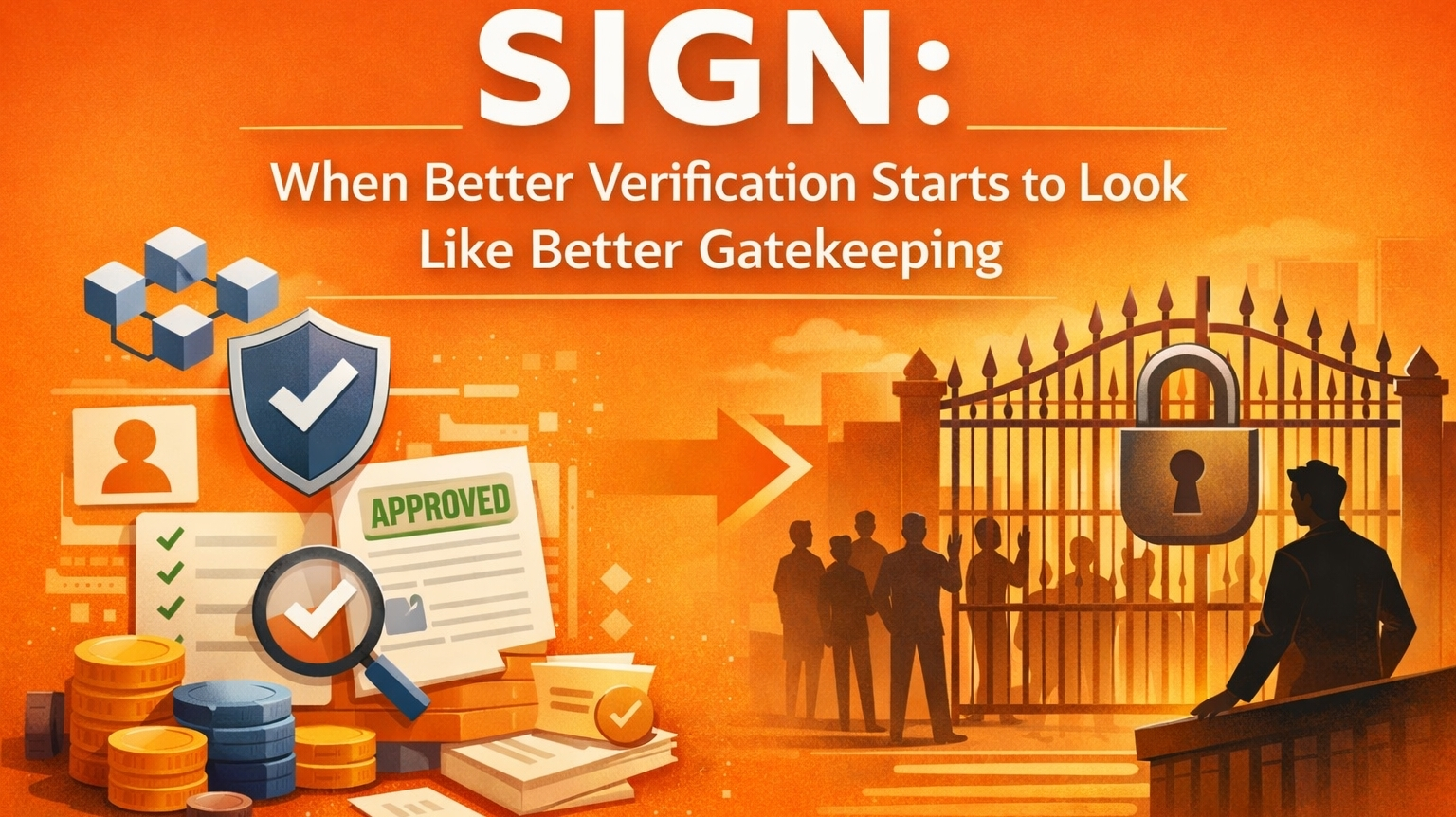
The better a system becomes at verification, the easier it is for people to mistake its output for neutrality. That is the tension I keep coming back to. SIGN wants to make eligibility and distribution cleaner, more structured, more auditable. On one level, that is obviously an improvement over the chaos we already have.
But the cleaner the process looks, the easier it becomes to stop questioning the people who designed it.
And that matters more than most people want to admit.
Because the real fights in crypto are usually not about whether something can be verified. They are about what deserves to be verified in the first place. Which credentials matter. Which actions count. Which behaviors are rewarded. Which issuers are trusted. Who gets authority over the definitions.
Technology can make the pipeline tighter, but it cannot remove politics from the input.
If an attestation says someone is eligible, that feels objective. If it says they are not, that also feels objective.
But both outcomes still come from human choices upstream. Someone decided what the credential means. Someone decided who can issue it. Someone decided that this proof matters more than another one.
That is the point where infrastructure stops being neutral.
A system like SIGN can absolutely make distribution more orderly. But it can also make gatekeeping feel more legitimate. Instead of messy judgment happening in public, you get structured judgment happening earlier, packaged in a format that looks cleaner and therefore feels harder to challenge.
The disagreement does not disappear.
It just moves.
It moves away from the visible moment of distribution and into the quieter layer where rules are designed and credentials are defined. And once that shift happens, exclusion feels different.
In the older model, when a team handled a distribution badly, at least the mess was obvious. You could see the contradictions. You could see the spreadsheet logic falling apart. You could see manual intervention happening in real time. The ugliness made the human power visible.
In a more formalized system, that same exclusion can arrive with much better posture. It can look precise. Consistent. Cryptographically supported. The person who gets left out still feels the same frustration, but now the denial comes wrapped in technical legitimacy.
That is a different kind of power.
And to be fair, I do not think that means SIGN is wrong.
If anything, I think it means the project is more important than it first appears. A lot of crypto infrastructure can be safely ignored because it solves problems that barely exist. This does not feel like one of those cases. Verification and distribution are real pain points. Communities are tired of opaque reward logic. Builders do need better systems for proving claims and allocating value.
So the need is real.
What I am less sure about is the social cost of solving that need too cleanly.
Because cleaner rails do not automatically create cleaner governance. They just make it easier to scale decisions. And scaling decisions is not the same thing as justifying them. You can make eligibility more efficient without making it fairer. You can make distribution more transparent without making it meaningfully contestable.
That is the part that stays with me.
Crypto likes auditability because it sounds close to justice. If the rules are visible, if the proofs are structured, if the process is onchain, people start to assume fairness has been solved. Sometimes it improves things, yes. But auditability mostly tells you what happened. It does not always help you challenge whether it should have happened.
A transparent exclusion is still an exclusion. A verifiable gate is still a gate.
And I think that is probably how SIGN will eventually be judged.
Some people will look at the current state of crypto and say this is exactly the kind of infrastructure the space has needed for years. They will have a strong case. Others will worry that it turns social judgment into technical machinery, where decisions become harder to question because they come stamped with proof. They will also have a strong case.
That is why I do not see SIGN as just a credential project.
I see it more as a bet on formalized trust. A bet that communities, markets, and institutions would rather live with explicit systems than with messy improvisation. A bet that encoded discretion will feel more acceptable than chaotic discretion. Maybe that turns out to be true. Maybe it even has to be true if crypto wants to scale beyond this current phase.
But it still comes with a cost.
Because once proof becomes infrastructure, the people defining proof start shaping access.
And that is the question I cannot shake. Not whether SIGN is useful. I think it is. Not whether it is solving a real problem. It clearly is. The real question is what kind of culture it quietly builds around itself.
A culture where distribution becomes less chaotic, maybe. But also one where legitimacy flows more and more through credential systems that ordinary users may not fully understand, influence, or challenge.
And if that is where things are going, then the most important trust question will not be whether the system can verify claims.
It will be whether the people defining those claims should be allowed that close to the gate.