
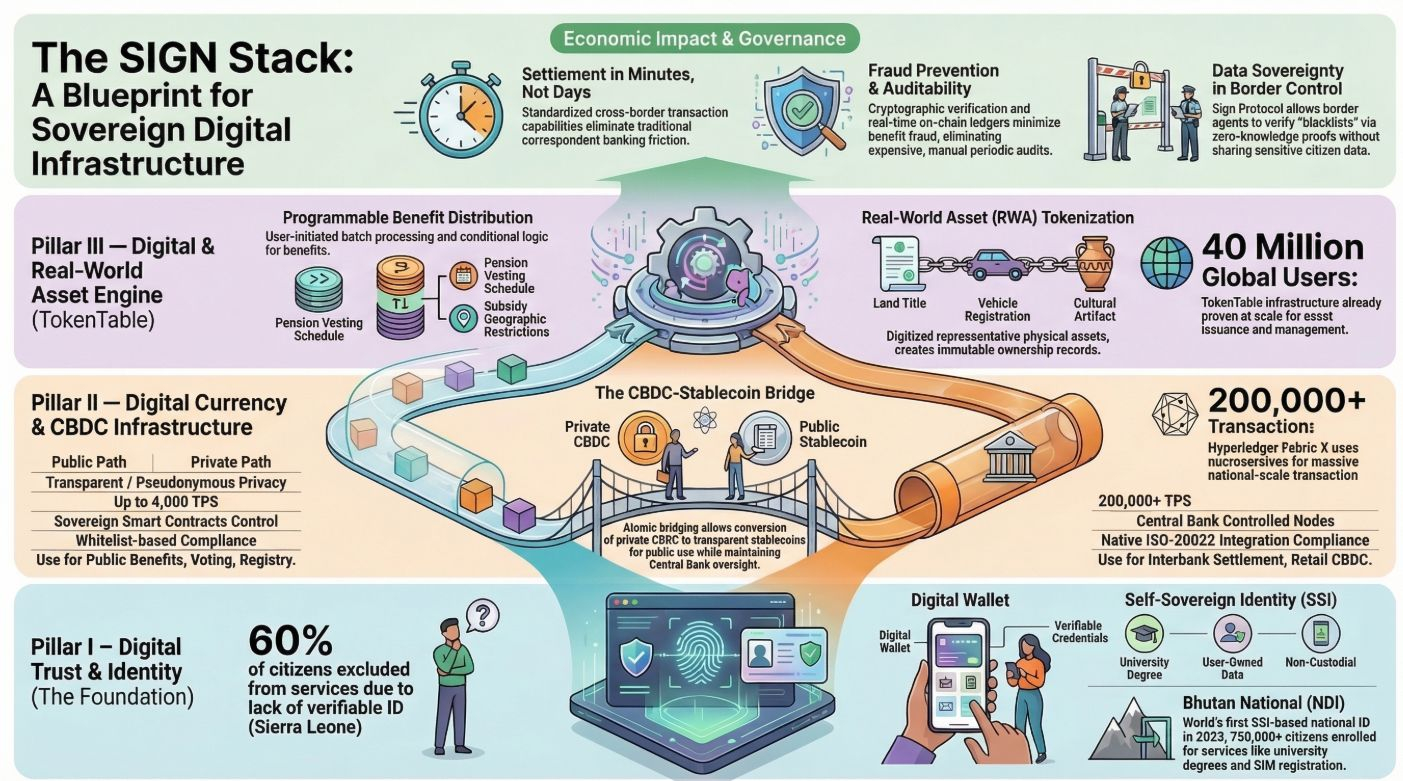
The S.I.G.N. Stack is genuinely well-designed for what sovereign clients need. The dual-layer architecture separates public attestation from sensitive national data. Hyperledger Fabric gives governments full control over who participates in verification. TokenTable has processed $3 billion in distributions across 55 million users, which means the system has been stress-tested at a scale that most enterprise blockchain infrastructure never reaches. The contracts with Kyrgyzstan and Sierra Leone are real agreements with real governments, not marketing announcements. That foundation is solid.
And I think the core instinct behind Sign is correct.
But as I read through the documentation more carefully, I kept returning to one line from the official docs: "Verification is most valuable when it is portable. S.I.G.N. embraces open standards and interoperable primitives so systems can evolve without locking policy into one vendor or one network."
That sentence is doing a lot of work. Because the architecture it describes runs directly into a problem that enterprise procurement teams call vendor dependency, and for sovereign clients, the stakes are higher than for any enterprise.
Consider what Kyrgyzstan is actually building. The Digital Som payment system runs on Hyperledger Fabric nodes configured and deployed by Sign. The attestation layer uses Sign Protocol as the evidence layer. The schema definitions, the node configuration, the key management, the integration points between Fabric and BNB Chain, all of it is built and maintained by one external team. This is not a criticism of Sign's competence. It is a structural observation about what happens five years from now when the Digital Som is running at national scale and the government wants to switch infrastructure providers, audit the underlying system independently, or extend the architecture in a direction Sign has not anticipated.
Traditional centralized government databases handle this through procurement law. Contracts require source code escrow, documentation standards, and transition assistance. There are legal frameworks for what happens when a vendor relationship ends.
There are no equivalent frameworks for permissioned blockchain infrastructure yet.
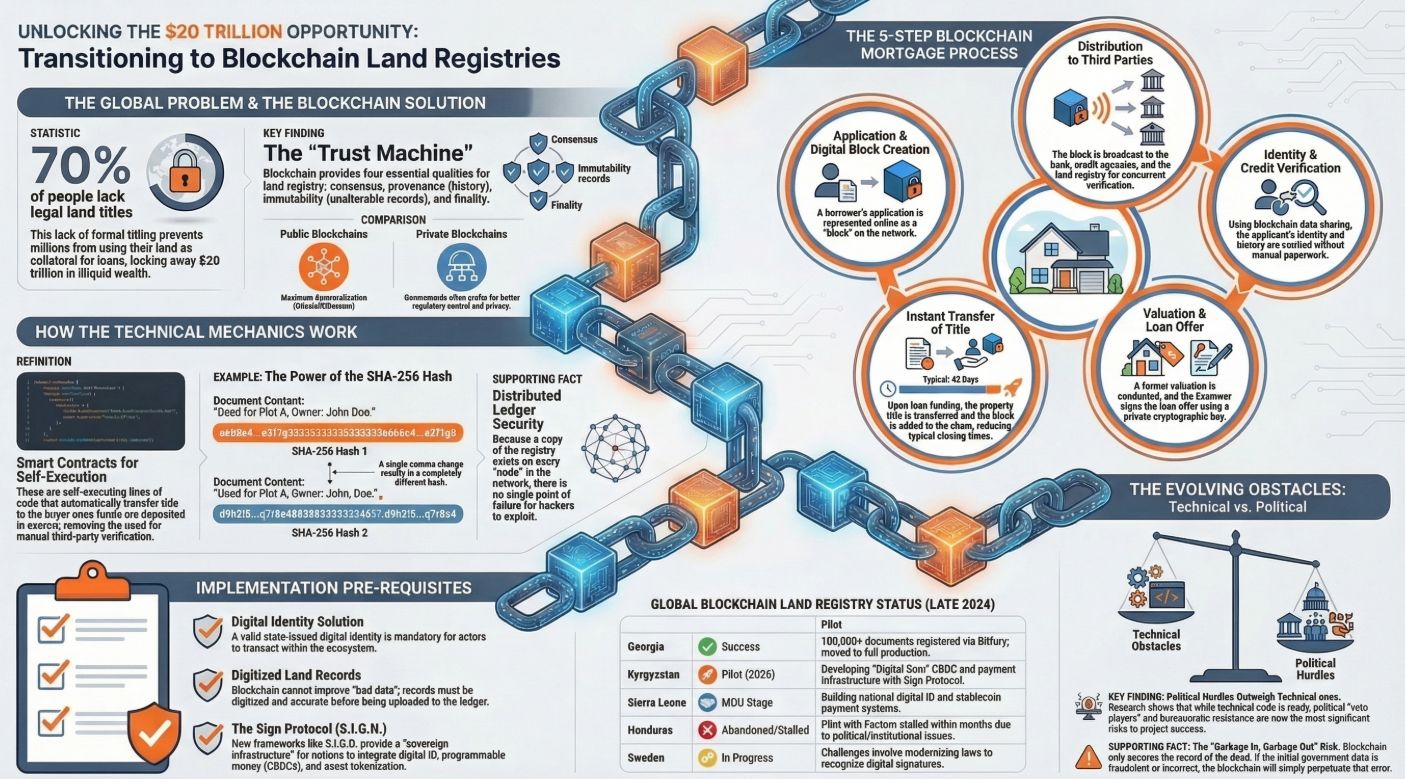
Here is where it becomes concrete. In 2021, the government of Honduras attempted to migrate its property registry from a blockchain system built by one vendor to a different infrastructure. The migration took over two years, cost significantly more than the original deployment, and left gaps in the attestation history that auditors could not reconcile. The technical data was intact. The operational continuity was not. This is what vendor transition looks like in sovereign blockchain deployments, and it happened with a relatively simple land registry, not a national payment system or identity infrastructure.
Sign's documentation addresses this directly by claiming open standards and interoperability. That claim deserves scrutiny. Open standards mean the attestation schema is readable. Interoperable primitives mean other systems can in theory verify Sign-issued attestations. But interoperability at the data layer is not the same as operational portability. A government that wants to replace Sign as its infrastructure provider still needs to migrate the Hyperledger Fabric node configuration, re-establish the validator network with different operators, and maintain continuity of the attestation chain during the transition. None of that is solved by open schema standards.
I do not think Sign is being deceptive about this. The documentation is honest about what the system does. The open standards commitment is real at the level it is claimed.
But there is a gap between what Sign is selling and what sovereign clients may believe they are buying. A government that signs a contract for sovereign infrastructure expects that sovereignty includes the ability to operate, audit, and transfer that infrastructure without depending on the original vendor indefinitely. Sign is selling a system that a government controls operationally. It is not yet clear that a government could own it independently.
The question is not whether Sign can build national infrastructure. Kyrgyzstan and Sierra Leone suggest it can. The question is whether a country that builds its payment system and identity layer on Sign has gained digital sovereignty, or whether it has traded dependence on legacy banking infrastructure for dependence on a Web3 infrastructure vendor with a more modern interface.
Until Sign publishes a clear sovereign exit framework, not just open standards documentation but an actual transition architecture that a government could execute without Sign's involvement, the word sovereign in S.I.G.N. describes the client's intent more than the infrastructure's design.