
It was nothing, really.
Just one of those small reply changes you only notice if you’ve been around long enough to feel the difference before you can explain it. A question came in, someone answered, and the answer was shorter than usual. Less eager. Less polished. Not rude, not suspicious either. Just different enough that I paused for a second.
I almost scrolled past it.
But then I kept noticing the same kind of thing in other places. People asking smaller questions. People sounding a little less certain when they talked about the same themes they used to speak about so confidently. A hesitation before sharing something they would normally call “alpha.” A slight delay before repeating a narrative.
Nothing dramatic. No clean signal. Just a shift in tone.
And in crypto, those little shifts matter more than people admit.
At first I thought it was just the market being the market. When things get messy, people tighten up. They stop talking like they know everything. They start protecting their upside a bit more. That part is normal.
But this felt a little deeper than that.
It wasn’t only caution. It was a change in how people were deciding what deserved attention.
That is usually where the real story starts anyway — not in the price itself, but in what people begin to trust, what they stop trusting, and what they quietly start waiting for.
I kept thinking about that.
Because there’s a difference between people being excited about a project and people actually changing how they behave around it. Those are not the same thing. Not even close.
Excitement is easy. It comes fast, fades fast, and usually doesn’t change much.
Behavior is slower. More honest, maybe. If a project makes people pause before acting, ask more careful questions, or think twice about what they’re sharing and why, that tells you something different.
That is where SIGN started to feel relevant to me.
Not because it was shouting for attention. Not because it was trying to force itself into every conversation. More because it fits into this quieter part of the market — the part where verification, access, and distribution start to matter in a behavioral sense, not just a technical one.
A system like that changes how people move.
It changes how quickly they act.
It changes how much they assume.
It changes who feels comfortable participating without thinking too hard.
And maybe that sounds abstract, but in practice it is not.
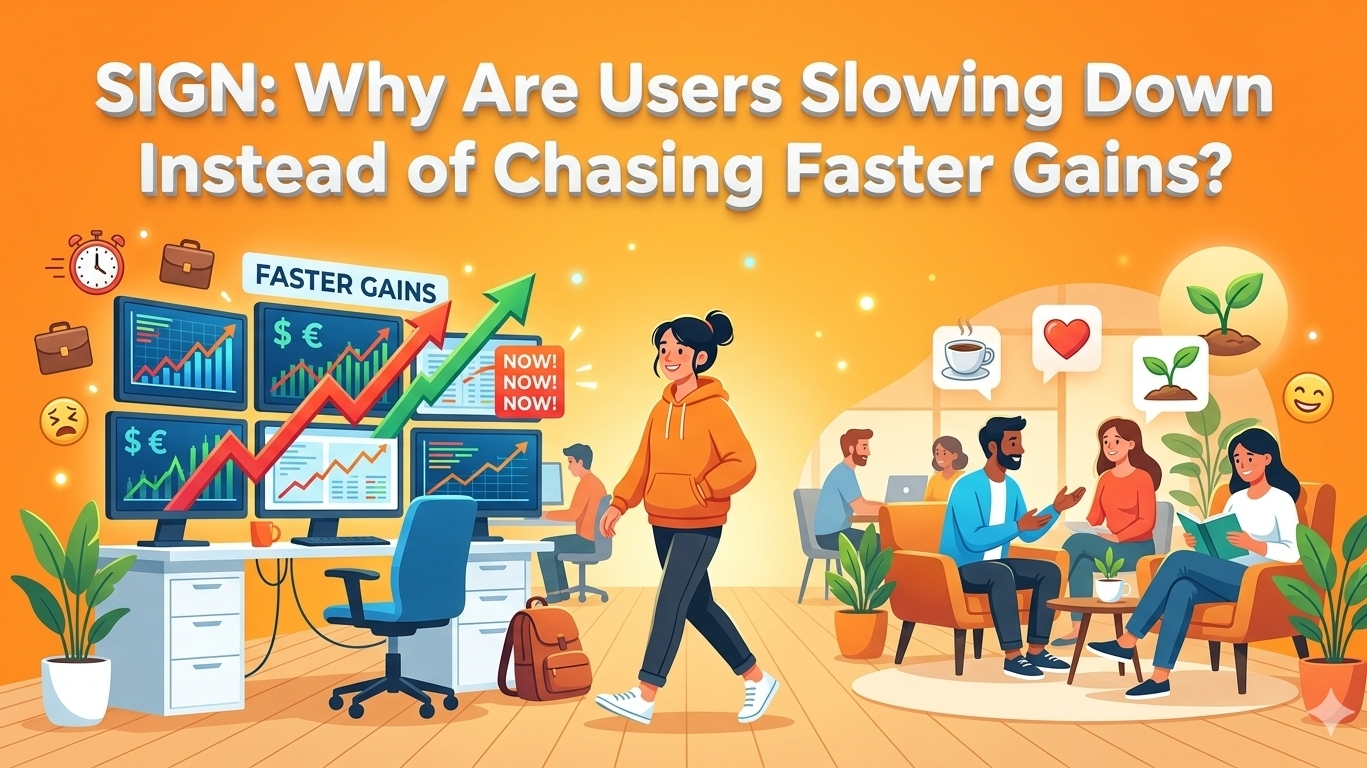
When a network starts to care more about verification, people start paying attention differently. Some users slow down. Some stop chasing every shiny thing. Some become more careful about where they place trust. Others get filtered out almost naturally, not because they are excluded in an obvious way, but because they do not like the extra layer of thinking it requires.
That part is interesting to me.
Because a lot of crypto still runs on speed and impulse. People want the trade, the call, the entry, the edge. Fast, fast, fast. But systems that focus on verification and distribution force a different habit. They make people think in terms of access, reliability, and consistency.
Not glamorous words. But maybe more useful ones.
And the funny thing is, you can see the effect before you can fully describe it.
You notice it in the way people ask whether something is worth holding longer.
You notice it in how often they ask about trust instead of price.
You notice it when a group that used to celebrate every move starts caring more about whether a system is actually structured to last.
That is probably why I do not see SIGN as just another narrative.
To me, it feels more like one of those projects that quietly changes the room.
Not instantly. Not loudly. But over time.
And I think that kind of change is easy to underestimate because it does not look dramatic at first. It does not always produce the kind of obvious excitement that makes people post screenshots and say “this is it.” It works on a slower layer. The layer where behavior starts adjusting before opinion does.
That is the part I keep coming back to.
Because once users start changing their habits around a system — how they assess risk, how they share information, how quickly they move — the system has already done something meaningful, even if the market has not fully named it yet.
I’m not fully settled on what that means long term.
Maybe the market eventually absorbs it and moves on to the next thing. That happens all the time. Maybe this is just one more example of crypto trying to organize trust in a way that feels more durable than the usual cycle.
Or maybe it is a sign of something a little more structural. Something that makes participants less impulsive and more deliberate, which is not a bad thing even if it is less exciting to talk about.
What I do know is this: I trust quieter signals more than I used to.
Not because they are always right. They are not.
But because they tend to reveal what people are becoming, not just what they are saying.
And in this space, that matters.
The people who survive the longest are usually not the ones who react fastest. They are the ones who notice when the tone changes, when the questions change, when the room starts behaving differently before anyone admits it.
That is often where the real edge is.
Not in being early to the loud thing.
But in understanding the small shift before it becomes obvious.
And maybe that is all this really is: a small shift, still forming, still not fully named.
But those are the ones worth paying attention to.
@SignOfficial #SignDigitalSovereignInfra $SIGN
