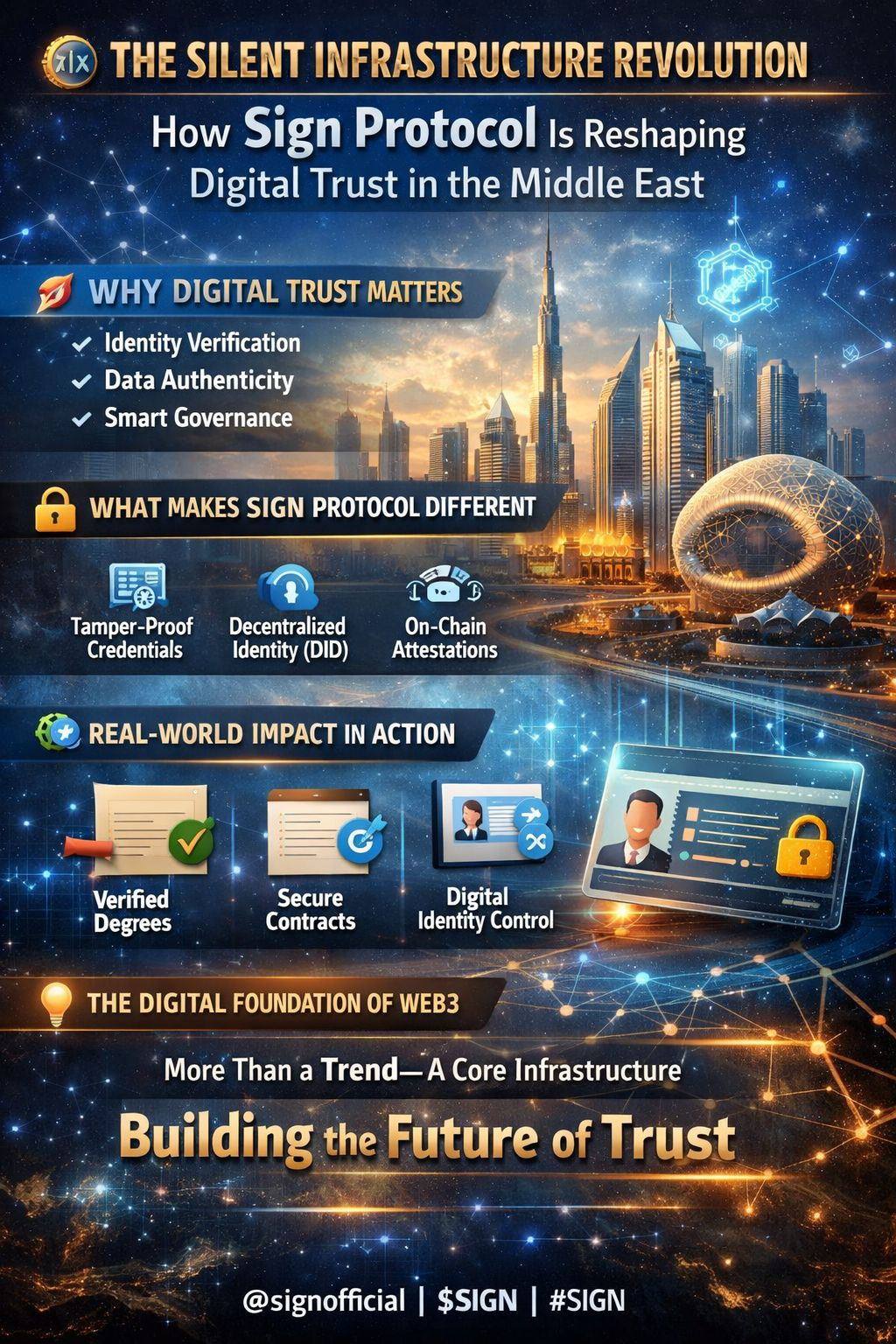
How Sign Protocol Is Reshaping Digital Trust in the Middle East
While global attention remains fixed on trending crypto tokens and short-term hype cycles, a quiet but powerful transformation is taking place across the Middle East — driven by @SignOfficial
This isn’t just another Web3 project. It’s the foundation of digital trust.
🚀 Why Digital Trust Matters More Than Ever
As Middle Eastern countries accelerate toward smart governance, digital economies, and blockchain adoption, new challenges are emerging:
Identity verification
Data authenticity
Transparency in digital systems
Without a reliable trust layer, digital progress can slow down or even fail.
That’s where $SIGN becomes essential.
🔐 What Makes Sign Protocol Different
Unlike traditional systems that rely on centralized control, Sign Protocol introduces a decentralized trust infrastructure.
It enables:
Tamper-proof credentials → Data that cannot be altered or forged
Decentralized identity (DID) → Users fully control their own information
On-chain attestations → Transparent and verifiable proof of truth
👉 Instead of trusting institutions, users can now trust the system itself.
🌍 Real-World Impact in Action
This technology is not theoretical — it’s already shaping real-world use cases:
🎓 Instant verification of academic degrees worldwide
📄 Secure and transparent business contracts
🪪 Full ownership of digital identity for citizens
This is the future of trustless verification, and it’s already being built.
💡 More Than a Trend — A Digital Foundation
Most crypto projects chase attention.
Sign Protocol is building infrastructure.
Its role is similar to early internet protocols — invisible to users, but critical for everything.
As adoption grows, $SIGN could become a core pillar of digital trust in Web3.
⚡ Final Insight
The biggest opportunities in crypto are often not the loudest — but the most foundational.
And right now, Sign Protocol may be one of the most overlooked innovations shaping the future of trust.