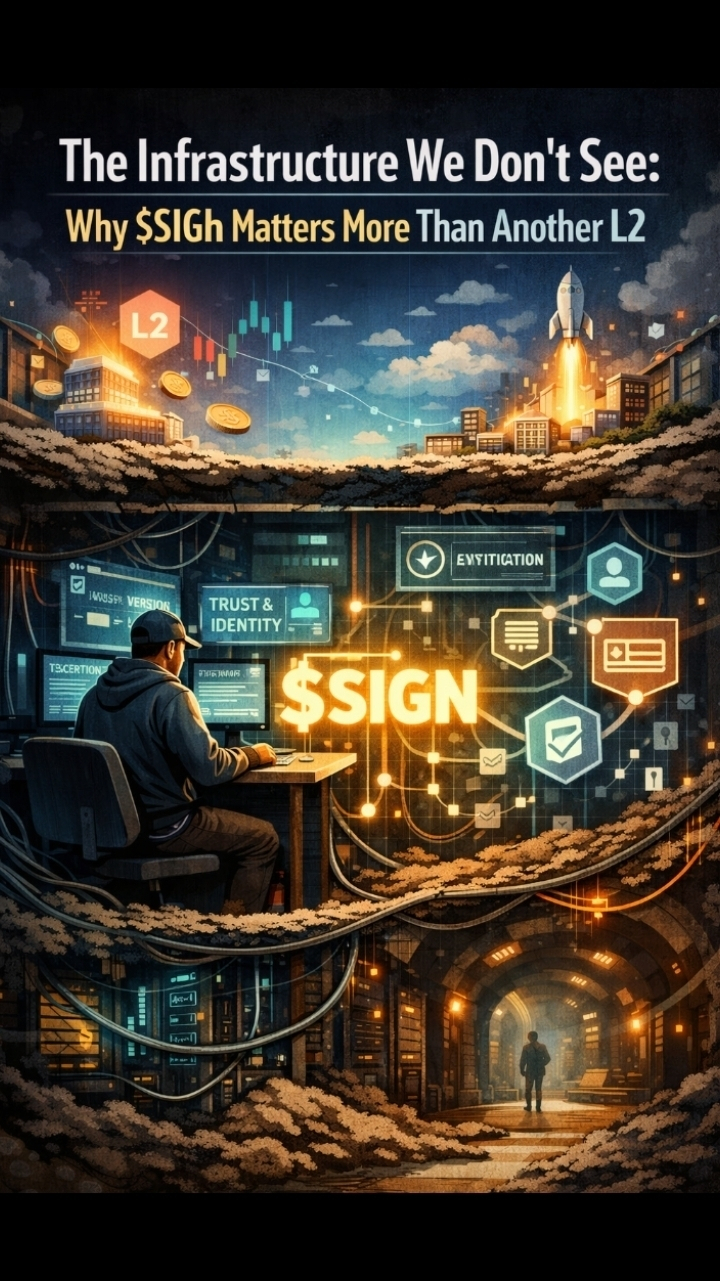
I’ve been in this space long enough to watch the narrative pivot every six months like clockwork. We went from "store of value" to "smart contract platforms" to "NFTs" to "AI agents," and now we’re circling back to "infrastructure." But here’s the problem with most of the infrastructure plays we see today: they are solutions looking for a problem. They’re building highways to nowhere, hoping that if the asphalt is smooth enough, cars will eventually appear.
That’s why, when I came across @undefined and the $SIGN ecosystem, I had to pause. Not because of a flashy marketing campaign or a celebrity endorsement—there isn’t one—but because of the uncomfortable truth they are addressing. We’ve spent the last decade obsessing over decentralization of assets, but we’ve completely ignored the decentralization of identity.
We are currently building a digital world on a foundation of sand. Every time you log into a dApp, you’re likely using a wallet address that is pseudonymous at best, but the second you need to prove you’re not a bot, or that you are a legitimate entity, we default back to Web2 solutions. We hand over our government IDs to centralized verification firms. We trust centralized exchanges to tell us who is who.
This is the gap $SIGN is designed to fill.
I’ll be honest: I’m tired of reading about projects that claim to be "revolutionary" because they’re slightly faster than Solana or slightly cheaper than Ethereum. Speed is a commodity now. What isn’t a commodity is trust. Sign isn’t trying to be the fastest chain; it’s trying to be the most credible layer for human interaction.
The concept is deceptively simple, yet technically brutal to execute. We’re talking about a decentralized identity infrastructure that allows individuals and organizations to attest to information without surrendering their privacy. It’s not just about slapping a "verified" checkmark on a profile. It’s about building a framework where you can prove you are a unique human, that you possess a certain credential, or that you are legally authorized to act on behalf of an entity—all without dumping your personal data onto a public ledger for the world to exploit.
I spent a few hours digging through their technical documentation recently. What caught my attention wasn’t the jargon, but the restraint. In an industry where projects promise to "change the world" before they even have a testnet, @undefined seems to be taking the boring, necessary route. They are focusing on the plumbing. Nobody gets excited about plumbing until it stops working, and right now, the plumbing of Web3 identity is clogged.
We saw this play out in the last bull run. Projects got wrecked not because the technology failed, but because of governance attacks, sybil attacks, and an inability to distinguish between a single engaged user and a thousand bots. Without sovereign digital infrastructure, we are doomed to repeat these cycles. Every airdrop becomes a war against farmers. Every DAO becomes vulnerable to a whale or a coordinated bot swarm. Every on-chain reputation system becomes a gameable mess.
SIGN is the economic layer that secures this infrastructure. It’s the fuel for the attestation market. When I look at the tokenomics, I’m not looking for a short-term pump. I’m looking for a mechanism that aligns validators, attesters, and users in a way that incentivizes truth over noise. If you want to participate in securing this identity layer, you stake $SIGN. If you want to request a verification or attestation, you pay in sign. It’s a circular economy built around a resource that has become scarce in the digital age accountability.
I’ve been guilty of it myself—chasing the shiny object, the high-APY farm, the NFT collection with the cool art. But after a while, you start to realize that the projects that survive the next bear market aren’t the ones with the best memes; they’re the ones that solve a problem so fundamental that the industry can’t function without them.
We are currently operating under a flawed assumption: that pseudonymity is the end goal. It’s not. Pseudonymity is a feature for privacy, but commerce and governance require accountability. You cannot have a decentralized society without the ability to establish trust between strangers. Right now, we outsource that trust to centralized players. Sign is attempting to bring that trust back on-chain, in a verifiable, privacy-preserving manner.
I’m not saying they have all the answers. This is a massive undertaking, and adoption is always the hardest hurdle in crypto. You can build the most elegant identity protocol in the world, but if the major dApps and institutions don’t integrate it, it becomes a ghost town. However, I’m willing to pay attention to the teams that are building during the quiet times. The teams that are heads-down on the hard problems while the rest of the market is distracted by fleeting trends.
For me, the thesis is simple: If we believe that Web3 is going to scale beyond speculation and into actual utility—into logistics, into voting, into professional credentials, into global commerce—then we need #SignDigitalSovereignInfra . We need a way to establish who we are (or what we are authorized to do) without asking permission from the same centralized institutions we left Web2 to escape.
@SignOfficial isn’t promising you a Lambo. They’re promising you a foundation. And in a market full of houses built on sand, a concrete foundation starts to look like the most valuable real estate you can hold.
I’ll be keeping a close watch on how the $SIGN token performs in terms of network participation, not just price. The metric I care about is whether real entities—businesses, DAOs, developers—start using this infrastructure to secure their operations. If they do, the value will follow. But for now, I’m content watching a team actually tackle the identity crisis that the rest of the industry keeps pretending doesn’t exist.
We wanted sovereignty. But sovereignty without identity is just chaos. It’s time we started treating digital identity with the same seriousness we treat digital assets.