
Most of the time, things don’t fail because one system is bad. They slow down because multiple systems don’t quite fit together. Each one works on its own logic, its own verification flow, its own structure. The problem only becomes visible when you try to move across them and realize nothing really carries over cleanly.
That feeling shows up quite clearly in parts of the Middle East right now. Growth is happening fast, platforms are expanding, and users are moving across different services without staying fixed in one place. But underneath that movement, identity keeps getting reshaped depending on where it is used. Not because it has to, but because systems are not designed to share it properly.
SIGN becomes relevant exactly at that point, not as something you notice immediately, but as something that removes repetition you were already used to. Instead of letting identity split into separate versions across platforms, it keeps a consistent structure that can be reused without losing its ability to be verified.
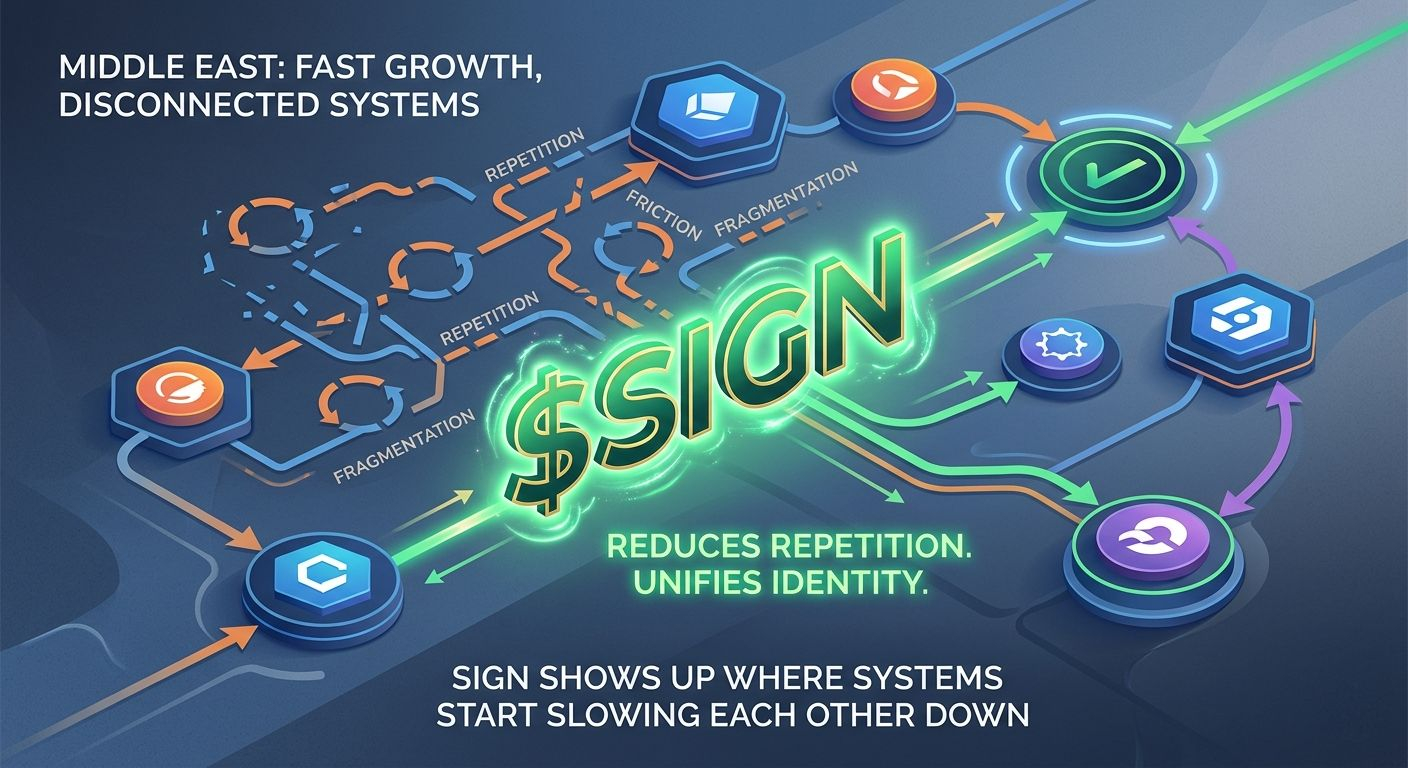
I noticed how unnecessary that repetition was in a simple case. A user went through almost identical verification processes on two platforms within the same region, yet nothing from the first could be applied to the second. There was no real conflict between the systems, just no connection either. It worked, but it felt like doing the same thing twice without a good reason.
When this pattern repeats across more users and more platforms, it stops being a small inconvenience. It becomes part of the system itself, adding friction in ways that are not obvious at first but grow over time.
$SIGN sits inside this structure as a way to keep everything from drifting apart again. When identity becomes something that can move and persist, the surrounding layers need to stay aligned so that the system does not fall back into fragmentation. The token reflects that coordination across different parts of the network.
The interesting part about the Middle East is not just how fast things are growing, but how many systems are being connected at the same time. If those connections remain loose, the weight builds up quietly. If they start to align, the whole environment becomes easier to move through. Sign does not try to stand out on the surface. It works more like a layer that reduces how often things need to be repeated. And when growth keeps accelerating, that kind of reduction starts to matter more than adding new features.