
However, a far more significant development may be unfolding quietly in the background—one that involves institutional capital on a massive scale.
Across the Gulf region, sovereign wealth funds such as Abu Dhabi Investment Authority, Public Investment Fund, and Qatar Investment Authority collectively manage approximately $3 trillion in assets. These institutions are not driven by short-term trends; they are designed to preserve and grow national wealth across generations. Increasingly, they are exploring tokenized real-world assets (RWAs) as a potential next phase of financial infrastructure.
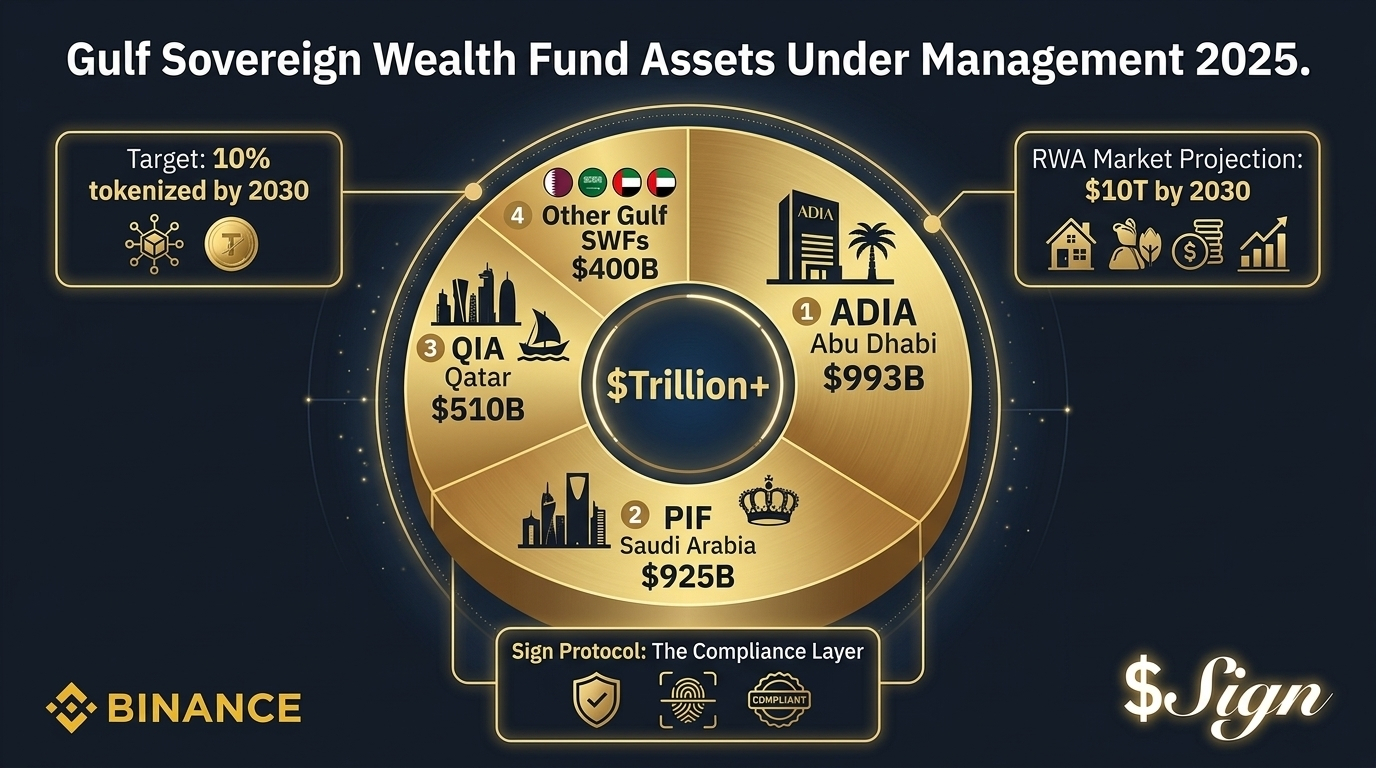
The growth trajectory of the RWA sector is already notable. Tokenized instruments—ranging from treasury bills and real estate to private credit and infrastructure funds—are projected by some analysts to reach $10 trillion in value by 2030. Yet despite this momentum, a critical bottleneck remains largely underappreciated.
Tokenization itself is not the challenge. Creating a digital representation of ownership on-chain is relatively straightforward with modern smart contract frameworks. The real complexity lies in the layers surrounding that token: compliance, identity verification, regulatory oversight, and auditability.
Key questions arise:
Who owns a given token, and are they legally permitted to hold it?
Has the investor completed KYC/AML requirements?
Can regulators audit ownership and transaction history without compromising privacy?
Can auditors verify compliance with distribution rules without accessing sensitive personal data?
These are not peripheral concerns—they are fundamental barriers preventing large-scale institutional participation.
This is where Sign Protocol introduces a compelling architectural approach.
Rather than focusing solely on asset tokenization, Sign Protocol addresses the verification and compliance layer. It enables the issuance of cryptographically signed attestations that validate ownership, compliance status, and transaction records. These attestations can be verified by authorized parties while preserving confidentiality—ensuring that sensitive data is not exposed on public ledgers.
For sovereign wealth funds, this model is particularly relevant. Consider a scenario in which the Public Investment Fund tokenizes a portion of its real estate portfolio. Investors could receive verifiable credentials confirming ownership, while distributions and compliance checks are recorded as cryptographic proofs. Regulators and auditors gain access to a transparent, verifiable audit trail—without exposing proprietary portfolio data or individual identities.
This balance between transparency and privacy is essential for institutional adoption.
The implications extend further in a cross-border context. The Gulf region is actively developing financial corridors with Asia, Africa, and Europe, particularly in areas such as trade finance. Sign Protocol’s alignment with ISO 20022 positions it to integrate with existing banking and settlement systems. Rather than replacing legacy infrastructure, it functions as a verification layer that enhances trust and interoperability in tokenized transactions.
This distinction is critical.
The next major wave of blockchain adoption is unlikely to be driven by retail speculation alone. It will be led by institutions—provided they have access to infrastructure that meets their standards for governance, compliance, auditability, and privacy.
Sign Protocol appears to be designed with this reality in mind. Its positioning is not as a consumer-facing application, but as foundational infrastructure—where government technology, financial systems, and cryptographic verification converge under sovereign control.
Importantly, this approach aligns with the political and regulatory realities of regions like the Gulf. Instead of attempting to displace existing financial systems, it complements them—offering a layer that enhances transparency, security, and operational efficiency without requiring systemic overhaul.
From an architectural standpoint, this is a meaningful differentiation. Building a financial application is one challenge; building infrastructure that can underpin national or cross-border financial systems is another entirely.

For these reasons, this is a space—and a project—worth close attention. Not because of short-term market narratives, but because the underlying logic addresses one of the most critical gaps in institutional blockchain adoption.