
@MidnightNetwork $NIGHT #night
I keep noticing a small change in how people move through crypto now. Not a loud change, not the kind that becomes a trend report, just a quiet shift in posture. People still chase opportunities, still open new wallets, still test new chains and farming ideas. But they do it with more hesitation than they used to. You can feel it in the extra wallet they create, the pause before they connect, the way they talk about onchain activity as if it leaves a stain that never fully fades.
A few years ago, transparency felt almost noble in crypto. Everything visible, everything auditable, everything out in the open. It sounded clean. Now it feels more complicated. The same public trail that makes systems easy to inspect also makes users easy to map, easy to profile, easy to pressure, and easy to misunderstand. Most people do not talk about this in philosophical terms. They just behave differently. They compartmentalize. They hesitate. They become more selective without always knowing how to explain why.
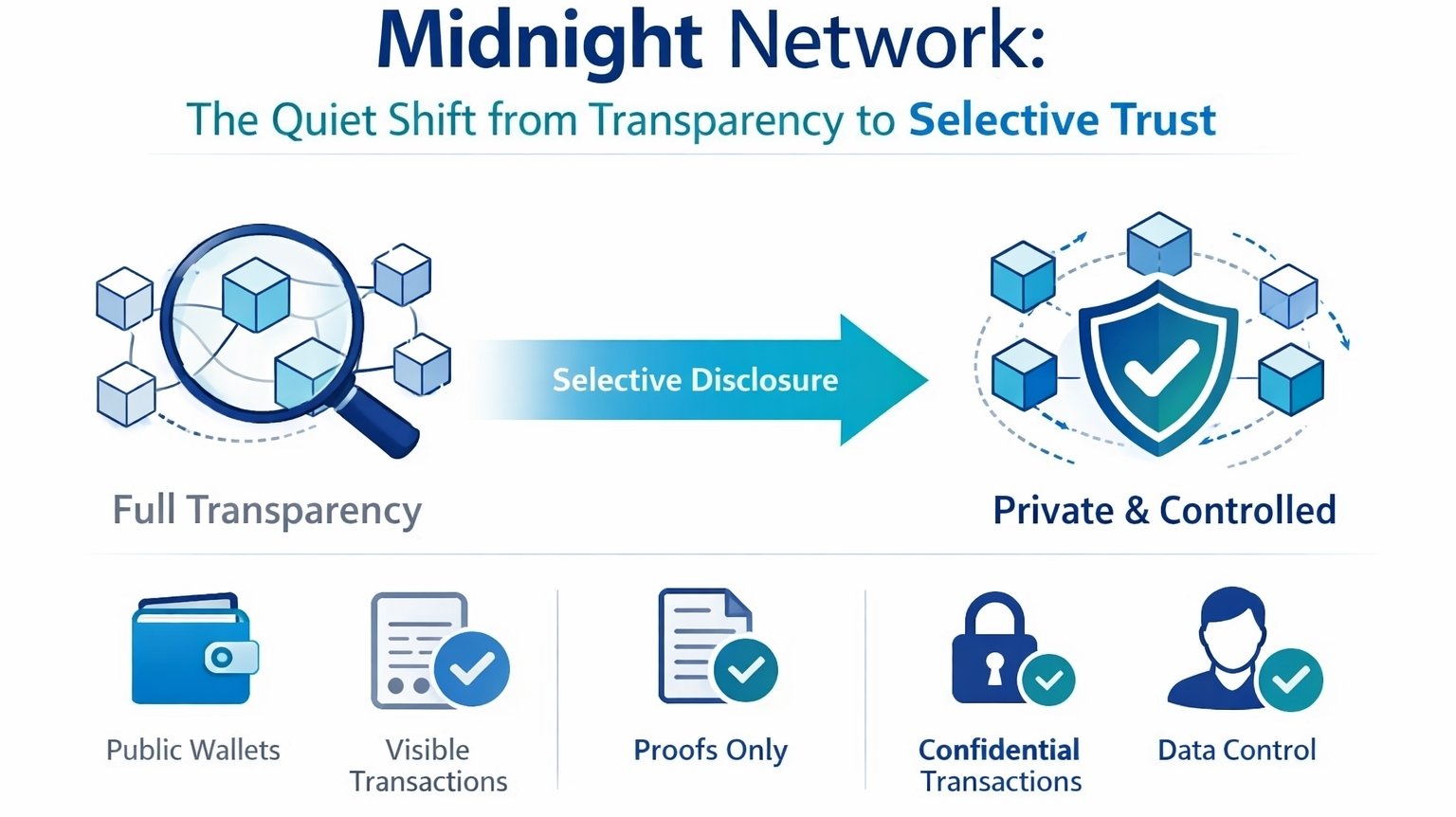
That is why Midnight Network started to make more sense to me the longer I looked at it. Not because “privacy” is a fresh narrative in crypto. It isn’t. We have had privacy language for years, and a lot of it either drifted toward absolutism or stayed too abstract to matter to ordinary users. What Midnight seems to be reaching for is something more restrained: not secrecy for its own sake, but a model where you can prove what matters without exposing everything underneath. In Midnight’s own documentation, that idea shows up through zero-knowledge proofs, selective disclosure, and what it calls “rational privacy,” which is really just a more practical way of saying that privacy should be contextual rather than absolute.
That distinction matters more than the branding around it. A lot of crypto users are not trying to disappear. They are trying to avoid unnecessary exposure. There is a difference. Most people are fine proving that they meet a rule. What they dislike is surrendering their full history just to satisfy one checkpoint. Midnight’s approach is built around that tension. Its docs describe a system where transactions and smart contracts can remain private by default, while specific facts can still be disclosed to an auditor, counterparty, or regulator when needed. In plain terms, it is trying to reduce the all-or-nothing choice that users often face on transparent chains: either expose too much, or stay out entirely.
If that works the way it is intended to, the practical consequence is not just “more privacy.” It is less behavioral distortion. People behave strangely when every action is permanently observable. They split funds awkwardly. They avoid certain interactions. They over-optimize optics. They make decisions based not only on risk and utility, but on how exposed they will look afterward. A system that lets users reveal only what is relevant could improve decision quality in a very ordinary way: it could let people act with a little less defensive paranoia. That sounds small, but crypto is full of small frictions that compound into bad behavior.
The token design also tells you something about how Midnight sees the problem. NIGHT is the public, unshielded native and governance token, while DUST is a shielded, non-transferable resource used to pay for computation and transactions, generated through holding NIGHT. DUST is also described as renewable and decaying. I think the important part here is not the novelty of having two components. It is the attempt to separate capital from usage. In theory, that could make operating on the network feel less like being constantly repriced by a volatile gas token, while also reducing the amount of fee-related metadata users leak through normal activity. But it also introduces a new cognitive burden. Regular users already struggle with one token and one fee model. Asking them to understand a public asset plus a private, decaying execution resource is elegant at the systems level and messy at the human level.
That is a recurring pattern with Midnight in general. The design logic is thoughtful, but thoughtful systems still have to survive actual user behavior. Midnight’s materials frame zero-knowledge proofs as a way to validate actions without revealing sensitive inputs, and they point to use cases like identity checks, compliance proofs, confidential transactions, and private asset swaps. All of that sounds reasonable to me. But reasonable architecture does not automatically become adopted architecture. People do not reward complexity just because it is justified. They reward what feels usable at the moment they need it. If Midnight cannot make these privacy-preserving flows feel normal, then the market will continue doing what it usually does: tolerate broken transparency until the pain becomes impossible to ignore.
And to be fair, the project’s own educational material does not hide the friction. Midnight’s docs openly note that selective disclosure comes with implementation complexity, verification difficulty, and interoperability challenges. That honesty matters, because too many crypto projects talk as if better cryptography automatically erases human and engineering costs. It does not. Better privacy often means more moving parts, more developer burden, more ways for tooling to fall short, and more room for UX confusion. Midnight may have the right diagnosis of the problem, but diagnosis and distribution are different achievements.
The timing is also interesting. Midnight’s official updates say mainnet is scheduled for late March 2026, and the network is entering that phase with a federated node model designed to emphasize operational stability as it moves into production. The Foundation has announced a growing set of federated node operators, including firms such as Google Cloud, Blockdaemon, MoneyGram, eToro, Pairpoint by Vodafone, Worldpay, and Bullish. I think the market will read that in two ways at once. One reading is generous: if you want privacy-preserving infrastructure to support real applications, reliability matters, and launching with institutional-grade operators may reduce early chaos. The other reading is more skeptical: crypto users still care about decentralization optics and control, so any model that looks managed or staged will invite questions about how permissionless the system really is at the start. Both readings are fair.
There is also a broader market reason this project is worth watching. Midnight’s own recent survey framing says most users want more data protection even while an enormous amount of web3 activity still flows across transparent rails. Whether or not one agrees with the exact framing, the underlying tension feels real to me. Crypto kept assuming that transparency was always a feature. In practice, it often behaves like a tax on users who are active enough to matter. The more financialized the ecosystem becomes, the less harmless that tax looks. At some point, privacy stops being a niche preference and starts looking like basic market infrastructure.
What I find most compelling about Midnight is not that it promises to hide everything. Honestly, that kind of promise usually makes me less interested, not more. What holds my attention is that it is trying to build a chain where disclosure becomes intentional instead of automatic. That is a more mature goal. It accepts that modern systems have compliance demands, audit demands, and coordination demands. But it refuses the lazy assumption that meeting those demands should require exposing the full interior of a user’s financial or personal life.
For everyday crypto participants, that is why this topic matters. Not because everyone suddenly needs a privacy thesis, and not because every user is about to migrate to a new chain. It matters because the structure of a network shapes the quality of the decisions people make on it. When visibility is excessive, people become defensive, fragmented, and reactive. When privacy is too absolute, systems become hard to trust. Midnight is interesting because it is trying to sit in the uncomfortable middle, where users can keep control of their data without turning the network into a black box. I do not know yet whether the market will reward that balance. Crypto often notices infrastructure late. But I do think the question Midnight is asking is the right one: not how to hide more, but how to reveal less without making trust collapse. And for people who are tired of choosing between total exposure and blind faith, that is a meaningful place to start.