
#signdigitalsovereigninfra $SIGN @SignOfficial
I have noticed something strange in crypto conversations.
People still talk about freedom, but when a launch, airdrop, grant, whitelist, or community allocation appears, the mood changes almost instantly. The language gets narrower. Who qualifies. Who got excluded. Which wallet counted. Which activity mattered. Whether the snapshot was fair. Whether the rules were clear. Whether the team can prove anything at all.
It is a very crypto pattern.
We say we want open systems, but the moment value is on the table, everyone starts asking for gates, evidence, filters, and enforcement. Not because they became anti-crypto overnight. Because chaos gets expensive very fast.
That is part of why SIGN immediately makes sense to me.
At first glance, it feels like one of those projects solving a problem the industry keeps pretending is temporary. Credential verification, attestations, token distribution, structured proof of eligibility. None of this sounds glamorous, and maybe that is exactly why it matters. Crypto has spent years obsessing over execution speed, liquidity, and community growth, while one of its most persistent weaknesses kept sitting in plain sight: we are still very bad at proving who should receive what, and why.
That weakness has shown up everywhere.
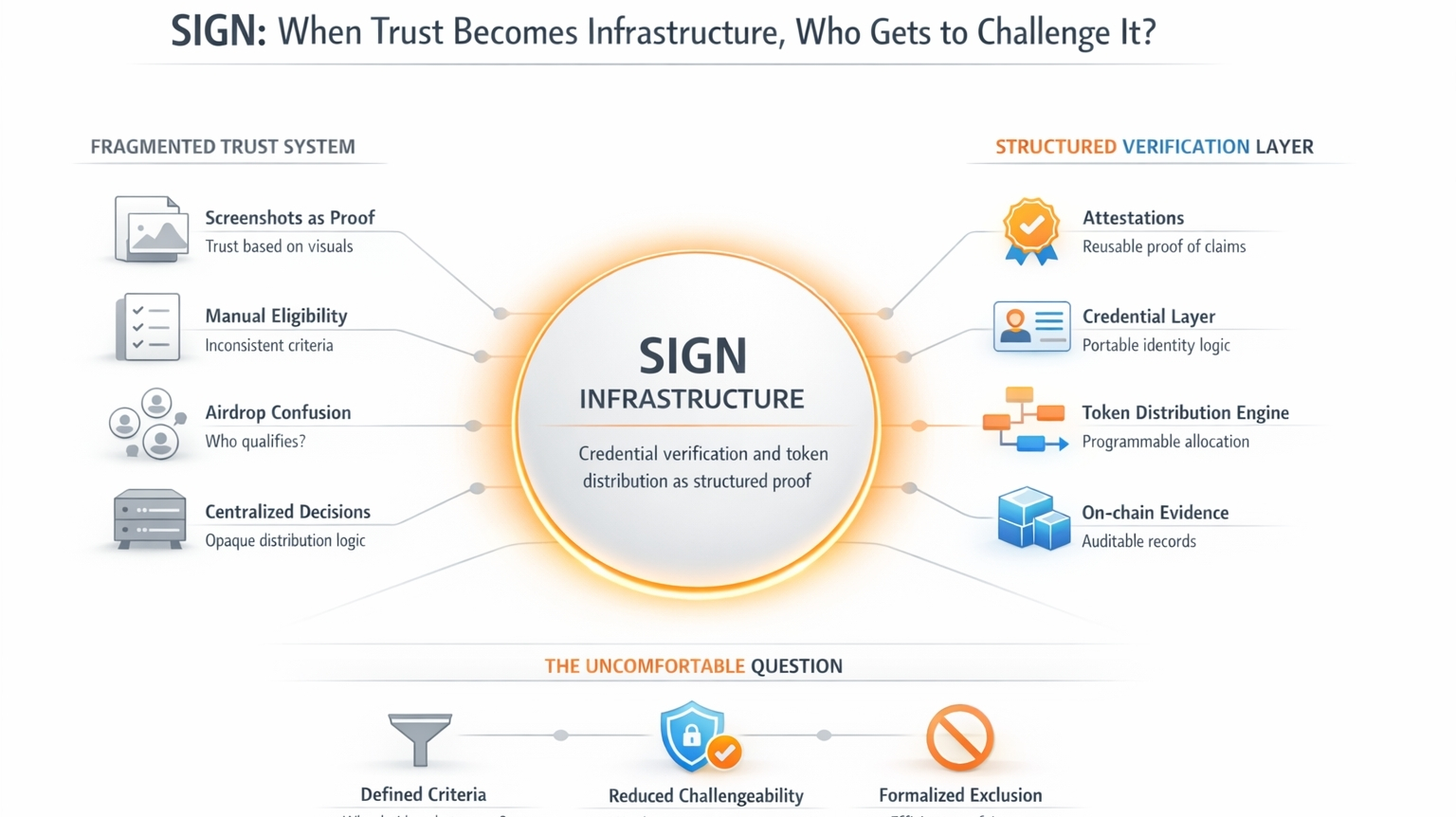
Messy airdrops. Fake sybil filtering. Screenshots passed around as if they are evidence. Teams inventing custom distribution logic every few months and then acting surprised when users accuse them of favoritism. Communities demanding fairness while relying on systems that are often improvised, opaque, or socially enforced instead of cryptographically grounded.
So when a project comes along and says, more or less, let us build actual infrastructure for claims, credentials, and distribution, it is not hard to see the appeal. In fact, it sounds overdue.
That is where SIGN starts strong.
I can feel why people get excited by it. The idea is clean. Separate the proof layer from the distribution layer. Make attestations reusable. Make eligibility more legible. Make token allocation less chaotic. Turn trust from something social and fragile into something structured and portable.
In a market full of empty abstraction, that has weight.
And yet the longer I sit with SIGN, the less relaxed I feel.
Not because the idea is weak. Actually the opposite. The idea is strong enough to create a different kind of discomfort.
The more efficient trust becomes, the more dangerous it can become when the underlying assumptions are wrong.
That, to me, is the real contradiction inside SIGN.
Crypto people hear “verification infrastructure” and think fairness. Order. Better coordination. Less fraud. Cleaner incentives. I understand that reaction. But infrastructure does not just organize trust. It also organizes exclusion. It formalizes who counts, which evidence matters, who defines validity, and how easy it is to challenge the result.
And challengeability is where I start getting uneasy.
A messy system is frustrating, but at least its weakness is visible. Everyone can see the confusion. Everyone can argue with the criteria. Everyone knows the process is imperfect because the imperfections are exposed in real time. It is ugly, but the ugliness itself leaves room for dispute.
Good infrastructure changes that feeling.
Once proof becomes standardized, once credentials become portable, once distribution logic starts feeling clean and machine-readable, decisions gain an aura of legitimacy that people may not fully inspect. The process looks professional. The exclusions look earned. The outputs look objective. But underneath that smoothness, someone still chose the criteria. Someone still defined what counts as participation, what counts as personhood, what counts as merit, what counts as eligibility.
That choice does not disappear because it is wrapped in better infrastructure.
It just becomes easier to scale.
This is why SIGN feels more serious than the usual credential project. It is not merely offering a product. It is trying to turn judgment into infrastructure. And that is where my respect and discomfort start to overlap.
Because crypto has a habit of treating formalization as if it were neutrality.
It is not.
A structured attestation is still downstream of an issuer. A credential system is still downstream of a source of authority. A token distribution rule is still a governance choice wearing technical clothing. The rails may be decentralized in some places, but the meaning flowing through them is rarely neutral. It comes from institutions, teams, communities, or protocols with their own priorities and blind spots.
That does not make SIGN dishonest. It makes it real.
And reality is harder than the pitch.
The pitch says: trust less, verify more.
The reality is closer to this: trust gets relocated, not eliminated.
Instead of trusting a screenshot, maybe you trust an attestation.
Instead of trusting a spreadsheet, maybe you trust a distribution contract.
Instead of trusting a team’s manual process, maybe you trust the credential issuer and the rules engine sitting underneath the process.
That may still be an improvement. In many cases, it probably is. But it is not the same thing as solving trust. It is solving trust coordination.
That distinction matters.
Because once systems like SIGN become good enough, ecosystems will start leaning on them not just for convenience, but for legitimacy. Projects will point to the infrastructure and say the outcome is fair because the process is structured. Users will be told the evidence is there, the credentials are there, the distribution logic is there. Everything will look auditable from a distance.
But auditable is not always the same as contestable.
And I think crypto badly needs to remember that.
A fair system is not just one that records decisions cleanly. It is also one where the basis of those decisions can be questioned meaningfully. If the evidence layer becomes too abstract for normal users, if the attestation standards become socially accepted before they are deeply scrutinized, if distribution becomes programmable but the political logic behind it remains insulated, then we may end up with a more elegant version of the same old problem.
Power hiding inside procedure.
This is also where the market side gets complicated.
Infrastructure projects like SIGN often look stronger intellectually than they do commercially, at least early on. Everyone agrees the problem exists. Fewer people urgently pay to solve it. Developers love better rails in theory, but in practice they often tolerate ugly workflows until the cost of not upgrading becomes unbearable. That delay matters. It means the market can respect the thesis long before it rewards the token.
And tokenomics, whether people like it or not, sits right in the middle of that tension.
A project can be strategically valuable and still face slow value capture. It can sit close to real activity without necessarily extracting durable economic upside from that activity. That is not a knock on SIGN specifically. It is a structural challenge for a lot of protocol infrastructure. The clearer the utility, the more people assume the economic model will take care of itself. It often does not.
So when I look at SIGN, I do not see a shallow story. I see a serious one. That is why I keep thinking about it.
I think the project is pointing at a real weakness in crypto. We do need better evidence. We do need reusable verification. We do need cleaner token distribution. We do need less chaos around claims, eligibility, and trust coordination.
But I also think people are too eager to treat this category as morally straightforward.
It is not straightforward to build systems that decide who is recognized.
It is not straightforward to turn social legitimacy into technical legitimacy.
It is not straightforward to make exclusion more efficient and assume that efficiency itself is justice.
That is why SIGN leaves me impressed, but not comfortable.
The compelling part is obvious. Crypto cannot keep growing on screenshots, ad hoc rules, and vague promises of fairness. A real credential and distribution layer could remove a lot of noise from the system.
The harder part is what comes after that.
If SIGN succeeds, it may not just make trust more portable. It may also make gatekeeping more durable, more scalable, and harder to challenge once it is formatted as proof.
And that leaves me with one question I cannot shake.
When the infrastructure for verification becomes clean enough that everyone accepts its outputs, who will still have the power to question the truth that was verified?