
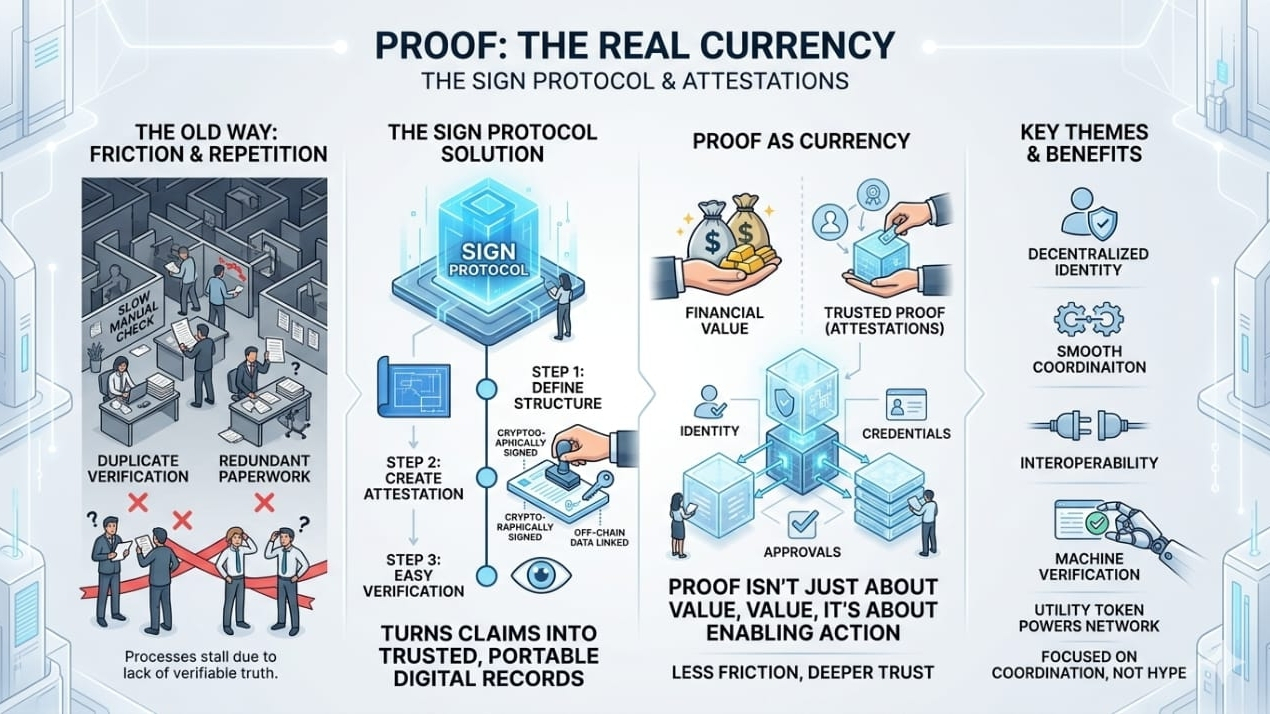
I noticed something subtle but important while thinking about how your friend struggled with business registration. The real issue was not paperwork itself, but the lack of clean, trusted proof. Every step required someone to verify something again and again, as if nothing could be trusted unless it was manually checked. This is where many systems, even outside crypto, begin to feel slow and frustrating. And strangely, crypto has often repeated the same pattern. It has made transactions transparent, but it has not always made trust easier.
I started thinking about how most blockchain projects focus on moving money faster or cheaper, but very few focus on making proof itself simpler. That is where Sign begins to feel different. Instead of asking how value moves, it asks how information becomes trusted. That shift may sound small, but it changes everything. Because in the real world, progress is often blocked not by lack of money, but by lack of verifiable truth.
At its core, Sign is trying to turn proof into something structured, portable, and easy to verify. The idea is surprisingly simple once you step back. Imagine you could take any claim, like an identity verification, an approval, or a credential, and turn it into a digital record that anyone can check without needing to repeat the entire process. That record is what Sign calls an attestation. I wondered why this matters so much, but then it becomes clear when you think about how many systems today rely on repeated validation. Sign is trying to remove that repetition.
The way it works is not complicated, but it is carefully designed. First, there is a structure that defines what kind of information is being recorded. Then there is the actual claim, which follows that structure and is cryptographically signed. This means the data is not just stored, it is also provable. Some of this information can live directly on the blockchain, while other parts can be stored off-chain but still linked in a verifiable way. I noticed that this flexibility is important, because not all data should be public, and not all data needs to be heavy or expensive to store.
As I explored this more, I started thinking about why the system is built this way. It feels like the builders are not just solving a technical problem, but a practical one. Real-world systems are messy. Data is scattered, formats are inconsistent, and verification is often manual. By creating a shared structure for proof, Sign is trying to make different systems speak the same language. It becomes less about replacing everything and more about connecting what already exists.
The token in this system plays a quieter but still important role. It is not meant to represent ownership or profits. Instead, it acts as a utility within the network. It helps power actions like creating attestations, verifying them, and interacting with storage systems. I noticed that this design choice reflects a broader trend in crypto, where tokens are increasingly tied to usage rather than speculation alone. Whether that balance holds over time is another question, but the intention is clear.
We are seeing a larger shift in the industry where infrastructure is becoming more important than hype. Projects like Sign sit within a growing category of systems focused on coordination rather than just transactions. They connect naturally to themes like digital identity, decentralized governance, and even machine-driven economies. I started thinking that in a future where machines interact with each other, proof will matter even more than payment. A machine does not trust like a human does. It verifies.
At the same time, it would be unrealistic to ignore the challenges. Adoption is always the hardest part for infrastructure projects. Developers need to choose to build on it. Organizations need to trust it. And users need to interact with it without even realizing it is there. There are also questions around incentives. Why should participants maintain and support the network? How does the token maintain meaningful utility without becoming purely speculative? And then there is regulation, especially when identity and verification are involved. These are not small hurdles.
Success for something like Sign will not happen overnight, and it will not always be visible. It will show up quietly, in the number of systems that start relying on shared proof instead of isolated verification. It will show up in how often attestations are created and reused. It will show up when developers stop building custom trust solutions and instead plug into a common layer. I noticed that this kind of success is harder to measure, but also more durable when it happens.
There are also risks that cannot be ignored. If adoption remains limited, the system could struggle to justify its complexity. If standards fragment, the value of a shared proof layer could weaken. And if trust in the underlying infrastructure is ever compromised, the entire premise becomes fragile. These are real concerns, and they remind us that building trust systems is always more difficult than it first appears.
In the end, what stayed with me is not just the technology, but the idea behind it. We often think of value as something that moves, but rarely as something that is proven. Sign is built around the belief that proof itself can become a kind of currency, not in the financial sense, but in the sense of enabling action. When proof becomes easy, processes become faster, decisions become clearer, and systems become less dependent on friction.
And maybe that is the deeper shift we are beginning to see. Not a world where everything is visible, but a world where what needs to be trusted can be verified instantly. If that idea continues to take shape, then projects like Sign may not just improve existing systems, but quietly redefine how trust works in a digital world.
@SignOfficial #SignDigitalSovereignInfra $SIGN
