

For a long time, I believed most crypto projects were solving trust. Identity layers, credentials, attestations — it all sounded like the right direction. But after spending more time around real systems, I noticed something uncomfortable. Trust doesn’t really break when things are working. It breaks when something small stops working.
Not a hack. Not a collapse. Just a delay.
An indexer slows down. An API stops syncing. An explorer shows outdated data for a few minutes. Suddenly, people don’t know what’s correct anymore. Balances look off. Claims fail. Users start questioning everything. That small window is enough to shake confidence.
And the strange part is, most of these systems are still “on-chain.” But in practice, nobody reads raw blockchain data directly. Everything depends on layers built on top. When those layers fail, the system technically exists, but practically becomes unusable.
That’s where my perspective started shifting, and where Sign began to make more sense to me.
Instead of assuming everything will always be available, it seems to assume the opposite — that failure will happen. And the system should continue working anyway. Not by relying on one place, but by spreading data across different environments.
Public chains handle verification. Storage layers like Arweave keep data alive. Other layers can adapt depending on use. It’s not clean or simple, but it reflects how real infrastructure works. Redundancy is not optional, it’s necessary.
The same thinking shows up in how identity is approached.
Right now, identity in Web3 is scattered. One person can have multiple wallets, social accounts, and off-chain profiles. None of them naturally connect. Every application tries to rebuild identity again from scratch, which creates inconsistency everywhere.
At one point, I thought the answer was to combine everything into one universal identity. But that idea quickly runs into problems. Control becomes centralized. Ownership becomes unclear. And flexibility disappears.
Sign doesn’t try to compress identity into one object. Instead, it links pieces together. Through structured claims, different identities can be connected without forcing them to merge. It’s less about creating a single profile and more about proving relationships between existing ones.
That shift may seem small, but it removes a lot of friction. You don’t replace identity, you connect it.
This becomes very practical when you look at how tokens are distributed today.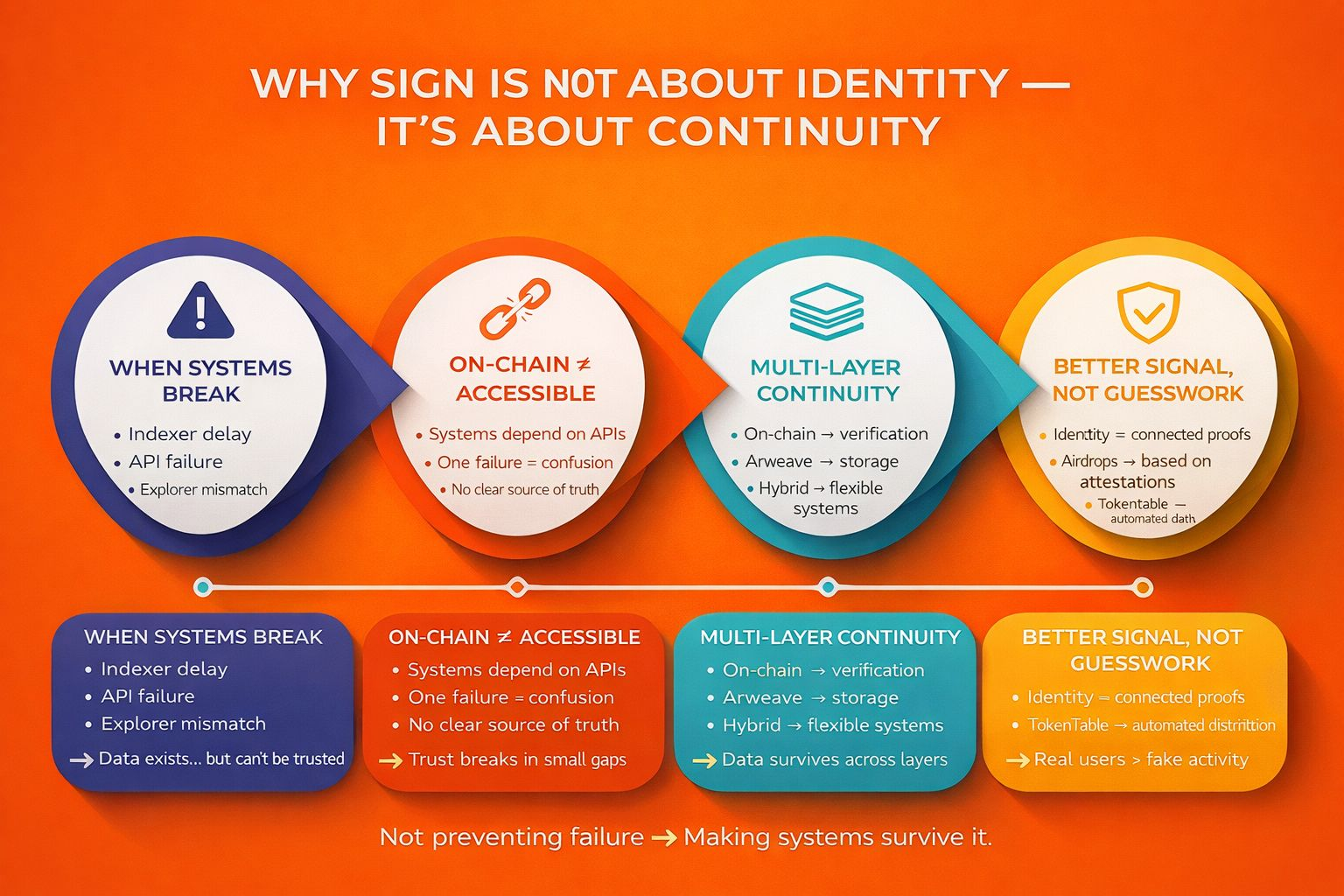
Most airdrops rely on activity signals — how many transactions, how old a wallet is, how often it interacts. But these signals are easy to fake. Bots have already optimized for them. So teams end up guessing who is real and who is not.
With attestations, the signal changes. Instead of measuring activity, you measure proof. For example, instead of rewarding a wallet for interacting many times, you reward it for having a verified role or contribution.
That difference is important.
Think about something like a grant program. Instead of manually reviewing applications or filtering spreadsheets, you define requirements using verifiable conditions. If those conditions are met, distribution happens automatically. No guessing, no last-minute changes.
But this doesn’t come for free.
Now you depend on reliable attesters. You need shared standards. You need systems that can verify across multiple environments. That adds complexity, and complexity always introduces risk.
Still, when I zoom out, I don’t see Sign as trying to control identity or redefine trust entirely. It feels more grounded than that.
It’s trying to make sure that when one part of the system fails, everything else doesn’t collapse with it. That identities don’t need to be rebuilt every time. That decisions are based on something stronger than surface-level signals.
Whether it can handle real-world pressure is still uncertain. Systems like this are heavy, and even small issues can cascade quickly.
But the direction makes sense.
Because in reality, the goal is not to build systems that never break. It’s to build systems that don’t lose meaning when they do.