
keep trying to compress this into one clean idea and it just slips every time. first read it feels obvious. privacy chain, selective disclosure, zk proofs, done.but that framing doesn’t hold for long, #night
because what Midnight is actually doing is not just hiding data. it’s splitting the system into layers that each do something real, but none of them fully carries the whole thing.computation doesn’t happen where consensus lives anymore. @MidnightNetwork
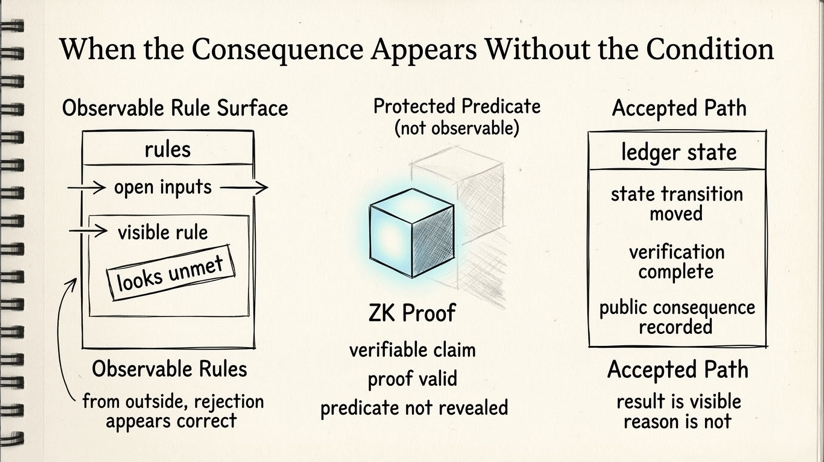
that’s already weird if you stop pretending it’s normal.on Midnight (@MidnightNetwork) the real logic runs in private state, account-style, local to the user or system, where the full inputs actually exist. not some cleaned version. the real thing. full state, 
full business logic, full messy context.Compact is what lets people write that logic without dealing with circuits directly, but under the hood it still becomes constraint systems. that is what the proof later gets checked against.so the first important thing in Midnight is already off-chain.the actual decision happens before public state even knows anything happened.then Kachina comes in, and this is where people flatten the Midnight architecture way too much. $NIGHT
Kachina is not just a proof bridge. it decides what kind of statement is allowed to cross from private state into public state.recursive zk-SNARKs compress the execution into a proof artifact. not the inputs. not the intermediate steps. not the full decision path. just a verifiable claim tied to a predicate.
something like: this condition held under these rules.that’s a very different thing from showing the condition itself.and even the public side is shaped for that. Midnight’s public state is UTXO-based, which matters because what lands there is not rich explanatory state
. it is a proof attached to a state transition, something validators can verify quickly.the BLS12-381 upgrade matters here too. smaller proofs, faster verification, millisecond-level checks. that sounds like performance detail, but it changes behavior. once proof verification gets cheap enough, Midnight can lean much harder into show less, verify more.
even the state shape reflects that split now: account-rich private state, UTXO-minimal public state.so now you already have two worlds that don’t fully overlap. private state, where execution actually happened, and public state, where only the proof of that execution exists.and Midnight doesn’t try to reconnect them. it doesn’t replay the logic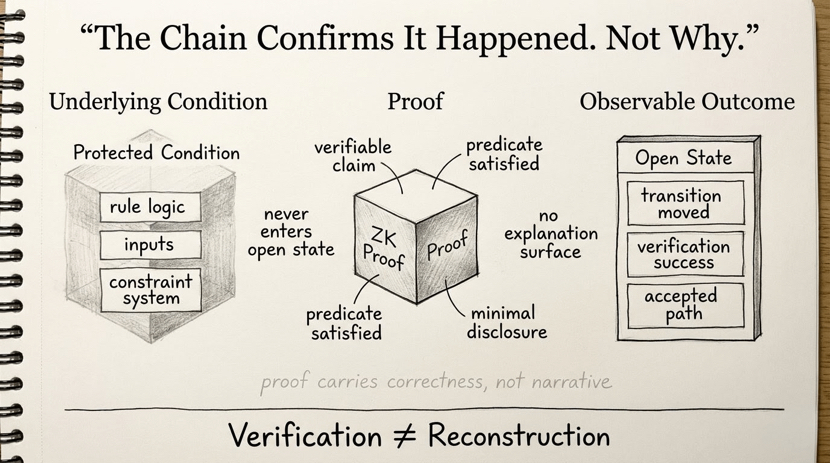
, doesn’t ask for inputs, doesn’t reconstruct anything. it just runs proof verification against the constraint system and moves the accepted path if it passes.“the system accepted it.”yeah okay.
but accepted what exactly?that’s the part i keep getting stuck on, because that acceptance is happening without the chain ever holding the full context. the predicate is satisfied,
the proof verifies, the transition is valid, but the underlying state that made it true never leaves private state.Midnight is not just hiding truth. it is distributing it.part of it lives in private execution, part of it is encoded inside the proof artifact, part of it is just public state reflecting that something was accepted. those parts align enough for correctness, but they do not merge into one place you can fully inspect.and then the security layer makes it stranger
. Minotaur pulls in validators and Cardano SPOs to secure the network, but they are not securing raw data or direct execution. they are securing proofs and state transitions derived from proofs. they don’t see the inputs, they don’t see the business logic, they don’t see the full decision path.
they verify that the proof meets the rules and finalize that result.so now you have a Midnight system where computation happens in one place, proof exists in another form, and consensus secures the outcome without seeing either in full.
“secured doesn’t mean seen anymore.”and yeah maybe that’s the upgrade. no shared data honeypots, no forcing sensitive workflows into global visibility, no leaking internal logic just to get consensus. Midnight fixes something real there.
but it replaces it with something else.because if you actually follow a Midnight flow end to end, it is clean internally but strange from the outside. a condition lives in private state, the user spends DUST
to generate the proof, the proof crosses the disclosure boundary, validators check it, the state transition moves, NIGHT sits on the public side as part of the visible coordination layer, everything consistent.but then you stand outside it and ask a very normal question.why did this happen?and the system just says: the proof was valid.
valid against what? which condition? visible to whom? does anyone else get to see it later? is there a second disclosure layer, or is that boundary final?and yeah, technically you can answer it. predicate satisfied, constraint system held, proof verified.
but that’s not the same as explanation.that’s verification without reconstruction.so now if something feels off, not broken, just off,
there’s no single place to look. the chain has the proof. the proof encodes the constraint result. the data sits in private state. the system is still correct.so what do you question then? the proof? the hidden input? the logic written in Compact?
the Kachina boundary that decided what was enough to disclose? who has the right to reopen that without turning selective
disclosure into forced disclosure?because this is where Midnight stops being just cryptography and turns into something more annoying. trust surfaces. authority boundaries. who gets visibility when correctness is not enough to answer the human question of what actually happened.and this isn’t edge-case stuff. Compact makes this scale across apps. private execution everywhere, proofs everywhere, DUST fueling hidden computation, NIGHT coordinating the visible layer, and from the outside it all collapses into the same signal.“the system said yes.”
most of the time that’s enough. systems run, accepted paths move, no leaks, everything looks smooth.maybe too smooth.because older systems had this ugly advantage where you could eventually reconstruct what happened from the chain itself. here you can’t. not because it’s hidden poorly,
but because it was never meant to be there.not on Midnight.Midnight doesn’t remove truth. it distributes it across private state, proof systems, public state, and consensus. none of those layers alone holds the full picture anymore.
the chain still verifies, still secures, still finalizes.but it’s no longer where the full truth lives.it’s where truth gets accepted, while the thing that made it true stays somewhere else, still real, still decisive, just not in the same place anymore