
@MidnightNetwork #night $NIGHT
I’m tired of the cycle this market keeps repeating.
Not individual failures, but the pattern itself.
Every few months it’s the same language repackaged. Privacy. Transparency. Decentralization. Presented as if repetition increases validity. At this point it doesn’t feel like innovation narratives anymore. It feels like semantic inflation. Thin product, thick vocabulary.
Transparency, in particular, is still treated like an unquestionable virtue. In practice it behaves differently. Full visibility turns every interaction into permanent history. Every action becomes extractable context. That isn’t necessarily empowerment. It is traceability by default, with no meaningful containment layer. The industry rarely acknowledges this as a design cost.
Midnight starts from that discomfort rather than arguing against it.
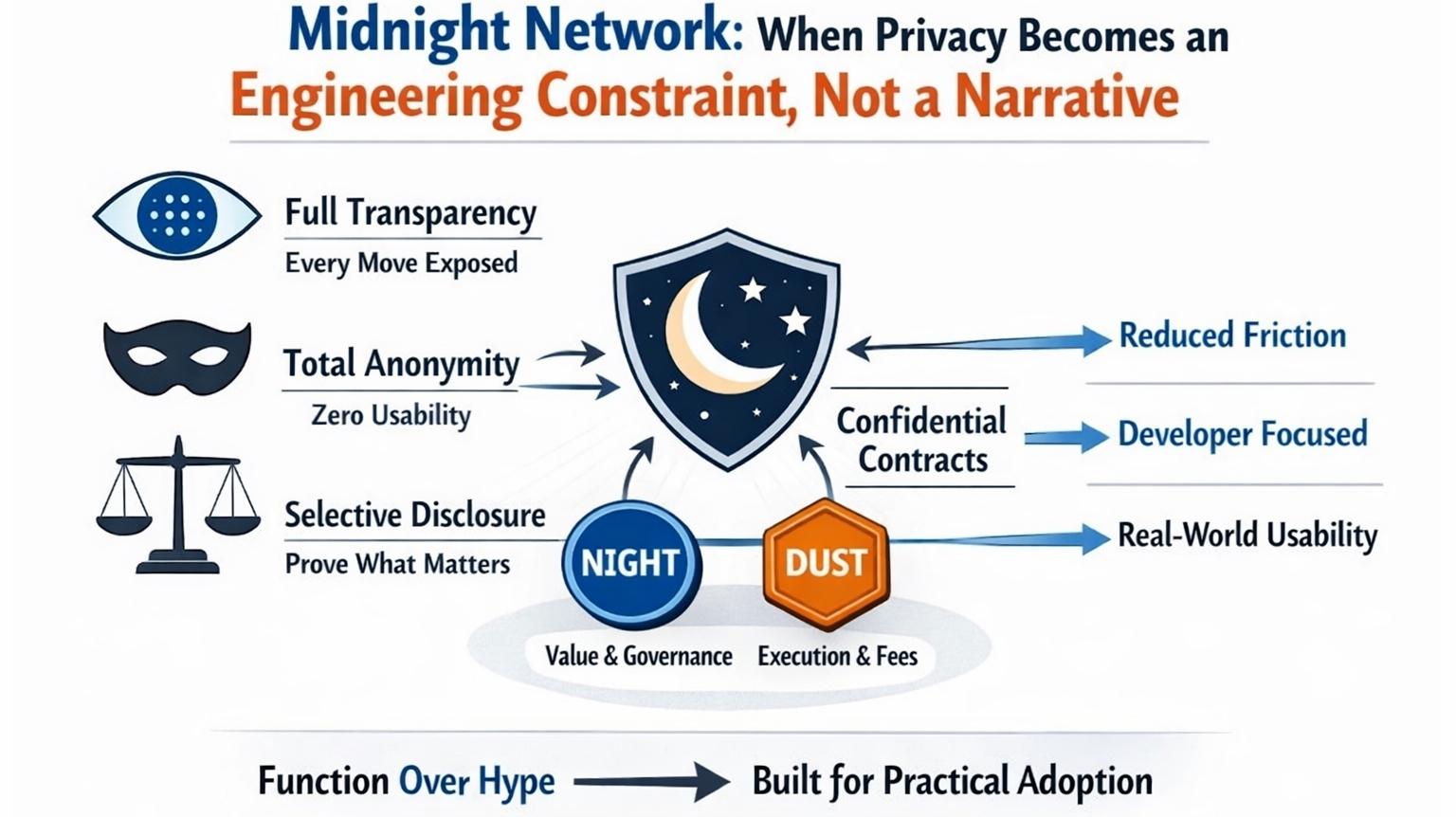
It does not try to frame privacy as ideology or positioning. It treats it as an engineering constraint that must coexist with usability and verifiability. That shift matters because it removes the emotional framing entirely. What remains is a systems problem: how do you validate state without fully exposing it.
The answer it leans toward is selective disclosure. Not total concealment, not full exposure. A narrower mechanism where only the necessary portion of data is revealed for verification.
It is not elegant in a narrative sense. It is structurally pragmatic. And in crypto, pragmatism is usually underpriced until it becomes unavoidable.
I’m not romantic about this space anymore. Too many architectures that looked logically sound failed once real users entered the system. Not because they were wrong in principle, but because the distance between design assumptions and behavioral reality is wider than most teams model.
Failure in this sector is rarely dramatic. It is usually quiet drift.
The ZK narrative sits inside that same fatigue cycle now. Most participants no longer evaluate it at the cryptographic level. They evaluate it through friction. Whether the system feels usable, whether privacy introduces complexity or removes it, whether it reduces cognitive overhead instead of increasing it.
Midnight appears to be optimizing around that axis rather than mathematical novelty. That alone makes it more aligned with current user expectations, even if it is less narratively exciting.
The token architecture is where the system stops resembling a standard L1/L2 design.
Most networks compress all economic functions into a single asset. That simplicity looks efficient in theory but tends to create coupled failure modes in practice. Price volatility directly affects usage cost. Network demand feeds back into token speculation. Eventually the system becomes economically self-referential rather than functionally stable.
Midnight separates those roles.
NIGHT represents value, governance, and economic exposure. DUST represents execution capacity. The separation is not cosmetic. It is an attempt to isolate market speculation from operational throughput.
At first glance it adds complexity. That is a valid criticism. But the deeper question is whether simplicity in token design is actually solving a real systems constraint or just hiding it.
DUST behaves less like an asset and more like constrained computational capacity. It is consumed rather than traded. That distinction matters because it breaks the immediate coupling between token price and usage cost.
In effect, users are not paying per action in a volatile unit. They are consuming a bounded execution resource that regenerates based on system rules tied to NIGHT.
This shifts the economic model closer to infrastructure provisioning than asset circulation. And infrastructure pricing behaves differently. It prioritizes predictability over speculation, which is often misaligned with how crypto markets naturally evolve.
Maybe I’m overthinking it, but this is where the design starts to feel less like a token experiment and more like an attempt to engineer stable usage conditions.
That, however, does not guarantee adoption.
In fact, it may work against early traction.
Markets do not initially reward systems that reduce volatility. They reward systems that amplify attention. Infrastructure that behaves correctly under load rarely outperforms narratives that behave loudly under speculation.
This is where the builder layer becomes critical. If developers can abstract cost dynamics through NIGHT-driven DUST generation, then end users never interact with the underlying mechanics. In theory, that improves adoption friction significantly.
But theory is not deployment.
User behavior is not abstract. It is habitual. And habits are far harder to shift than architecture is to design.
I’ve seen well-structured systems fail at this exact point. Not because they lacked capability, but because they required a behavioral transition the market was not ready to make. Tooling alone does not guarantee retention. It only guarantees accessibility.
Partnerships sit in the same category of signals. They indicate interest and exploratory alignment, not operational dependency. The market repeatedly confuses early institutional engagement with validated usage. Those are not equivalent states.
Integration is where most of these assumptions collapse. Sustained usage is even more selective.
Mainnet is where abstraction ends. Simulation environments and controlled stress testing can validate system behavior under constrained conditions, but real networks introduce uncontrolled variability. Users do not follow expected paths. They exploit inefficiencies, generate edge cases, and expose hidden economic assumptions.
That is the point where design stops being theoretical.
What remains is performance under unpredictability.
At this stage, Midnight does not read as a finished narrative. It reads as a restrained system still attempting to validate its own assumptions under real conditions. There is no attempt to overstate its position in the ecosystem. It is not presenting itself as disruption. It is closer to infrastructure engineering than market storytelling.
That restraint has tradeoffs. It reduces narrative velocity. It slows attention formation. And in crypto, attention is often the first layer of valuation, even before utility is proven.
So the tension is structural. A system designed for long-term functional stability operating in a market optimized for short-term narrative acceleration.
Both forces cannot be simultaneously satisfied without compromise.
The actual risk here is not technical failure. The architecture, as described, is internally coherent. The risk is behavioral misalignment across three groups that must converge for the system to matter: developers, users, and market participants.
Each group evaluates success differently. Each group moves on different time horizons. Aligning them is not an engineering problem. It is a coordination problem.
Most systems fail here, not in design but in adoption sequencing.
For now, Midnight sits in that category of projects that are difficult to categorize precisely because they are not obviously flawed, but also not yet proven necessary. That ambiguity is often where long cycles begin, or quietly end.
It does not feel like noise.
But it also does not feel resolved.
And in this market, unresolved systems either become infrastructure or disappear without needing to be wrong.