
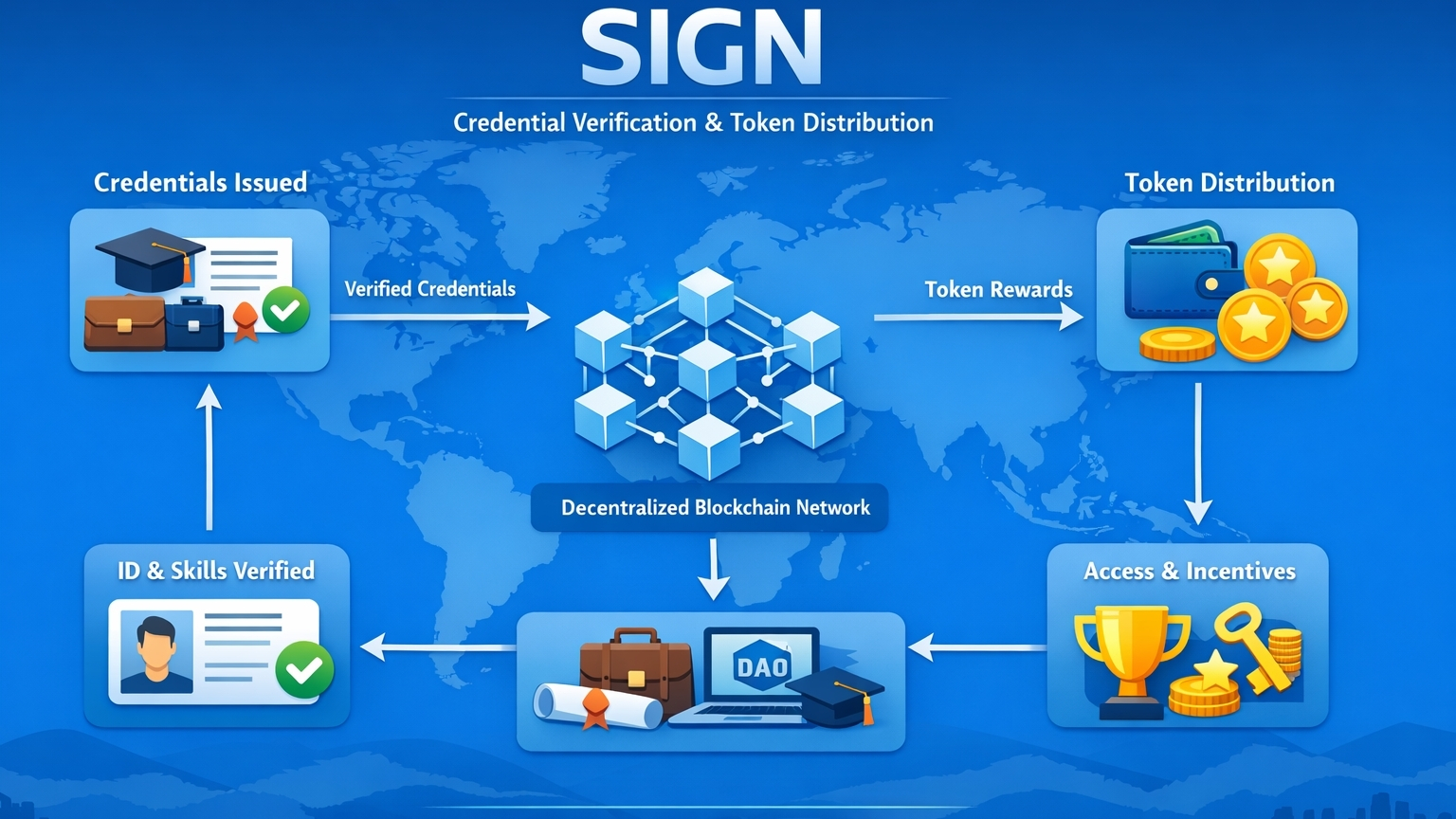
In the rapidly evolving world of blockchain and decentralized systems, one of the persistent challenges has been creating a reliable, universally accessible way to verify credentials and manage the distribution of digital tokens. Many projects have attempted to address pieces of this puzzle—identity verification, token management, or secure record-keeping—but few have attempted to tackle both in a cohesive framework. This is where SIGN, a project focused on a global infrastructure for credential verification and token distribution, enters the conversation. At its core, SIGN seeks to make the process of proving identity or qualifications and distributing digital assets both trustworthy and efficient, without the friction of traditional centralized systems.
The motivation behind SIGN is rooted in a simple, yet pressing problem: in a world where digital interactions are increasingly commonplace, verifying credentials—whether academic, professional, or otherwise—remains cumbersome and often fragmented. Traditional verification methods require intermediaries, paper documents, and time-consuming processes, which can slow down everything from hiring decisions to grant approvals. By leveraging blockchain technology, SIGN proposes a system where credentials can be issued, stored, and verified in a secure, tamper-resistant manner, accessible anywhere in the world. At the same time, it provides mechanisms for distributing tokens tied to specific achievements, access rights, or incentives, integrating both reputation and rewards into a single framework.
Technically, SIGN operates as a layered architecture designed for transparency and scalability. At its foundation is a decentralized ledger that records credential issuance and verification events, ensuring that once a credential is registered, it cannot be retroactively altered or forged. On top of this ledger sits a set of protocols for credential management, which allows institutions, employers, or organizations to issue verifiable digital certificates that recipients can share securely. These credentials can range from simple proof of participation to fully accredited professional certifications. The system is designed to be modular, meaning it can integrate with existing identity management solutions, educational platforms, and enterprise networks without requiring them to overhaul their infrastructure.
A key innovation of SIGN is how it links credential verification to token distribution. Instead of treating these as separate functions, SIGN envisions a world where verified accomplishments automatically unlock access to specific digital assets, whether that’s a utility token, a governance token, or a reward tied to participation. This creates a seamless ecosystem where achievements and incentives are interconnected, giving users tangible benefits for verified actions while providing organizations with a reliable mechanism to reward engagement. It also introduces the possibility of building more sophisticated decentralized applications (dApps) on top of this infrastructure, from professional marketplaces to learning platforms that reward verified skill acquisition.
The potential role of SIGN in the broader crypto and decentralized identity landscape is substantial. It addresses a fundamental gap in trust: the ability to prove claims without relying solely on centralized authorities. In doing so, it strengthens the foundations of web3 applications that depend on verifiable credentials, such as decentralized finance platforms, DAOs (Decentralized Autonomous Organizations), and educational technology projects. Moreover, by standardizing credential issuance and token distribution across a global infrastructure, SIGN could reduce redundancy, minimize fraud, and accelerate processes that currently require multiple layers of verification and manual oversight.
In practical terms, this approach has implications far beyond blockchain enthusiasts. Employers can instantly validate candidate skills, educational institutions can streamline alumni verification, and organizations can create incentive structures tied directly to real-world achievements. The architecture also allows for interoperability, meaning that credentials verified on SIGN could be recognized across different platforms and industries, reducing the friction that often accompanies cross-institutional verification.
SIGN is not just a technology; it is an infrastructure experiment aimed at reshaping how trust, recognition, and reward operate in digital and physical ecosystems alike. Its focus on both credential verification and token distribution provides a bridge between traditional verification systems and the emerging tokenized economy. By simplifying verification, automating trust, and linking achievements to rewards, SIGN offers a vision of a more connected, efficient, and verifiable world, where credentials and digital assets can coexist seamlessly. In essence, it’s an ambitious attempt to lay down a global framework for proving, rewarding, and leveraging achievements in a way that feels natural, secure, and universal.