

I think a lot of people are asking the wrong question about Midnight. The conversation usually starts with “should more apps be private?” but that feels too broad to be useful. A better question is simpler and more grounded: which applications actually stop working properly when everything is visible?
That shift changes how you see Midnight entirely.
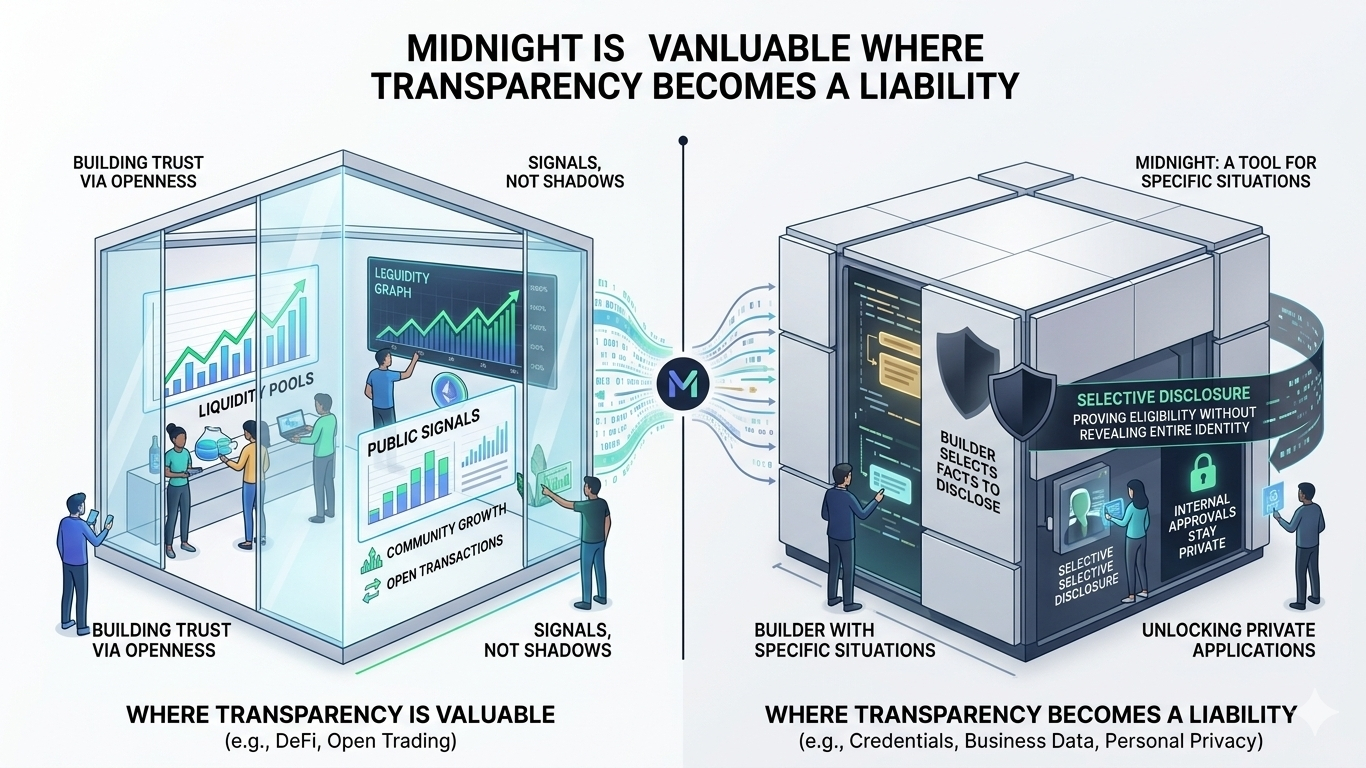
Most crypto apps don’t really need it. In fact, many of them feel stronger because they are transparent. When you’re trading, minting, tracking liquidity, or watching a community grow, visibility is part of the experience. You want to see what others are doing. You want signals, not shadows. If you take that away, the product can start to feel less trustworthy, not more.
That’s why I don’t think Midnight is trying to make crypto “more private” in a general sense. It’s more focused than that. It’s built for situations where too much transparency actually pushes people away or makes the product awkward to use.
The clearest example is anything tied to credentials. There are a lot of cases where someone needs to prove they qualify for something, but sharing everything about themselves is excessive. Think about proving you’re eligible, compliant, or part of a specific group. You don’t need to reveal your entire identity or history to do that. You just need to prove one fact. Midnight makes that feel natural instead of forced.
The same pattern shows up when you look at how businesses might use it. Most companies don’t want to hide everything, but they also can’t operate with full public exposure. They need a middle ground. They want to prove that rules were followed, that approvals were valid, or that certain conditions were met, without turning their internal processes into public data. That’s where Midnight starts to feel less like a niche tool and more like something practical.
I think that’s also why the project has been leaning into things like developer tooling and selective disclosure. It’s not just about privacy as a concept. It’s about giving builders a way to decide what gets revealed and what stays protected. That feels like a much more realistic direction than trying to make everything invisible by default.
At the same time, there are clear places where Midnight just doesn’t make much sense. If an app depends on openness to build trust, hiding information can actually hurt it. Some parts of DeFi rely on users being able to see collateral, risk, and system health in real time. Take that away, and people may hesitate instead of feeling safer. The same goes for communities that value transparency as part of their identity. Not everything improves when you reduce visibility.
This is where I think people overestimate privacy as a universal upgrade. It’s not like faster transactions or lower fees. It only really matters when the act of revealing information changes how people behave. If users become more cautious, if businesses hold back, or if sensitive relationships are exposed, then transparency becomes a problem instead of a feature.
That’s the lens I keep coming back to. Some applications are fine with everything out in the open. Others are not. Midnight is built for the second group.
So the real opportunity here isn’t turning every app into a private one. It’s unlocking the kinds of products that couldn’t comfortably exist on fully transparent systems in the first place. When you look at it that way, Midnight feels less like a broad upgrade to crypto and more like a tool for very specific situations. And those situations, quietly, might matter a lot more than people expect.