
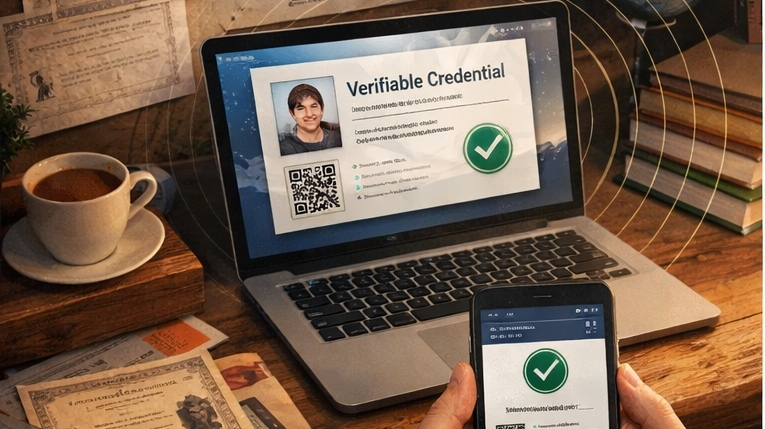
I wasn’t trying to understand a “system” when I first came across this idea—I was just annoyed.
It was supposed to be something simple—just proving a small detail about myself—but somehow it turned into this long, annoying process. I had to search through old files, remember passwords I hadn’t used in ages, and sit there waiting for things to get verified. It didn’t feel difficult, just unnecessarily complicated… like everything else online had moved forward, except this.That’s honestly what got me curious in the first place.
I came across this idea—something about a global system for credentials and tokens—and at first, it sounded a bit too big to really grasp. The kind of concept that sounds impressive but doesn’t immediately click. Still, there was something about it that kept me interested, so I stuck with it and tried to break it down in my own head.
And bit by bit, it started to make sense.
The first thing that clicked for me was this: what if a credential didn’t need someone else to confirm it every time? What if the proof could just… stand on its own?
That was the shift.
Instead of your certificate or achievement living on someone else’s system, this approach lets you actually hold it yourself—but not like a file you download and forget about. It’s more like a sealed proof, something that’s been signed in a way that can’t be tampered with. When you show it, it verifies instantly. No calls back, no waiting, no “we’ll get back to you.”
I remember thinking, why wasn’t it always like this?
But then things got more interesting when I started noticing how tokens fit into all of this.
At first, I’ll be honest—I assumed tokens were just there to make things look more exciting. Like an extra layer that didn’t really need to exist. But the more I followed the flow, the more it felt like they actually belonged there.
Because once something can be proven instantly, the system doesn’t have to sit there and do nothing with that information. It can react.
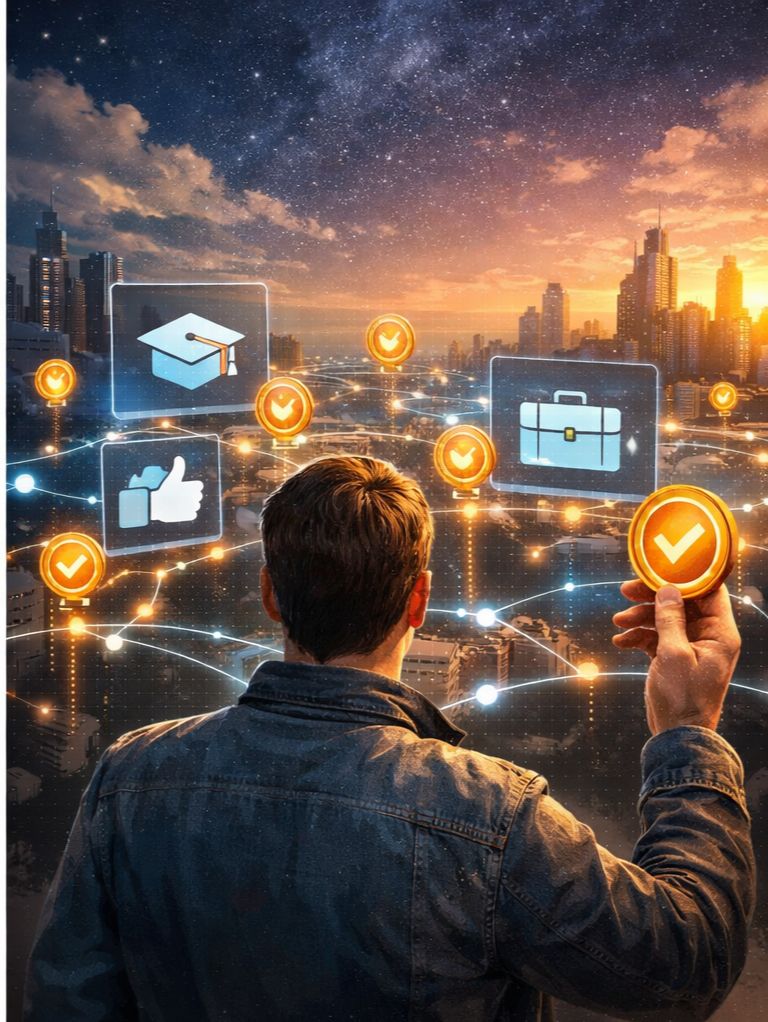
So imagine you complete something meaningful—learn a skill, contribute to a project, verify your work. That action becomes a credential. And because that credential is instantly trusted, the system can immediately respond to it.
That response can be a token.
Not as a random reward, but as a kind of acknowledgment that this happened, and it matters. There’s no delay, no middle step where someone decides if it counts. If the proof is real, the reaction follows.
That part really stayed with me.
As I kept exploring, I started to see how people would actually build on top of this. Not just use it, but create things with it. The tools are there to issue credentials, to verify them anywhere, to connect them with actions. And once you understand that flow, it opens up a different way of thinking.
Instead of building systems that depend on trust, you build systems that depend on proof.
I found myself imagining simple things—a platform where your progress isn’t just tracked but proven, where your contributions don’t disappear into a database but stay with you, where your identity isn’t locked inside one app but moves with you across everything.
It all felt surprisingly natural once I stopped overthinking the tech and just looked at the experience.
And the ecosystem around it doesn’t feel like a single company trying to control everything. It feels more like a shared space where different people—developers, users, organizations—are all working with the same building blocks. No one owns the whole thing, but everyone can use it.
That’s probably what makes it feel real.
By the time I stepped back, I realized this wasn’t just about credentials or tokens on their own. It was about fixing something that’s been quietly broken for a long time—the way we prove things, the way we trust things, the way value gets recognized.
And the biggest shift, at least for me, was this feeling that you’re no longer asking the system to believe you—you’re showing it something it can’t ignored.