


I was tracing a set of attestations earlier when one recipient address kept repeating.
No activity.
I checked it.
Nothing.
No transactions.
No interactions.
Still receiving credentials.
At first I assumed I had the wrong address.
So I checked again.
Same result.
I pulled the attestation fields.
`recipients`
Encoded.
Resolved cleanly.
No errors.
No missing data.
So I widened the scope.
Different issuers.
Different schemas.
Same pattern.
Addresses being assigned credentials...
without ever appearing anywhere else in the system.
One of them held three attestations.
Still zero activity.
That’s where it stopped feeling like a coincidence.
And started feeling structural.
I stayed on it longer than I planned.
Because nothing was breaking.
Every attestation resolved.
Schema loaded.
Issuer verified.
Everything passed.
But the recipient never showed up.
Not before issuance.
Not after.
And nothing in the flow required it to.
That’s the part that held.
The system records the recipient.
It doesn’t wait for the recipient.
No acknowledgment.
No interaction.
No signal that the relationship was ever completed.
I ran it again.
Different set.
Same behavior.
Credentials stacking on addresses that never moved.
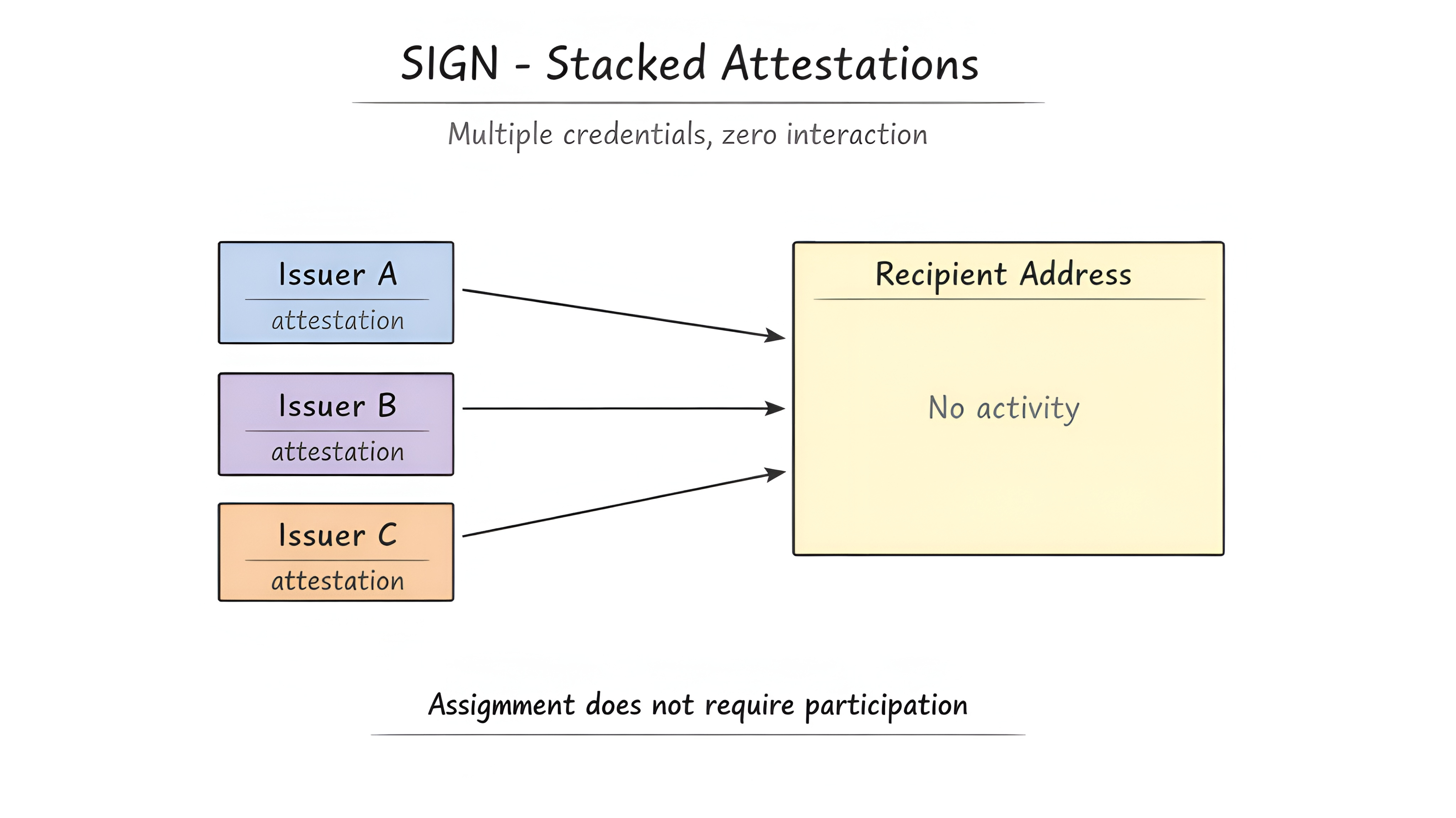
Never responded.
Never interacted with anything.
And still...
fully valid.
That’s when the direction flipped.
This wasn’t about inactive users.
It was about what the system considers enough.
Because verification never checks for presence.
Only structure.
The address exists.
It’s included in the attestation.
That’s sufficient.
Nothing in the resolution layer asks whether the recipient ever participated.
I keep coming back to this.
A ghost recipient.
An address that holds credentials...
without ever leaving a footprint.
And once you see it, it starts showing up everywhere.
Because multiple attestations can stack on the same address.
Across issuers.
Across schemas.
All valid.
All clean.
Some tied to active participants.
Some tied to addresses that never did anything at all.
And the system treats them exactly the same.
No distinction.
No signal.
No separation between assignment and participation.
That’s where it starts to matter.
Not when one credential exists.
But when many do.
Because once these begin to accumulate...
the surface changes.
You don’t just have credentials.
You have distributions.
Recipient sets.
Clusters of addresses holding attestations.
Some active.
Some completely silent.
And nothing in the system tells you which is which.
Because verification never looks for that difference.
It only confirms that the attestation structure is correct.
The rest is assumed.
That assumption holds when activity is small.
It becomes harder to rely on when scale increases.
Because the system keeps confirming credentials...
without confirming whether the recipient was ever actually there.
And that shifts what the credential represents.
Not proof of participation.
Just proof of assignment.
$SIGN only matters here if a system that cannot distinguish between recipients that act and recipients that never show up is still enough once these records begin to accumulate.
Because once that line disappears...
verification stops reflecting interaction.
It only reflects inclusion.
And that’s a different kind of truth.
So the real question becomes this.
When a credential resolves correctly...
what exactly is the system confirming about the recipient?
#SignDigitalSovereignInfra #Sign
