
Most crypto projects are easy to describe and hard to believe.
SIGN gives me the opposite reaction. It’s actually harder to summarize in one clean sentence, but the more I look at it, the more it feels like one of those rare projects that is trying to solve something foundational instead of dressing up another familiar token story.
At surface level, people usually put SIGN into boxes like credential verification, token distribution, attestations, identity rails, or onchain signatures. None of those descriptions are wrong. They’re just incomplete. What SIGN seems to be building is much closer to a trust infrastructure layer for the digital economy — the kind of thing that becomes more valuable as more systems, institutions, and users need proof that something is real, valid, approved, or authorized without repeating the whole verification process every single time.
That idea matters more than it sounds.
The internet became very good at moving data. Blockchains became very good at making transactions visible. But there is still a huge gap between information existing and information being trusted. That gap is everywhere. Who is eligible for something? Who signed what? Which wallet qualifies? Which claim is valid? Which distribution is legitimate? Which credential can be verified across systems without endless manual checks?
That is the territory SIGN is trying to own.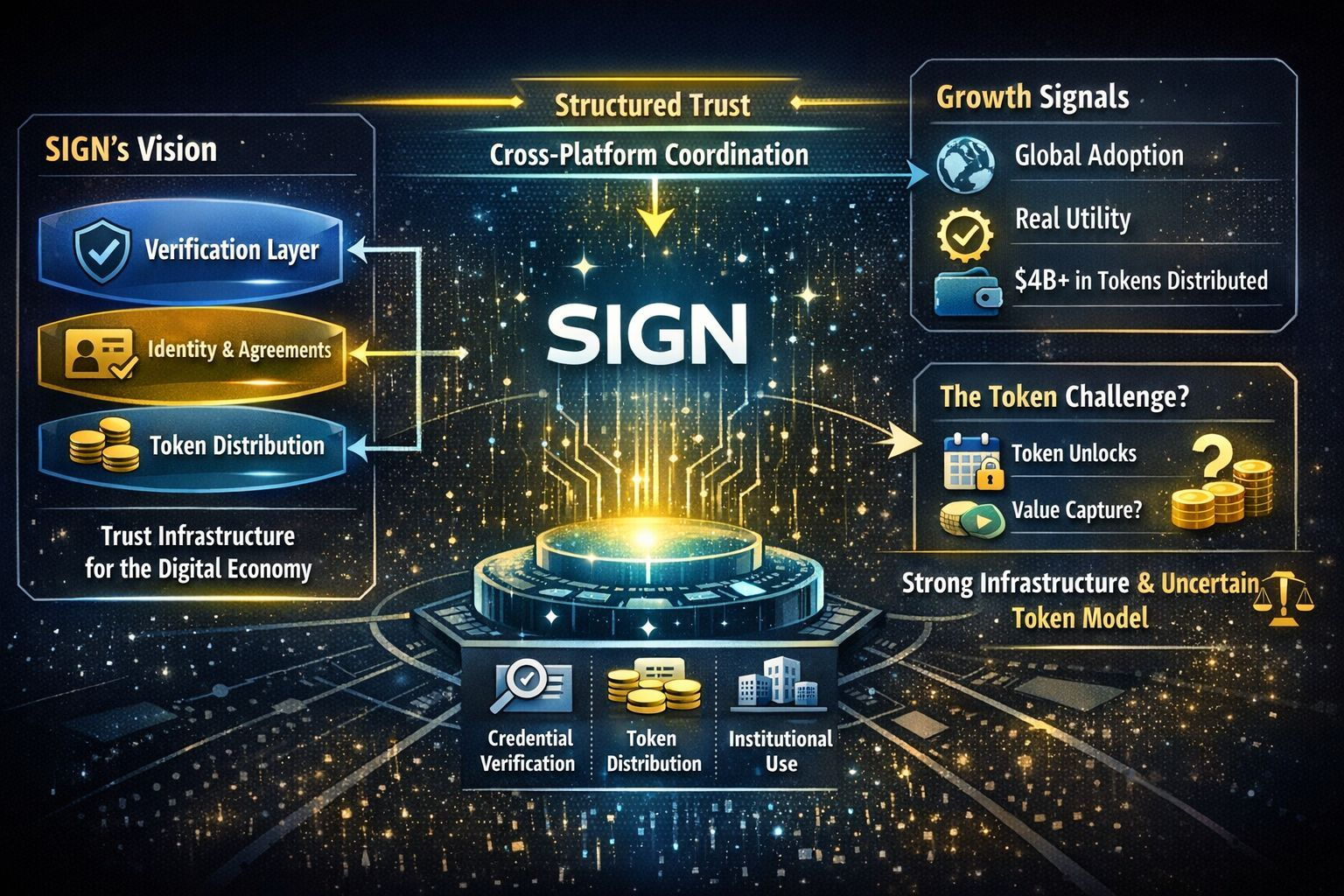
And honestly, that’s what makes it interesting to me. Not because it sounds futuristic, but because it feels painfully practical. A lot of crypto still lives in a world of narratives. SIGN feels like it is dealing with administrative reality. Proof. Eligibility. verification. distribution. auditability. structured trust. These are not the loudest themes in the market, but they are the themes that tend to matter once speculation cools down and real usage starts demanding structure.
The strongest part of SIGN, in my view, is that it doesn’t appear to be relying on one narrow product to justify its existence. It has a protocol layer, but it also has applications and workflow products around that layer. That is important. A lot of infrastructure projects stay too abstract. They become technically impressive but commercially vague. Others go too far in the other direction and build a single app with limited defensibility. SIGN is trying to bridge the two. It wants to be useful to builders, but it also wants to sit inside real user and institutional workflows.
That gives it a different feel from many other “trust” or “identity” projects. It is not just saying that attestations matter. It is trying to turn attestations into usable operational rails.
That said, the project becomes more impressive the more you look at the product side, and more complicated the more you look at the token side.
That distinction matters a lot.
As infrastructure, SIGN has a strong case. The direction makes sense. The product stack feels closer to real utility than most crypto middleware. The market increasingly needs systems that can verify claims across fragmented digital environments. If finance, identity, tokenized assets, online agreements, and regulated digital activity keep converging, then verification does not stay optional. It becomes a core layer.
But none of that automatically means the token captures enough value.
That’s the part I think many people avoid saying clearly. A project can build something genuinely useful and still struggle to create a great token market structure around it. Crypto has been full of examples where the product became more credible over time while the token stayed under pressure because supply, unlocks, weak capture design, or unclear demand mechanics kept weighing everything down.
SIGN still has to prove it can overcome that.
And that is probably the fairest way to look at it right now. The infrastructure thesis may be ahead of the token thesis. The business logic may be ahead of market sentiment. The project may already be more important than the chart suggests, but that does not mean the chart is irrational. Sometimes the market is not rejecting the product. It is just waiting for harder proof that network usage turns into token gravity instead of staying trapped at the application layer.
That’s why I don’t think SIGN should be analyzed like a hype asset. It makes more sense as a long-duration infrastructure question.
Does the digital world need better systems for portable proof, verification, and structured trust?
If the answer is yes, then SIGN is pointed at something much deeper than a short-term category trend. If the answer is no, then it risks being one more smart project building in advance of demand that takes longer than expected to mature.
Personally, I think the demand is real. The world is moving toward more digital coordination, not less. More tokenized assets. More cross-platform identity needs. More compliance pressure. More need for auditable systems. More situations where “just trust me” stops being acceptable. In that environment, proof infrastructure starts looking less like a niche and more like a missing layer.
That is why SIGN stands out to me.
Not because it is perfect. Not because the token model is fully resolved. Not because the market has already decided to reward it.
It stands out because it seems to be building around a genuine structural need. And in crypto, that alone already puts it in a different class than most projects people talk about every day.
#SignDigitalSovereignInfraSIGN ra @SignOfficial $SIGN
