
@SignOfficial #SignDigitalSovereignInfra ..I was sitting with my colleagues at work, casually talking about Binance, markets, the usual crypto noise. One topic led to another.
And somehow, the conversation drifted toward the Sign campaign.
At first, it stayed at the surface; tokens, narratives, positioning.
Then it shifted.
From products… to systems.
From systems… to infrastructure.
And eventually—to how entire regions are trying to build digital identity from the ground up.
That’s where it got interesting.
Because there’s one case I’ve been quietly tracking. Not for the headlines, but for what’s happening underneath them.
On paper, it sounds impressive.
First large-scale national SSI deployment.
Hundreds of thousands of users onboarded.
Launched fast. Scaled fast.
Most people stop there.
But the real story isn’t the launch.
It’s what happened after.
The system didn’t stay still.
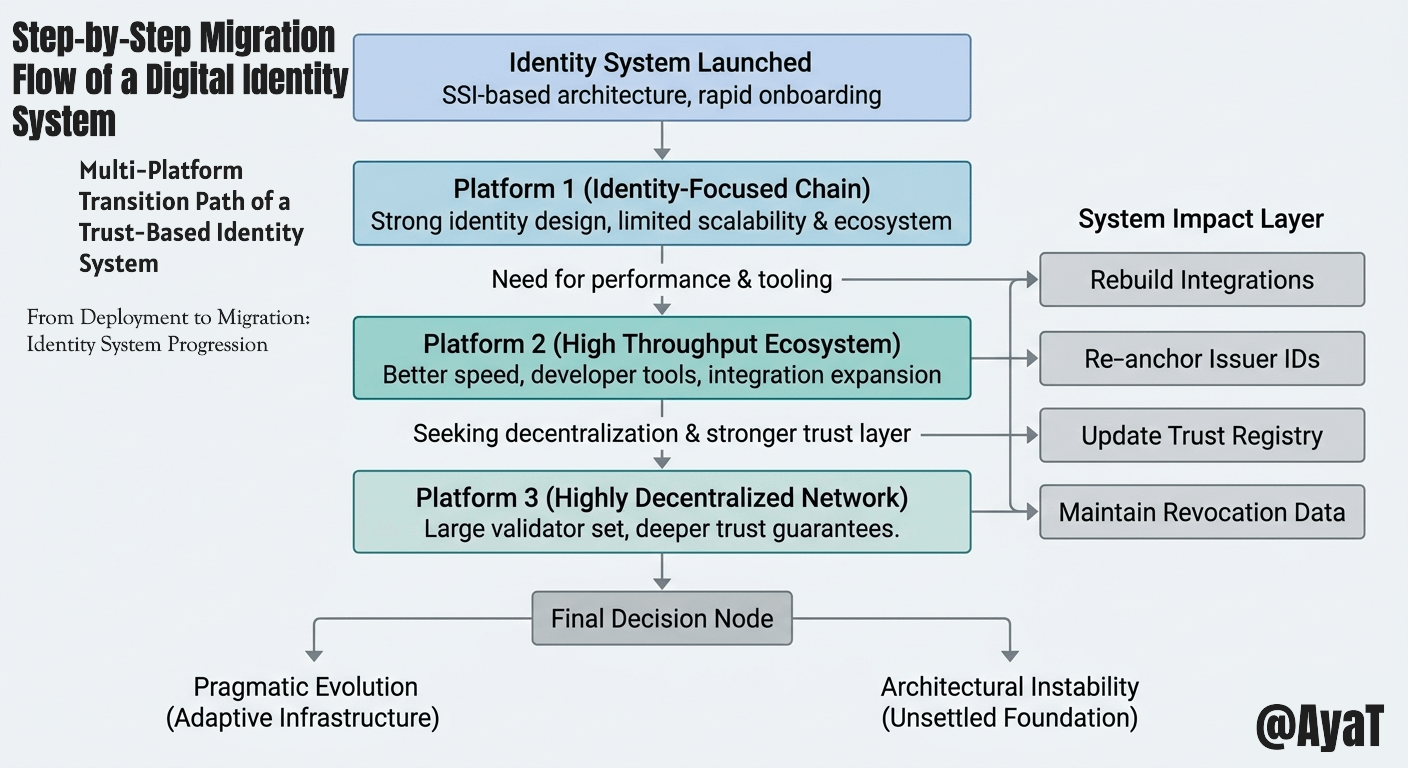
It started on one identity-focused blockchain.
Then moved to another ecosystem with better tooling and speed.
Now it’s aiming for a third, one known more for decentralization depth and validator diversity.
Three different platforms.
Roughly two years.
For something as sensitive as identity.
Now, officially, this is framed as pragmatic evolution.
And to be fair, that explanation isn’t wrong.
Different infrastructures solve different problems.
One was designed specifically for self-sovereign identity, but struggled with scale and connectivity.
Another brought performance and developer flexibility.
The next promises stronger decentralization guarantees.
Each move makes sense… in isolation.
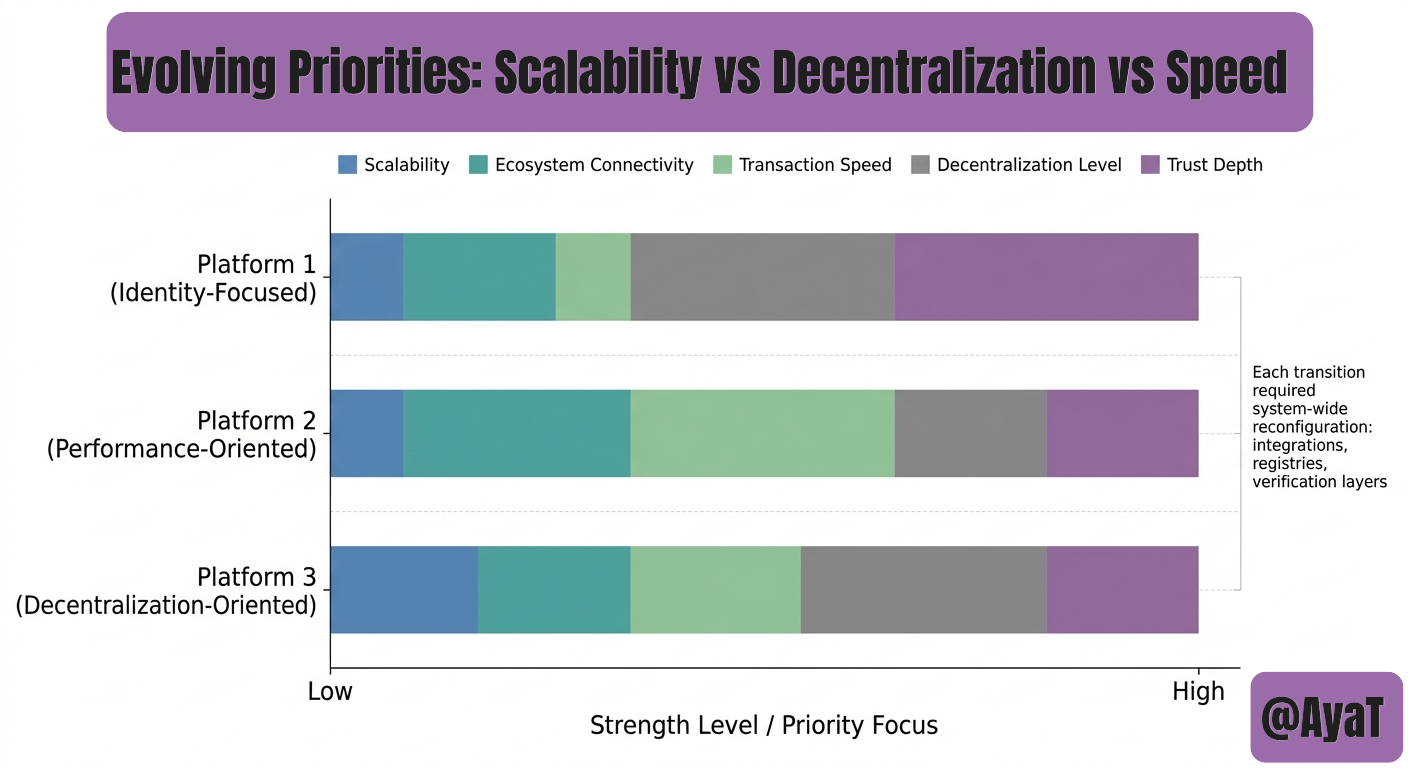
But identity systems aren’t isolated systems.
They are trust anchor
This isn’t like migrating a website or upgrading a payment backend.
This is the layer where verification happens.
Where credentials get their legitimacy.
When that layer moves, everything connected to it has to move too.
Every issuer.
Every verifier.
Every integration built on top of it.
Banks. Services. Internal agencies.
All of them.
Rebuild. Reconnect. Revalidate.
Again.
And then again.
Now, technically, the architecture tries to handle this.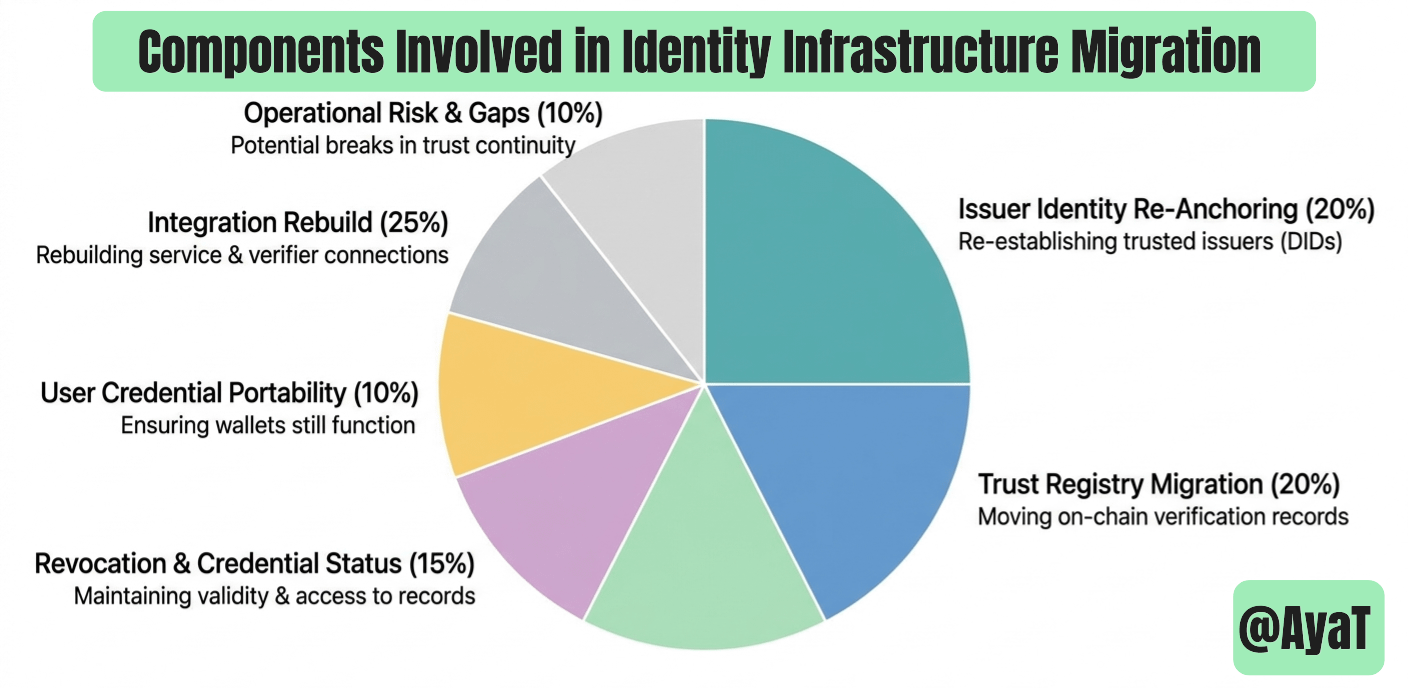
It leans on global standards.
W3C Verifiable Credentials.
Decentralized Identifiers.
That means, in theory, a credential issued once should remain usable across platforms.
Portable. Chain-agnostic. Future-proof.
That’s the idea.
But theory and execution don’t always align.
Because portability isn’t just about format.
It’s about completeness.
Every issuer identity has to be re-established.
Every registry must stay resolvable.
Every revocation record must remain accessible.
Miss one piece, and the whole portable identity promise starts to crack.
So the real question isn’t whether migration is possible.
It is.
The question is whether it’s fully realized; end to end, without gaps.
Because for the person holding that credential, none of this is abstract.
Their identity only works if the system works.
Across every transition.
And that’s where the pattern becomes hard to ignore.
Three major platform shifts, in a short time frame, on a live identity system..
Is that a sign of strength?
Or instability?
You could argue both.
Maybe this is what real innovation looks like.
Messy. Iterative. Constantly adjusting until the foundation feels right.
Or maybe…
Speed came first. Stability is catching up.
And the system is still paying for that tradeoff.
I don’t have a clean answer.
But I do know this:
When infrastructure keeps moving beneath something as critical as identity,
it’s not just a technical detail.
It’s a signal.
Either of a system doing the hard work to get it right; or one still searching for where it should have started.
And that difference?
It defines whether something becomes a reference model…
or an ongoing experiment.
@SignOfficial #SignDigitalSovereignInfra #signdigitalsovereigninfra $SIGN $TRUMP $RIVER