

Crypto is full of big claims. I have heard them for years. Every cycle brings a new promise about trust and scale and mass adoption. A lot of it sounds smart for a week and then falls apart when real pressure shows up. That is why I do not get excited quickly anymore. I watch first. I wait. I try to see what still works when the easy mood is gone. That is the frame I had when I looked at SIGN and the way TokenTable and EthSign sit next to each other. Sign itself describes TokenTable as the part that handles allocation and large scale distribution and EthSign as the part for agreements and signatures with verifiable proof of execution. That division caught my attention because it feels more like system design than story telling...
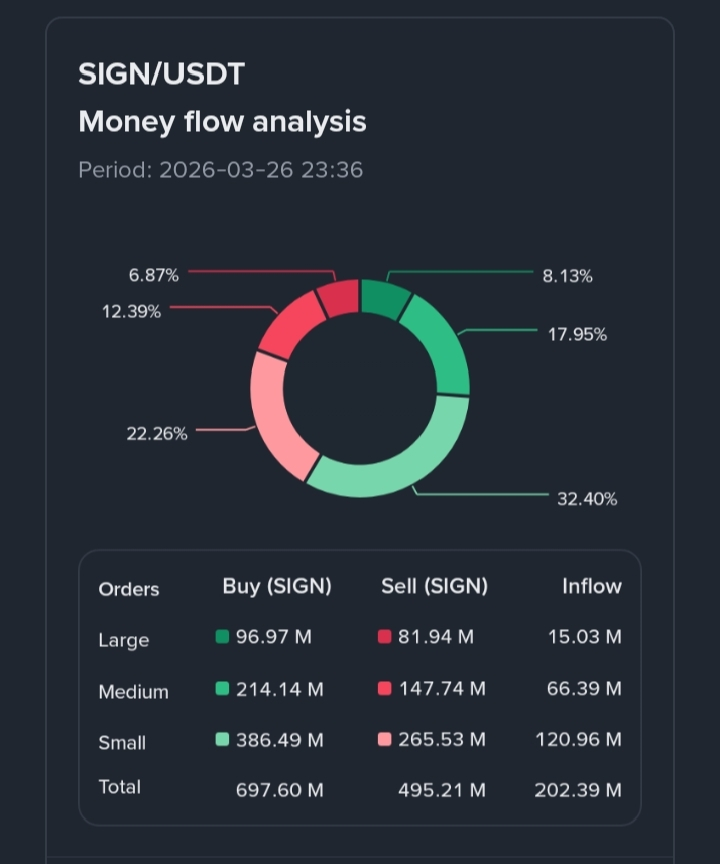
SIGN Money Flow
What made me keep looking was not the branding. It was the shape of the problem. Too many crypto projects still act like distribution is simple and trust is automatic. It is not. Someone has to decide who gets what. Someone has to show why. Someone has to record consent and terms in a way that can be checked later. TokenTable is described as a rules driven distribution engine for allocation and vesting. EthSign is described as a legal and agreement product that can create binding agreements and anchor proof on chain. Put together that starts to look less like hype and more like a practical workflow. One tool helps define and execute value movement. The other helps prove that people actually agreed to what was supposed to happen...
The simple idea is easy enough to say in normal words. TokenTable seems to answer the question of who should receive value and when. EthSign seems to answer the question of who accepted the terms and how that agreement can be verified later. That pairing matters because token systems often break at the human layer and not only at the code layer. Smart contracts can move assets. They cannot remove confusion by themselves. They cannot explain whether a recipient was eligible. They cannot prove the full story around consent and obligations unless the system around them was designed well. Sign’s own docs frame TokenTable around allocation logic and execution while EthSign handles document signing and proof of agreement. That feels like a cleaner split of responsibility than trying to make one product pretend to do everything...
What matters most to me is what happens under pressure. That is where weak systems get exposed. A market crash does it. A token unlock wave does it. A messy airdrop does it. An overloaded claims process does it. Broken trust usually starts with small failures. Bad lists. Manual fixes. Missing records. Delays that nobody can explain. TokenTable says it exists because traditional distribution relies on spreadsheets and manual reconciliation and one off scripts and that those approaches lead to duplicate payments and fraud and weak accountability. That sounds harsh but familiar. Real systems are not judged when everyone is calm. They are judged when users are angry and the team is under stress and people want answers right now...
That is also why this feels different from the usual meme driven part of crypto. I am not saying price does not matter. It always shows up in the room. But there is a deeper layer here. Infrastructure is boring until it fails. Trust is invisible until it breaks. TokenTable is not framed as a social token toy. It is framed as an engine for controlled distribution. EthSign is not framed as a vibe product. It is framed as a way to create agreements and preserve evidence. Even Sign’s broader docs place them as separate products that can be combined depending on the workflow. I tend to respect that kind of modular thinking more than grand claims about one app changing everything...
Still I am not blindly supporting it. Serious systems cannot afford weak design. One weak point can damage trust fast. If allocation rules are wrong then distribution becomes unfair. If agreement flows are clumsy then users lose confidence. If proofs are hard to inspect then the whole trust layer becomes a slogan. Even the idea behind Sign’s stack makes this clear. Different parts carry different duties. Evidence and attestations sit in one layer. Distribution sits in another. Agreements sit in another. That sounds sensible to me but it also means execution matters a lot. Clean architecture on paper does not save a product that fails in the field...
When I zoom out that is where the bigger meaning sits. The long term value of blockchain should not come from noise alone. It should come from useful systems that people can rely on when money and identity and responsibility are involved. Real adoption is not just more users. It is more situations where the system holds up when the stakes are real. Sign’s product map points in that direction. TokenTable handles rules based distribution. EthSign handles agreements and verifiable proof. Sign Protocol underneath is described as the evidence and attestation layer. That stack does not guarantee success. But it at least points toward a version of crypto that tries to be useful before it tries to be loud...
So I end up in a familiar place. Interested but careful. I do not think caution is a bad habit in crypto anymore. I think it is the only sane one. Sign has built something that at least looks like it understands where trust usually breaks. That does not mean I am sold. It means I am watching. I am still learning how well these pieces work outside the neat version on a docs page. But I would rather study systems like this than listen to another empty promise about the future. In crypto the calmest ideas are often the ones worth watching the longest...