
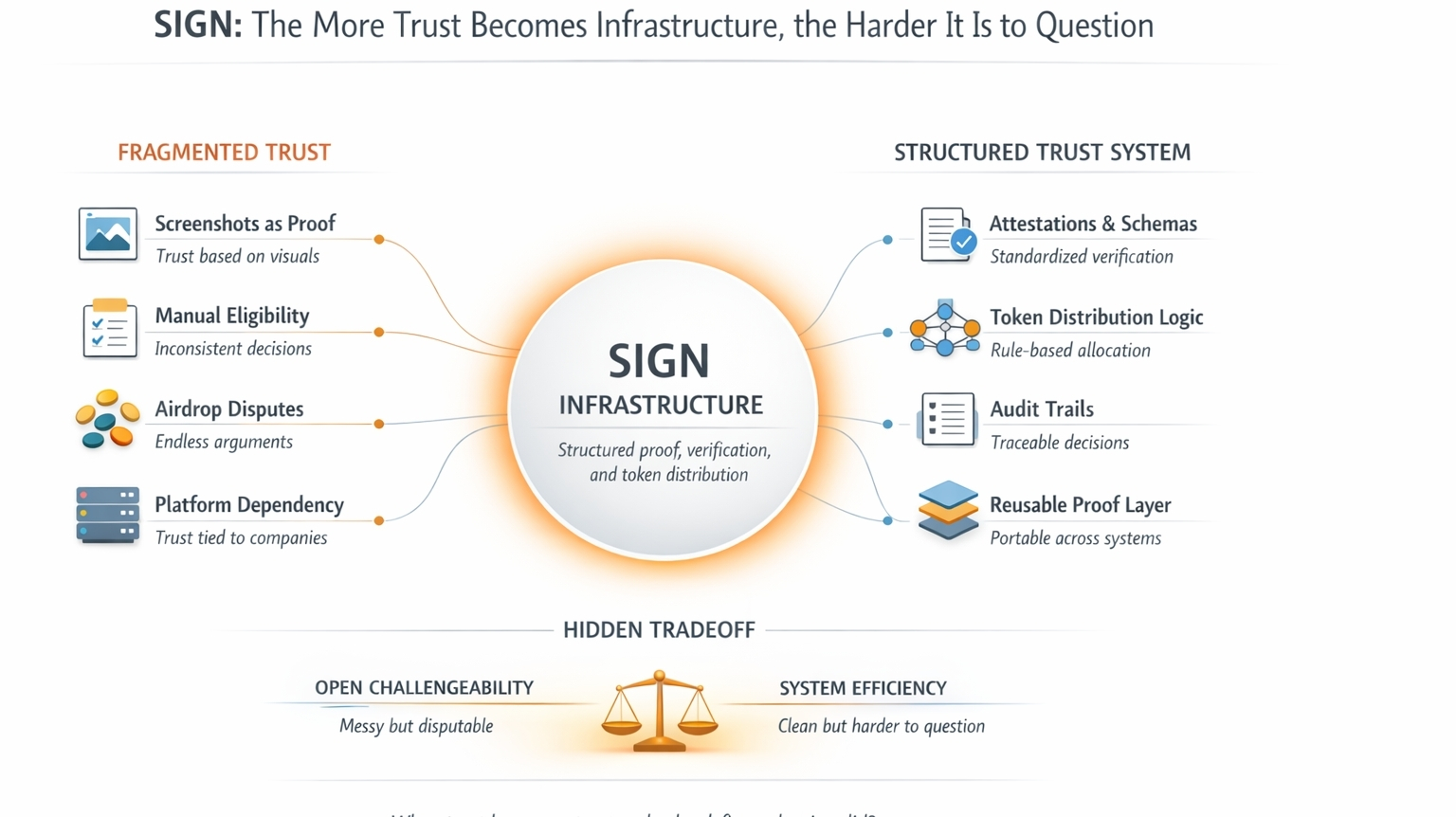
@SignOfficial #signdigitalsovereigninfra $SIGN
I’ve noticed something in crypto conversations that feels small on the surface, but says a lot.
People are less excited by freedom now. They are more excited by order.
Not the old kind of order. Not banks, not regulators, not the usual institutions everyone spent years pretending to hate. I mean digital order. Clean lists. Verified eligibility. provable claims. distribution logs that can survive a fight. You can feel the mood shift every time a messy airdrop happens, every time screenshots become “evidence,” every time a community argues for two weeks over who was supposed to qualify and why.
The market still talks like it wants openness.
But when money is actually on the line, what it really wants is structure.
That is why SIGN makes immediate sense to me.
At first glance, it feels like one of the more serious ideas in this cycle. Not because it is loud. Because it is aimed at a part of crypto that everyone touches and almost nobody respects enough. Verification. allocation. proof. the boring machinery underneath trust.
And honestly, that machinery matters more than a lot of people admit.
A chain can be fast. A protocol can be elegant. A community can be passionate. None of that helps much when the argument starts. Who was eligible. Who approved this. Which rules applied. Whether the distribution was manipulated. Whether the claim was real. Whether the record can still be trusted six months later, after the screenshots are gone and the excuses begin.
That is the lane SIGN is trying to own.
Its current docs frame S.I.G.N. as a broader digital infrastructure stack around money, identity, and capital, with Sign Protocol acting as the shared evidence layer and products like TokenTable and EthSign sitting around that core. Sign Protocol itself is described as infrastructure for structured schemas, attestations, verification, and auditability rather than as a base chain of its own.
That is compelling.
Maybe more compelling than another chain pitch, if I’m being honest.
Because crypto has had no shortage of systems for moving assets. What it has lacked is a credible way to standardize proof around decisions. Not just “this happened,” but “this happened under these conditions, with this authority, under this version of the rules, and here is the evidence trail if you want to challenge it.”
That sounds dry until you realize how much chaos lives in the absence of it.
Airdrops become theater. Governance becomes interpretation. Onboarding becomes manual trust cosplay. Entire ecosystems still rely on screenshots, spreadsheets, platform databases, and social reputation at the exact moments they are pretending to be trust-minimized.
So yes, when SIGN says this part of the stack needs to be formalized, I get it immediately.
Probably because the market has already been asking for it in broken language.
People say they want fairness. What they usually mean is legibility.
People say they want decentralization. What they often mean is “please give me a system that does not fall apart when this gets contested.”
SIGN understands that better than a lot of projects do.
But this is where my comfort starts to fade.
Because the moment trust becomes infrastructure, power starts hiding inside definitions.
That is the part people skip.
If verification becomes standardized, then whoever defines the schema matters.
If eligibility becomes machine-readable, then whoever encodes the criteria matters.
If distribution becomes auditable, then whoever designs the audit surface matters.
And if all of that becomes smooth enough, institutional enough, and efficient enough, the dangerous thing is not that people will reject it.
The dangerous thing is that they will stop noticing where the real discretion moved.
This is the contradiction that keeps sticking in my head: efficiency versus public challengeability.
SIGN can make trust workflows cleaner. I believe that.
It can make claims more inspectable. I believe that too.
It can make distribution less chaotic, more reproducible, more defensible after the fact. Again, that seems genuinely useful. TokenTable is explicitly positioned for auditable capital allocation and distribution workflows, while EthSign is framed around agreement and signature flows that can plug into the same evidence-oriented stack.
But cleaner is not the same as more contestable.
In fact, sometimes cleaner systems are harder to fight.
Messy systems expose their politics. Structured systems bury politics inside process.
That is what makes SIGN feel impressive and slightly unnerving at the same time.
The more mature the trust layer becomes, the more likely people are to confuse standardization with legitimacy.
And crypto users do this all the time.
We see a dashboard and assume neutrality.
We see an attestation and assume truth.
We see an onchain record and assume fairness happened somewhere upstream.
But attestations do not remove authority. They crystallize it.
Evidence does not eliminate politics. It organizes it.
An infrastructure layer for proof does not answer who should have the right to define proof in the first place.
It just makes that choice travel better.
That is a very different thing.
And to be fair, SIGN’s own framing is not naïve about this. The docs repeatedly emphasize governability, auditability, privacy boundaries, open standards, and the need to avoid coupling oversight to one vendor or one ledger environment. They also present Sign Protocol as portable across multiple systems rather than as a self-contained sovereign truth machine.
I respect that a lot.
Actually, I respect it more than the average crypto project pretending code can dissolve institutional reality.
SIGN is not really pretending that.
It seems to understand that real systems involve authority, compliance, issuers, revocation, evidence, and dispute. That is a more adult view of infrastructure than most of the market is used to.
But adult systems create adult worries.
Because once you accept that trust needs structure, you are already halfway to accepting gatekeepers, just with better interfaces.
And maybe that is necessary.
Maybe crypto was always going to end up here.
Maybe the fantasy phase was useful, but temporary. Maybe systems that touch identity, benefits, capital allocation, or cross-institution workflows were never going to run forever on vibes and public memeing. Maybe the future really does belong to projects that can turn ambiguous trust into legible process.
I can believe all of that and still feel uneasy.
Especially when I think about the token side.
Infrastructure projects often look intellectually stronger than they look economically clean. That gap matters. A system can be useful, adopted, even quietly important, while the token attached to it remains hard for the market to price honestly. The official SIGN token exists alongside a stack whose products and institutional use cases may be easier to explain than the exact path from usage to durable token value.
And that matters because the market is impatient.
It prices stories before it prices operational reality.
So there is a real chance people look at SIGN and see exactly what they want to see. Serious infrastructure. credential verification. token distribution. sovereign-scale ambition. clean narrative. mature framing.
All of that can be true.
And still not answer the harder question.
Who gets to challenge the machine once trust has been translated into structured proof?
Not use it.
Not integrate it.
Not admire it.
Challenge it.
Because if SIGN succeeds, it will not just make verification easier.
It will help decide what counts as valid verification in the first place.
And that is the moment where infrastructure stops being neutral, even if it remains useful.
That is why I cannot dismiss this project.
It is also why I cannot relax around it.
The idea is too real to laugh off.
The implications are too large to clap for too quickly.
So that is where I land with SIGN right now.
Not cynical.
Not sold.
Just stuck on one question that feels more important the longer I sit with it:
When trust becomes structured enough to scale, who still has the power to dispute the structure itself?