

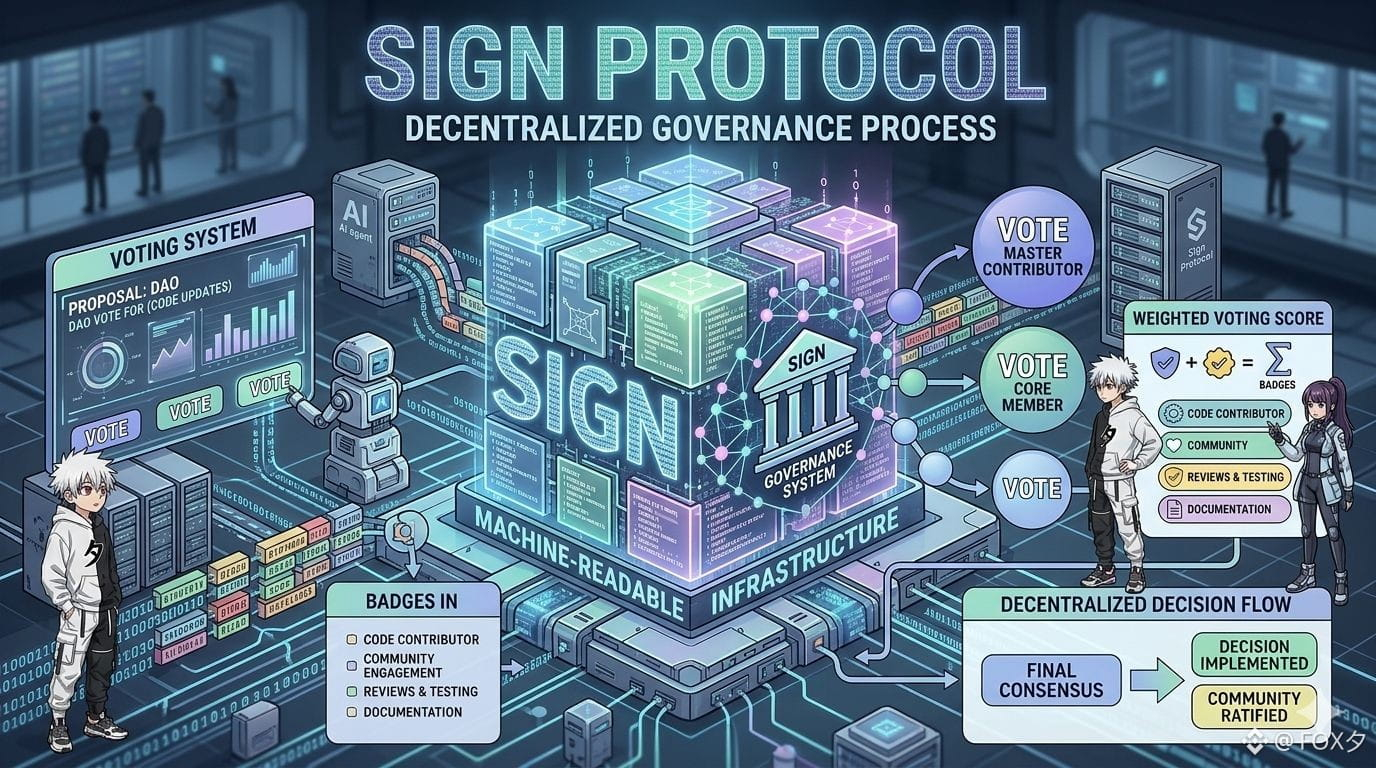
There is a shift that often goes unnoticed, yet its impact is becoming increasingly widespread: digital identity is now less frequently read by humans and more often processed by machines. In an ecosystem filled with automation, APIs, and interconnected systems, SIGN is evolving from something visual into something structural, designed to be understood by systems, not merely seen by users.
Recent developments show that SIGN is now widely used in the context of machine readability. This means that credentials tied to SIGN are no longer just presented as information, but as data that can be directly processed, verified, and utilized by various systems without manual intervention. This creates a level of efficiency that was previously difficult to achieve, especially in scenarios requiring high speed and accuracy.
What’s particularly interesting is how this shift is changing the way SIGN is designed. It is no longer focused on aesthetics or visual form, but on consistent and interoperable data structures. SIGN becomes a kind of “technical language” that enables different systems to understand identities and credentials without the need for reinterpretation.
In practice, this can be seen in how SIGN is used to automate various processes, from accessing services to validating participation within an ecosystem. Systems no longer need to “ask” or “re-verify,” because SIGN already carries sufficient information to enable immediate decision-making.
On a deeper level, this marks a transformation in the relationship between humans and systems. As SIGN becomes increasingly machine-readable, much of the trust process shifts from the human domain to the realm of algorithms. Decisions are no longer based on perception, but on structured, verifiable data.
At the same time, this also demands a higher level of accuracy and consistency. Because systems operate automatically, even small errors in the structure of SIGN can have significant consequences. This makes the design and implementation of SIGN increasingly critical, even if it often remains invisible to end users.
What is becoming evident is how SIGN is gradually turning into part of an invisible infrastructure that powers digital interactions. It no longer appears on the surface, but works behind the scenes, ensuring that systems can seamlessly understand one another without friction.
@SignOfficial #SignDigitalSovereignInfra $SIGN
