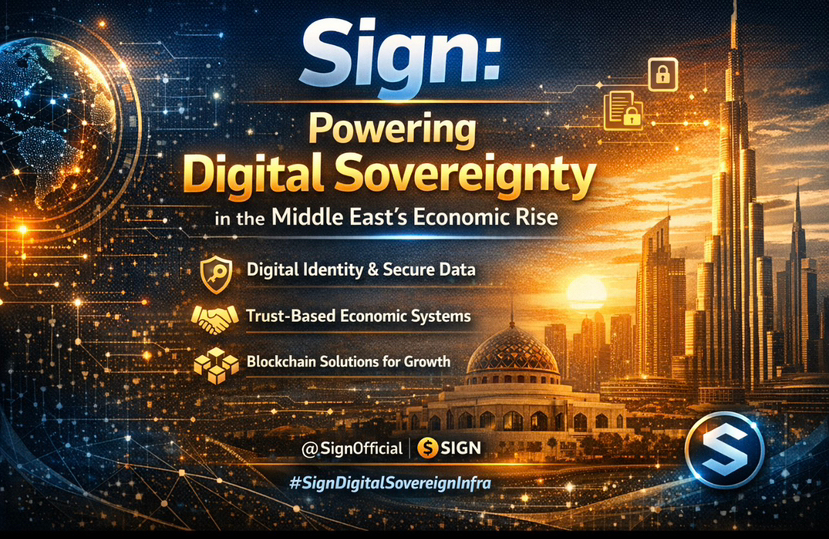
The global race for digital sovereignty is accelerating—and one region that is moving with remarkable speed is the Middle East. From the UAE to Saudi Arabia, governments are actively investing in next-generation infrastructure that can support digital identity, secure data ownership, and transparent economic systems.
But here’s the key question:
What powers this transformation behind the scenes?
This is where Sign enters the picture.
Sign is not just another blockchain project—it represents a foundational layer for digital sovereign infrastructure. In simple terms, it enables governments, enterprises, and institutions to build systems where trust is programmable, verifiable, and independent.
In regions like the Middle East, where large-scale economic diversification plans (such as Vision 2030) are already in motion, infrastructure like Sign becomes critically important. Why? Because the future economy is not just about oil or real estate—it’s about data, identity, and digital coordination.
With Sign, we are looking at a framework that can support:
• Secure digital identity systems
• On-chain verification of documents and agreements
• Transparent governance mechanisms
• Cross-border economic collaboration without friction
This is exactly what emerging economies need to scale efficiently while maintaining sovereignty over their digital assets.
Now let’s talk about the role of $SIGN.
The token is not just a speculative asset—it is the core utility that powers the ecosystem. As adoption grows, $SIGN could play a key role in:
• Network validation and security
• Access to infrastructure services
• Incentivizing participation across institutions and developer
And here’s where things get interesting…
The Middle East is uniquely positioned to adopt such infrastructure faster than many traditional markets. With strong government backing, capital availability, and a clear push toward digital transformation, the region could become a global leader in blockchain-based sovereign systems.
If Sign successfully integrates into these frameworks, it won’t just be another project—it could become a critical layer of future economies.
From an investor perspective, this is where long-term thinking matters. Projects tied to real-world infrastructure tend to have stronger staying power compared to hype-driven narratives.
So instead of asking:
“Is this the next short-term pump?”
The better question is:
“Is this infrastructure that nations could rely on in the next decade?”
Sign is building in that direction.
And if adoption aligns with vision, $SIGN could become one of the most important tokens in the digital sovereignty narrative.
The shift has already begun. The only thing left is to watch who leads it.
@SignOfficial $SIGN #SignDigitalSovereignInfra