
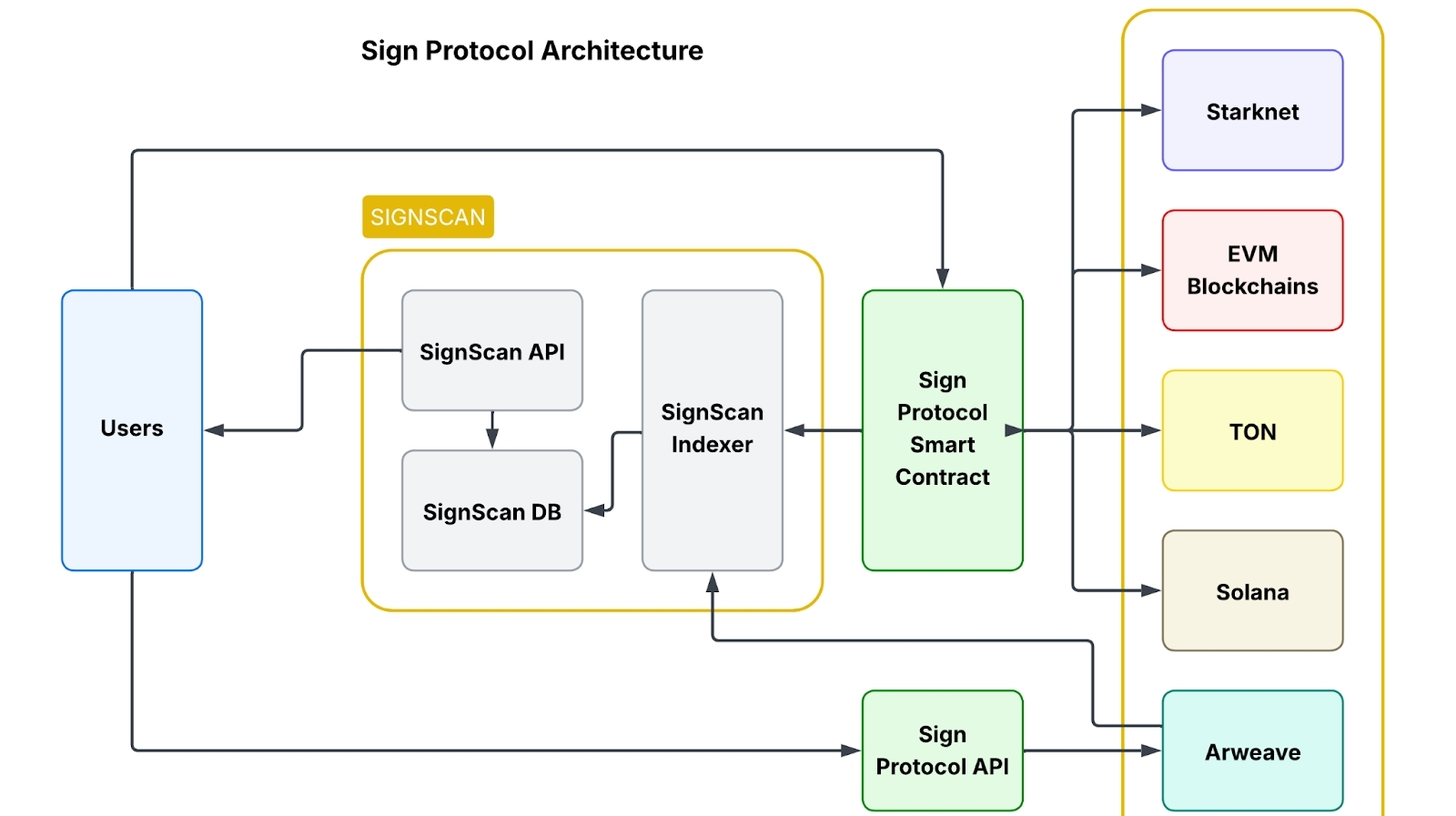
At the starting point of the architecture are the users. These users connect to the system through the SignScan platform, which acts as the interface that processes requests and provides data insights. Inside SignScan, there are three main components: the SignScan API, SignScan Database, and the SignScan Indexer. The API handles requests coming from users, allowing them to access trading signals, protocol data, or transaction details. The database stores structured information, while the indexer continuously collects and organizes blockchain data so it can be accessed quickly.
Once the data is processed, it connects to the Sign Protocol Smart Contract, which acts as the core engine of the system. Smart contracts are essential in blockchain environments because they automate verification and execution without relying on centralized control. In the case of the $SIGN USDT protocol, this smart contract helps validate signals, manage on-chain actions, and ensure transparency in how data and transactions are handled.
Another important aspect of this architecture is its multi-chain connectivity. The $SIGN Protocol interacts with several blockchain ecosystems, including Starknet, EVM-compatible blockchains, TON, and Solana. This cross-chain capability allows the protocol to gather signals and transaction data from different networks, making it more powerful and flexible for traders and analysts. By supporting multiple chains, the system reduces dependency on a single blockchain and increases the reach of the protocol.
Additionally, the system integrates with Arweave, which is used for decentralized data storage. Through the $SIGN Protocol API, important records and protocol-related data can be stored permanently on Arweave, ensuring immutability and long-term accessibility. This is especially valuable for maintaining transparent historical records of signals and transactions.
Overall, the Sign USDT Protocol architecture demonstrates a well-structured ecosystem where users, data indexing, smart contracts, and multi-chain infrastructure work together. The combination of SignScan tools and cross-chain blockchain integration makes the system scalable, transparent, and efficient for modern crypto trading and signal verification