

When i think about the potential of decentralized technologies, i often return to the same question: How can we establish trust in a system that thrives on decentralization? In a space where transparency is championed but privacy is often sacrificed, blockchain has yet to fully reconcile these two needs. Mai khud dekh rha hu.This is where Sign Protocol shines. It’s not just about creating a secure system; it’s about creating a system where trust, privacy, and scalability coalesce. The more I dig into the technical underpinnings of Sign, the more I see how this project offers real solutions to real problems. It’s a new frontier, one I believe can be a pivotal step in blockchain’s journey toward mainstream adoption.
The Problem: Decentralized Trust Meets Institutional Accountability.
When i reflect on my own experience working with decentralized systems, it’s clear to me that there are two major pain points that are often overlooked: trust and compliance. Blockchain promises transparency, but when it comes to real-world applications, how do we ensure that the systems we rely on are both trustworthy and compliant with institutional requirements? That’s where Sign Protocol comes in, offering a new framework that addresses the tension between decentralization and institutional accountability.
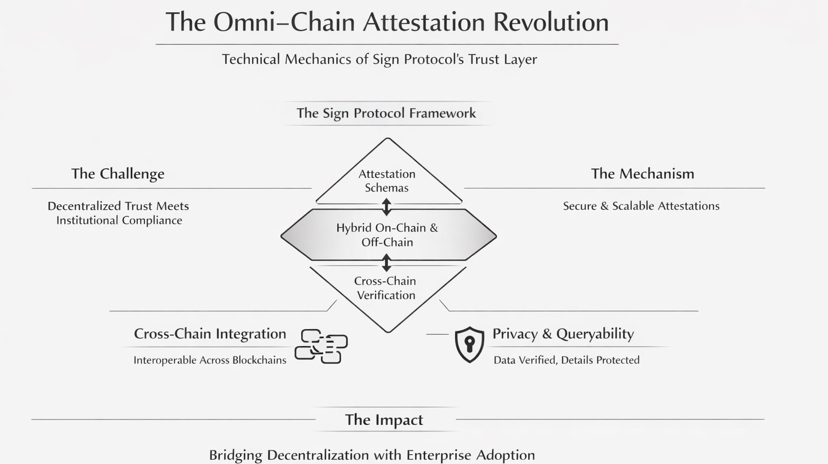
The thing is, i have seen countless projects try to tackle these challenges, but most of them fall short. They either prioritize decentralization at the cost of compliance, or they focus too much on centralized trust, undermining the very principles that blockchain stands for. Sign Protocol doesn’t make these trade-offs; it embraces both worlds. Through its unique implementation of attestations and its hybrid on-chain/off-chain data structure, it’s taking trust across blockchains to a new level.
The Mechanics of Sign Protocol’s Attestation System.
Let me take a step back and break down how this works, because it’s the technical design that sets Sign apart. At the heart of Sign Protocol is the concept of attestations—v verified claims that are cryptographically signed to confirm their authenticity without revealing sensitive data. These attestations are structured using schemas, a format that ensures the integrity of the data being verified. Whether it’s for personal identity or complex financial transactions, the schema dictates the rules under which the data can be validated, making the entire process both verifiable and standardized.
But here’s the kicker: Sign doesn’t stop at just creating secure attestations. It takes this a step further by implementing a hybrid data storage model, where sensitive data is stored off-chain, while the proofs that verify this data are kept securely on-chain. This hybrid approach is a game-changer, and I’ve seen how it solves one of the biggest bottlenecks in blockchain scalability. By keeping large, sensitive datasets off-chain, we maintain both the performance and privacy of decentralized applications, without sacrificing the transparency that blockchain guarantees.
This isn’t a theoretical solution; it’s a practical one. It directly addresses the scaling problems that arise when trying to verify data in decentralized systems, without making it a trade-off between security and speed.
Cross-Chain Verification: The Omni‑chain Attestation
The next evolution in Sign’s technical framework is cross-chain verification. Blockchain ecosystems are notorious for being isolated from each other, meaning that data from one chain often cannot be easily validated or referenced by another. For blockchain to live up to its potential, we need interoperability, but achieving this has always been tricky. I’ve seen too many solutions that fail either because they’re too centralized or because they’re inefficient.
Sign Protocol’s omni-chain attestation overcomes these issues by creating a universal framework for attestation that works across multiple blockchains.
Now, this is crucial because it means data can be verified and referenced across different ecosystems, without losing the privacy or security features of each individual chain. Whether you’re dealing with an Ethereum-based smart contract or a Cardano-based identity system, Sign’s cross-chain framework provides a common ground for trust and verification.
For developers, this opens up massive possibilities. Instead of dealing with the fragmentation of the blockchain ecosystem, you can now design cross-chain applications that work seamlessly and securely. What I love about this is that it removes a major roadblock to innovation.
You’re no longer restricted to working within the siloed limitations of a single blockchain; you can leverage the strengths of multiple chains, each contributing its unique advantages.
Privacy and Queryability: Walking the Fine Line
Now, privacy is always a tricky subject in blockchain systems. On one hand, we have the need for transparency. On the other, we need to respect user privacy and maintain confidentiality. This is where Sign Protocol’s hybrid system stands out. It strikes a delicate balance between queryability and privacy.
What really struck me when looking into Sign’s approach is how it ensures that data can be queried and validated without revealing sensitive details. It’s a sophisticated approach to query privacy. Users and institutions alike can query attestations to verify claims or actions, but they don’t need to expose private information like transaction history or personal identifiers to do so.
This is crucial for enterprise adoption. From my perspective, it’s the small details like this the way Sign navigates the privacy vs transparency tension that make it stand apart from other projects. Institutions, particularly in regulated industries like finance or healthcare, require both compliance and confidentiality. Sign meets that need head-on by allowing transparency where needed, without sacrificing privacy.
Why It Matters: A Forward-Looking Perspective
The potential of Sign Protocol goes far beyond its technical features. It’s changing the way we think about trust in decentralized systems, and I genuinely believe it’s a blueprint for how blockchain technology can evolve. We’re at a point where blockchain has shown us its power, but it’s clear to me that the future lies in the integration of decentralized systems with the real world..where compliance ,scalability and privacy must work hand in hand.
In practice, i see Sign leading the charge in making decentralized systems not just useful, but adoptable. For builders, it opens up new horizons, enabling them to create solutions that are both innovative and compliant. For enterprises, it offers a bridge to trust across chains and ecosystems. And for the broader blockchain community, it offers a vision of a world where data is verifiable, private and interconnected, unlocking the true potential of blockchain across industries.
T the real challenge will be expanding this model. We will need to continue pushing for even more integration with traditional systems, ensuring that decentralized technologies can scale globally and meet institutional demands. But what i see here is genuine progress—and Sign is right at the forefront of this next revolution in blockchain technology.