

Let’s start with the truth. When I first saw the phrase "Sovereign Infrastructure" slapped onto Sign Protocol, I didn't feel inspired. I felt tired.
I’ve spent four years deep in the crypto trenches, and if there’s one thing this industry excels at, it’s using language that is significantly larger than its actual utility. We’ve seen a thousand "Ethereum Killers" and ten thousand "Revolutionary Protocols" that turned out to be nothing more than a basic database with a token attached. So, I observe this world with a heavy dose of cynicism. My initial thought? “Oh, look, another project trying to sound like a government department to pump a valuation.”
The marketing felt overblown. The term "Sign" sounded too simple, while "Protocol" sounded too ambitious. I didn't trust the buzz. I saw the early hype and thought: “If this is just a digital signature, we’ve had those since the 70s. If it’s just EthSign with a new coat of paint, why do I care?”
But here is where my perspective shifted. In this space, the real Alpha isn't found in the Telegram groups; it’s found in the boredom of documentation. When I stopped looking at the Twitter threads and started looking at the architectural logic, I realized I wasn't looking at a "product." I was looking at a structural correction for the entire internet.
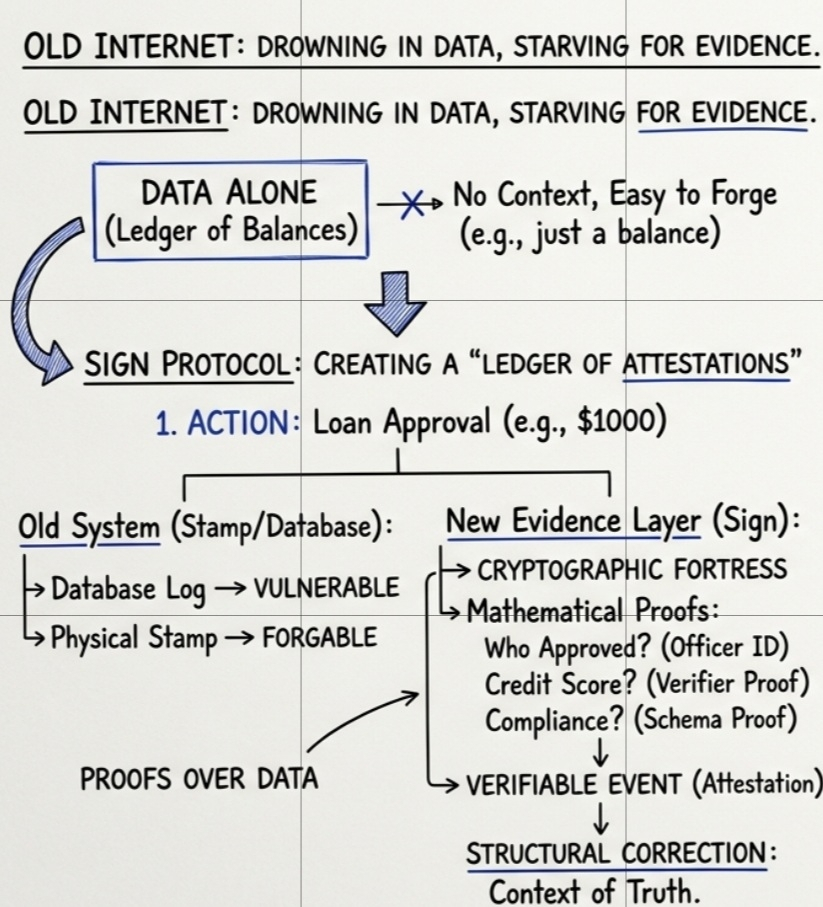
The Turning Point: The "Evidence Layer"
The real inflection point for me happened when I stopped treating Sign as a "signature tool" and started seeing it as an Evidence Layer.
There is a profound difference between data and evidence. The internet is drowning in data, but it is starving for evidence. I observe that in our current digital economy, we have no way to prove the "Context of Truth." If a bank approves a loan, we see the transaction. But why was it approved? Who checked the credit score? Which version of the regulatory compliance code was active at that exact millisecond?
Previously, Sign (as EthSign) felt like a point-solution—a way to sign a PDF on-chain. Fine, but niche. Now, the project is being pitched as the Sovereign Infrastructure for Money, Identity, and Capital. This isn't just a rebrand. It’s a realization that for blockchain to actually touch the "Real World"—the world of governments, massive supply chains, and legal systems—it needs more than just a ledger of balances. It needs a ledger of Attestations.
Sign Protocol has positioned itself as the underlying fabric that proves who did what, under what rules, and with what authority.
The Difference Between a "Tool" and a "System"
This is a nuance that most people miss, but it is deeply important to my view. Most crypto projects are "Tools." A DEX is a tool for swapping. A bridge is a tool for moving assets. But a "System" is something different. A system is an environment where multiple tools can operate under a shared logic.
Sign has transitioned from being a product to an integrated ecosystem for evidence management. When I look at the workflows they are building—audit trails, compliance schemas, and decentralized verification—I see something that can actually survive inside a government bureaucracy.
Governments don't care about "decentralization" for the sake of philosophy. They care about Verification and Accountability. They need to know that if a citizen claims a digital ID, that ID was issued by a specific officer, verified by a specific database, and hasn't been tampered with since. Sign provides the "Schema" for this. It’s not just "trust me, it’s on the blockchain." It’s "here is the mathematical proof of the entire decision-making chain."
The Core Philosophy: Proofs Over Data
The crisis of the modern state is a crisis of proof.
In the old world, we trusted the "Stamp." If a document had a physical seal from a ministry, it was true. But in the digital age, stamps are easily forged, and databases are easily hacked. I care about the fact that we are moving toward a world where "Truth" is no longer a matter of opinion or authority, but a matter of mathematical assurance.
Sign Protocol isn't just about signing a document; it’s about creating a Verifiable Event:
Who approved the budget?
Who rejected the visa?
Which specific law was applied to this transaction?
Sign wants to be the "System of Record" for these events. It turns the "Boring" parts of administration—the logs, the archives, the approvals—into a cryptographic fortress. This is why the project suddenly feels "real" to me. It’s not trying to disrupt the government; it’s trying to provide the government with the only tool that can save it from a total collapse of public trust.
From Theory to Administrative Reality
Most crypto projects die because they can't answer the "How?" How does a bank use this? How does a regulatory body audit this?
Sign started speaking the language of Workflows and Audit Trails. This is the "Street Language" of power. Power doesn't care about "Web3 Social"; power cares about Compliance. By focusing on Schema-based Attestations, Sign has built a bridge. Instead of saying "replace your system with ours," they are saying "anchor your system’s truth in ours." This moves the project from a theoretical whitepaper to an administrative reality.
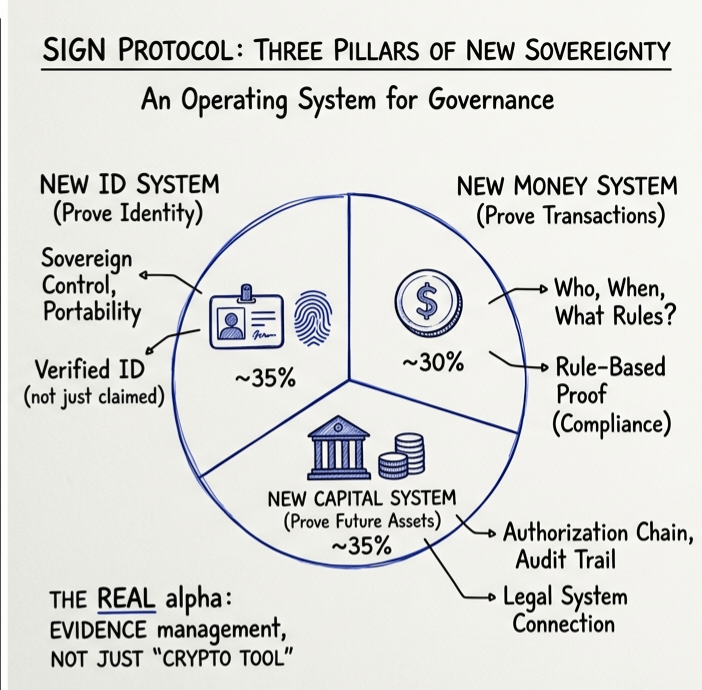
The Three Pillars of the New Sovereignty
I look at the way Sign has divided its architecture, and it reflects a deep understanding of how society functions. They’ve broken it down into:
New Money System
New ID System
New Capital System
Why these three? Because these are the three levers of Sovereignty. If you control the ID, you control the people. If you control the money, you control the movement. If you control the capital, you control the future. By acting as the Evidence Layer for all three, Sign is trying to be the "Operating System" for the next century of governance.
The "Hidden" Truth: Revealing Our Fragility
Sign doesn't create trust; it reveals how little trust we actually have. In the crypto world, we love to use the word "Trustless." It’s a beautiful lie. We aren't trustless; we are just constantly, exhaustively, and inefficiently checking each other's work.
I observe that if I prove my creditworthiness to a landlord, that proof dies the moment I leave his office. It doesn't travel. It doesn't accumulate. I have to prove it all over again to the next person. Sign Protocol’s real innovation is a Structural Correction. It’s trying to make "Proof" portable. If our proofs are sovereign and portable, we are free.
The Risk: The Crystalline Bureaucracy
As a researcher, I must be honest. There is a dark side. If we build a world where every approval and "event" is permanently anchored, we lose the "Right to Forget."
If a system remembers every mistake with mathematical certainty, we risk creating a "Crystalline Bureaucracy"—one so rigid it can never be reformed. The question isn't "Can we verify?" We know we can. The question is: "What is worth verifying?" If the rules of the Sign Protocol are captured by the same old elites, then we’ve just built a more efficient cage.
The "Aha!" Moment
I didn't get convinced by a price chart. I got convinced because Sign started describing the "Boring Details" with terrifying clarity. They aren't talking about "Mooning." They are talking about Archiving, Schemas, and Attestation Logic. My deep perspective is that the value of Sign won't be realized during a bull market when everyone is happy. It will be realized during a Legal or Financial Crisis. When a trillion-dollar DAO or a nation-state needs to prove "Who authorized this?" and the only answer that matters is a cryptographic proof from the Sign Protocol.
We are shifting from "Trust in Institutions" to "Trust in Evidence." Sign isn't just building a protocol; it’s designing the logic for a world where "What Happened" is no longer a matter of debate, but a matter of math.
$SIGN @SignOfficial #SignDigitalSovereignInfra
