
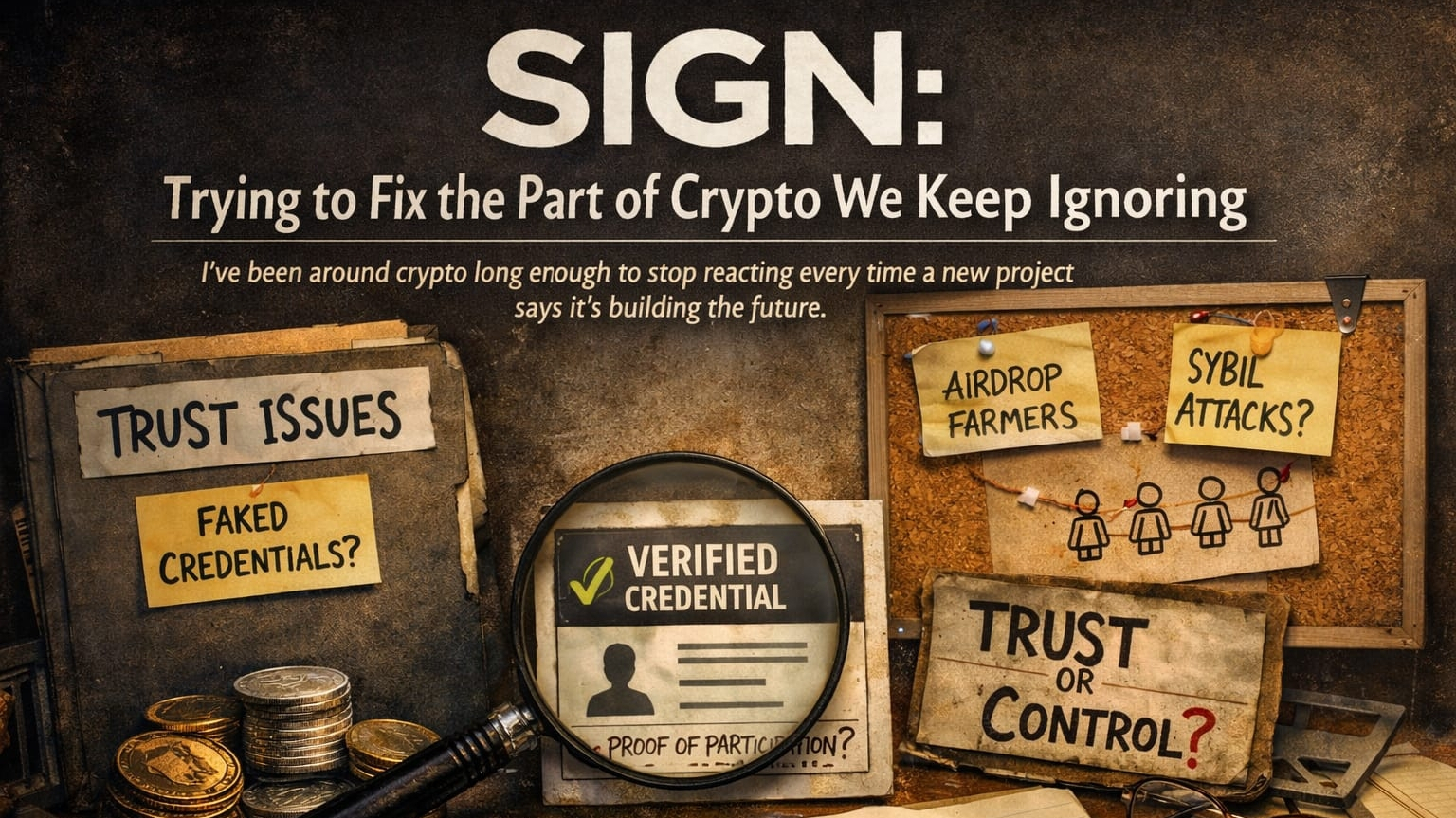
I’ve been around crypto long enough to stop reacting every time a new project says it’s building the future.
Most of the time it’s the same pattern. A new token, a recycled idea, a few big words about coordination or intelligence or ownership, and then the market moves on to the next thing before anything real gets tested.
That’s probably why SIGN caught my attention in a quieter way.
Not because it feels revolutionary.
Just because it seems to be looking at a part of crypto that still feels unresolved, even after all these years.
For all the talk about trustless systems, crypto still has a pretty messy relationship with trust.
Not code-level trust. That part people talk about endlessly.
I mean the more ordinary kind.
How do you know someone actually contributed to something?
How do you know a wallet belongs to a real participant and not just another farmer passing through?
How do you distribute tokens in a way that doesn’t immediately get distorted?
That’s where SIGN starts to feel a little different.
It’s focused on credential verification and token distribution, which sounds dry at first, but the problem underneath it is pretty real.
A lot of crypto still runs on shallow signals.
Wallet activity gets treated like reputation.
Participation gets reduced to clicks.
Communities talk about fairness, but when it’s time to distribute value, things often get chaotic fast.
You see it with airdrops all the time.
The wrong people get rewarded. The right people get missed. Farmers show up early, extract what they can, and disappear. Then everyone acts surprised, even though this has happened over and over again.
So the basic idea behind SIGN is not hard to understand.
It’s trying to create a way for credentials to actually mean something on-chain, and then use those credentials in practical situations like token distribution.
That doesn’t magically solve anything.
But it does at least start from a real point of friction.
Because one of the awkward truths in crypto is that distribution is still mostly broken.
People talk a lot about decentralization, but deciding who gets access, who gets rewarded, and who counts as a genuine participant is still incredibly subjective. Either teams make those decisions quietly behind the scenes, or they outsource them to messy wallet-based heuristics that can be gamed in a weekend.
Neither option feels great.
SIGN seems to sit in that uncomfortable middle ground.
It’s not pretending identity and reputation don’t matter.
But it’s also not fully escaping the old crypto problem, which is that the moment you start verifying people or credentials, you introduce new questions about power.
Who gets to issue the credential?
Who decides what counts?
Who gets excluded?
That’s the part I think people should stay honest about.
Because systems like this always sound clean in theory. In practice, they depend on institutions, communities, or platforms behaving in good faith. And crypto, for all its ideals, has never been especially good at avoiding social power just because it moved things onto a chain.
Still, I think there’s something worthwhile here.
Mostly because SIGN is dealing with a real-world mess instead of inventing a new fantasy.
The industry has spent years building rails for trading, looping, staking, and speculating. But the layer around proof, contribution, and legitimacy still feels underdeveloped.
That matters more than people admit.
If crypto wants to become something broader than a market for rotating narratives, it probably needs better ways to recognize who actually did something, who belongs in a community, and who should receive value from a network.
That’s not a glamorous problem.
It’s slow, political, and easy to get wrong.
Which is probably why it’s more interesting than most of the shiny things people talk about.
At the same time, I wouldn’t romanticize it.
If credentials become valuable, people will try to game them.
If token access depends on verification, fake verification markets will appear.
If certain issuers become trusted, those issuers gain influence.
That’s just reality.
So I don’t look at SIGN and see some clean answer to digital trust.
I see an attempt to work on a hard, slightly unglamorous problem that crypto has mostly danced around for years.
That may or may not lead anywhere.
A lot of projects built around identity, reputation, or attestations have struggled because users don’t really care until incentives appear. And once incentives appear, the system gets attacked.
So yes, there’s real tension here.
But that tension is also why it’s worth watching.
Not because SIGN is guaranteed to win.
Just because it’s operating in a part of crypto that still feels unfinished, and maybe more important than another round of market theater.
It could end up being useful infrastructure.
It could end up as another well-meaning experiment that never really escapes the edge cases.
Either way, the underlying problem isn’t going away.
And that alone makes it more interesting than most of what passes for a narrative in this space.