
I’ve lost count of how many times I’ve had to “prove” the same thing in slightly different ways. Join a platform, connect a wallet, sign a message. Move to another app, do it again. Sometimes it’s identity, sometimes it’s eligibility, sometimes it’s just confirming I’m the same user I was five minutes ago.
Each system has its own format, its own rules, its own way of asking the same question.
At first, it just feels like friction. Small, tolerable, part of the process. But when it repeats across enough places, it starts to feel less like individual inefficiencies and more like a lack of coordination.
At that moment, I realized the issue isn’t just that systems don’t share data. It’s that they don’t share meaning. One platform’s “verified” isn’t automatically understandable to another. The structure behind the proof doesn’t translate.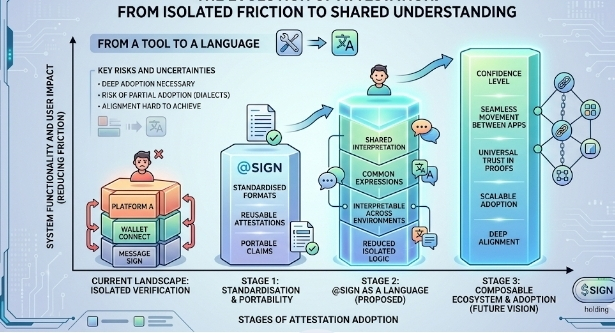
That’s where I keep circling back to @SIGN. Not because it fixes everything outright, but because it’s trying to define how these proofs can exist in a more portable way.
If i break it down simply, the idea is that an attestation becomes something reusable. Instead of proving something from scratch every time, you carry a structured claim that other systems can read and accept. Not raw data, but a statement backed by verification.
Initially, I thought that was enough. Standardize the format, make it easier to move proofs around, and the problem should shrink.
But the more I think about it, the more it feels incomplete.
Because standardization alone doesn’t guarantee understanding.
What I find interesting is that most systems don’t fail because they lack data. They fail because they interpret it differently. Even if two platforms receive the same proof, they might not treat it the same way unless they also share the logic behind it.
Upon reflection, that’s where the idea shifts for me. @SIGN shouldn’t just aim to be a system that stores or transfers attestations. It should aim to behave more like a language.
A language doesn’t just carry information, it carries structure, context, and shared interpretation. It allows different parties to not only receive a message, but understand it in the same way.
If attestations become that kind of shared language, something changes. Applications stop building isolated verification logic and start relying on common expressions. A proof isn’t just valid, it’s interpretable across environments.
At that point, composability starts to feel more natural. Different apps, different chains, even different use cases could coordinate without constantly redefining what a claim means. The user experience becomes less about repeating actions and more about moving through systems that already understand each other.
But I don’t think this shift is easy. At least not yet.
Because becoming a “language” is very different from becoming a tool. Tools can exist in isolation. Languages need adoption at a deeper level. They require agreement, consistency, and time. And in a space where new standards appear constantly, that kind of alignment is hard to achieve.
There’s also the risk of partial adoption. Some platforms might use the format, others might adapt it, and some might ignore it entirely. In that case, instead of one shared language, you end up with dialects that don’t fully connect.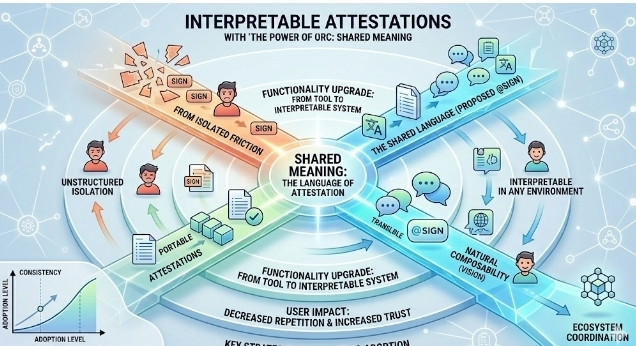
Right now, I’m still in observation mode. I hold a small amount of $SIGN, mostly to stay engaged with how it evolves. But I’m not fully convinced. I’ve seen too many systems try to become foundational and end up as just another layer.
But I keep coming back to the same thought.
If @SIGN succeeds as a system, it will be used.
If it succeeds as a language, it will be understood.
And the real test won’t be technical performance. It will be whether different applications can interpret the same attestation in the same way without needing custom logic every time.
The moment I can move between platforms, present a proof once, and trust that it carries the same meaning everywhere… that’s when I’ll know this worked.
Until then, it still feels like it’s deciding what it wants to be.
@SignOfficial #SignDigitalSovereignInfra
