

Last night, a few hours after a quiet snapshot window closed for a credential distribution campaign, I went deep into @SignOfficial’s documentation and replayed a simulation.
It didn’t break.
But it didn’t feel right either.
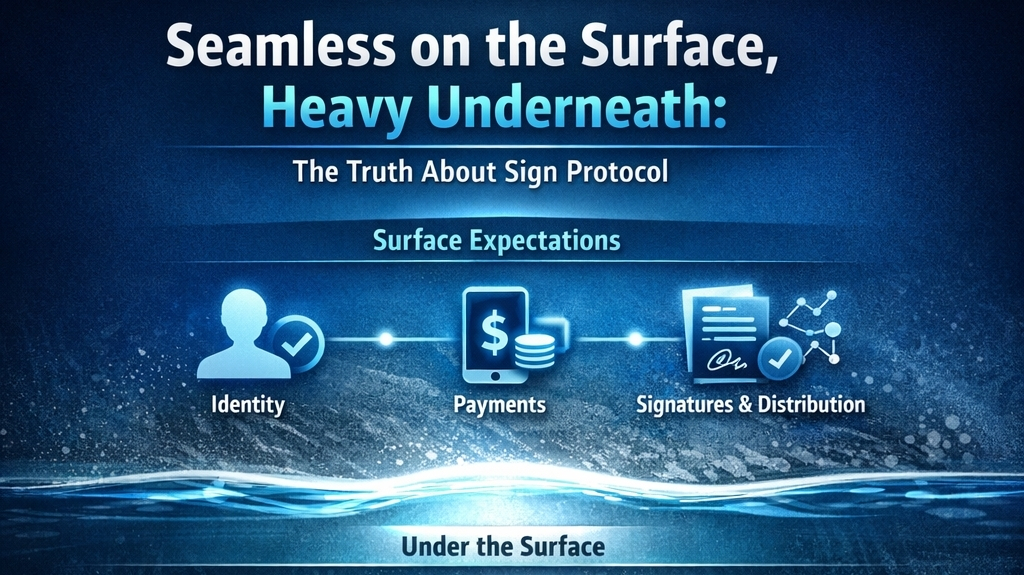
The idea still feels inevitable. A single super app where identity, payments, signatures, and distribution live together. One interface. No friction. It sounds like the final form of Web3 infrastructure.
Something we’ve been moving toward for years.
But when you step inside the system, the elegance starts to bend.
I followed a basic credential anchoring flow. Nothing complex. A 2 MB credential stored off chain, then hashed and anchored on chain.
Simple.
But the numbers tell a different story.
About $0.40 to pin the data. Another $0.30 in gas, even on testnet. Nearly $1 for one verifiable record.
That’s easy to ignore once.
Even a hundred times.
But scale it. Thousands of users. Constant updates. Multi chain distribution.
Now it’s not just cost.
It’s weight.
What stood out wasn’t the price. It was the loop.
Every update means a new hash. A new anchor. Another payment.
Again and again.
That doesn’t feel like identity. It feels like versioning pressure forced onto something that should move naturally.
Then there was a moment I couldn’t ignore.
A transaction didn’t fail. It didn’t revert.
It just… paused.
The indexing layer lagged behind, and for a few seconds, the system didn’t fully recognize its own state.
It caught up quickly.
But that gap matters.
Because the vision assumes something very different. Instant awareness. Systems that react in real time. AI that can read state and act without delay.
But underneath, the system still moves in steps.
And even small delays create friction.
At scale, that friction stacks.
The deeper I went, the clearer it became.
This isn’t a layered system.
It’s a loop.
The economic layer drives usage through incentives, but usage increases cost.
The technical layer splits data across on chain anchors and off chain storage, but that split introduces latency.
The identity layer automates trust through attestations, but identity keeps changing.
And every change restarts the loop.
Cost. Anchor. Index. Repeat.
When you compare this to more focused systems like or , the contrast is clear.
They optimize for one thing.
Coordination. Intelligence.
Sign Protocol is trying to unify everything.
And that’s what makes it powerful.
But also fragile.
Because every inefficiency gets amplified.
Here’s the honest tension I keep coming back to.
The surface already feels like the future.
AI driven compliance. Automated distribution. Clean user experience.
It feels ready.
But the foundation still carries old constraints. Storage splits. Indexing delays. Costs that don’t disappear, only shift.
So you end up with something strange.
A system that looks seamless from the outside, but underneath is still negotiating with itself.
And the real question isn’t whether it works.
It’s whether it works invisibly.
If all this complexity gets abstracted away, most builders won’t see it. They’ll just build on top and trust the system.
But what happens when that trust depends on things that aren’t always consistent?
Costs that change.
State that lags.
Data that arrives just a little late.
Will builders be empowered by that abstraction?
Or slowly boxed in by assumptions that only hold true most of the time?
@SignOfficial #SignDigitalSovereignInfra $SIGN
