I used to think on-chain money was some complIcated beast… layers on top of layers, smart contracts doing magic, all that stuff. but recently, something just clicked for me and I can’t unsee it now.
money is just signed claims.
That’s it.
once I started lookIng at it this way, everything from Stablecoins to L2s felt way less confusing and way more logIcal. every balance you see? It is just a claim. every transfer? another claim. And what makes it “real” is not the chain itself it is the signature behind it. Who signed It, whether it is valid, whether I can verify it myself.
that part matters a lot to me. I do not like relying on blind trust. If I can verify something myself, I am always going to prefer that.
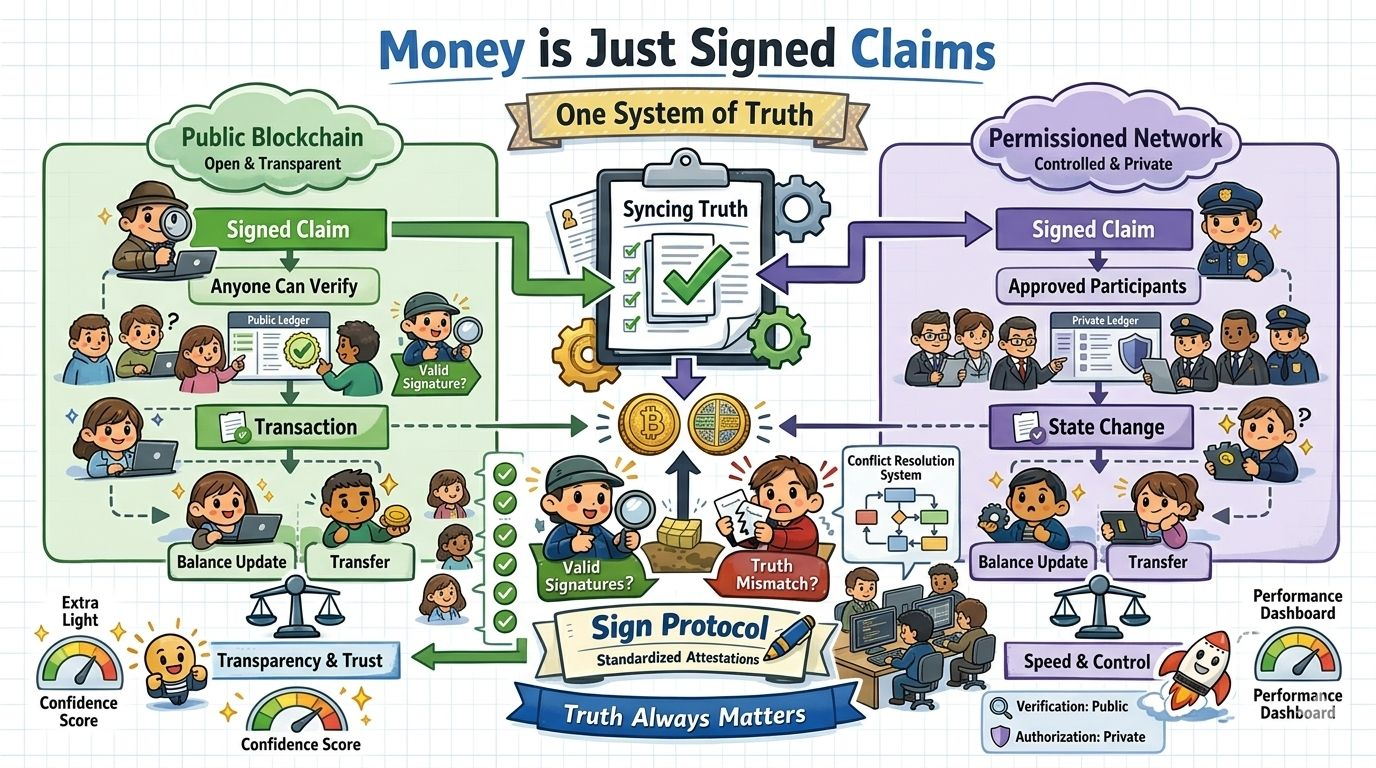
On public chains, this Idea feels almost obvious once you see it. everything is open, everything is transparent. I can lIterally go check transactions, verify signatures, trace where value moved. I do not need to believe anyone. The system shows me what is true.
but what surprised me was when I started thinking about permissioned systems… like hyperledger setups. at first I thought, okay, this is totally different. Closed system, controlled access, not the same vibe at all.
but honestly? Under the hood, it is the same thing.
still signed data.
The only difference is who is allowed to participate. not everyone can write, not everyone can read everything but every state change still comes down to someone signing off on it. A transfer is still a signed statement. A balance update is still a signed statement.
That where this whole $SIGN Sign Protocol idea started making more sense to me. It’s not trying to reinvent money or blockchains or anything flashy like that. It’s just standardizing this concept of attestations signed truths that can exist anywhere.
Public chain or private network… doesn’t matter.
Same logic.
And that consistency is powerful. It means you’re not really running two different systems you’re running one system of truth in two environments. One side is open and verifiable by anyone, the other is optimized for speed and control.
I’ve seen people get hyped about those big TPS numbers on the permissioned side like 200k+ transactions per second. I mean yeah, sounds great on paper. But I’ve been around tech long enough to know numbers are the easy part. Reality is where things break.
What I care about more is something way less flashy.
Do both sides agree on the truth?
Because if they don’t, the whole thing falls apart. It doesn’t matter how fast your system is if your data starts drifting. Even a small mismatch between public and permissioned states can mess everything up.
That’s the real challenge in my opinion not scale, not speed, but syncing truth.
And I’ve started thinking differently because of that. Instead of focusing on chains or infrastructure, I focus on signatures. I treat signatures as the actual product. The chain is just where those signatures live.
If the signatures are valid and consistent everywhere, the system works. If not, nothing else really saves it.
There is also something interesting here about performance. if you reduce everything to signed attestations, you are not doing heavy computation all the time. You are mostly verifying signatures and ordering events. that is a much lighter problem, which probably explains why those high throughput claims even exist in the first place.
Still… I would not blindly trust any system just because it is fast. I trust the one where I can verify the truth myself and see that both sides stay in sync over time.
That is why this whole approach stands out to me. It is simple, almost boring at first glance but actually kind of deep. It is not trying to rebuild everything from scratch. It is just structuring things around something fundamental.
Signed data.
and honestly, the more I think about it, the more I feel like that is what this space was always heading toward anyway. not more complexity, not more layers… just clearer ways to prove what is true.
At the end of the day, that is what I care about. not hype, not numbers, not buzzwords.
Just truth I can verify myself.

Artikel
Signed Truth: Why On-Chain Money is not Magic, It is Just Proof
Haftungsausschluss: Die hier bereitgestellten Informationen enthalten Meinungen Dritter und/oder gesponserte Inhalte und stellen keine Finanzberatung dar. Siehe AGB.