
I've been thinking about national identity systems for a while now. Not because I'm a policy nerd. Because I realized something: every country is building one, but nobody agrees on how. And the way they're building it matters more than most people realize.
There's three basic models. And none of them work perfectly. The reality is messier and more interesting than the crypto Twitter version where "self-sovereign identity" solves everything.
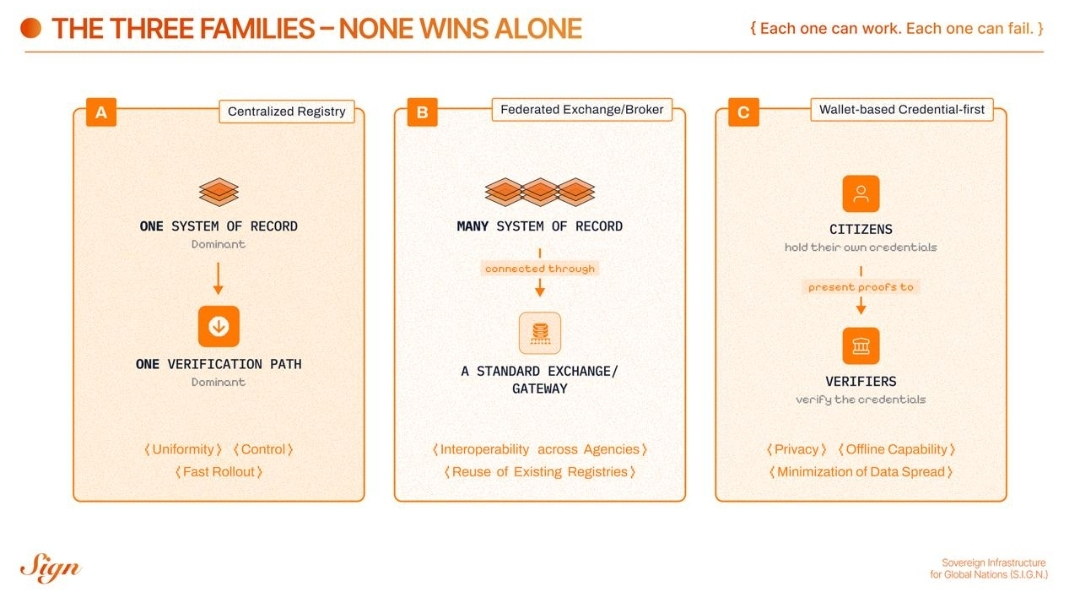
The Three Families
1. The Centralized Database Model
This is the old way. Government issues you an ID. Your data lives in a government database. Every time you need to prove who you are, the system queries that database. Simple. Efficient. Also terrifying. Because if that database gets hacked — and it will — your entire identity is exposed. Passport numbers, addresses, biometrics, everything. One breach and it's all out there forever.
Countries like India with Aadhaar use this model. It works. It's fast. But privacy is basically nonexistent. The government can see everything. So can anyone who breaches the system.
Why governments choose it: It's cheap. It's centralized. They control everything. No third parties. No complicated cryptography. Just a database with your name on it.
What it costs: Your privacy. If the database gets breached, your identity is gone. And once that data is out, you can't get it back.
2. The Federated Model
This is the "sign in with Google" version. Your identity is issued by a private company — Google, Facebook, whoever. You use their login to access government services. Convenient for citizens. Cheap for governments. But now your identity is controlled by a corporation. They decide if your account gets suspended. They decide what data to share. They decide when to turn you off.
Some countries are experimenting with this. Letting private companies handle identity verification. It's fast. It's easy. It's also giving corporations power that should belong to citizens.
Why governments choose it: It's cheaper than building their own system. Private companies already have the infrastructure. Citizens are already using it. Why reinvent the wheel?
What it costs: Sovereignty. Your identity is now controlled by a company accountable to shareholders, not citizens. If Google decides your account is suspicious, you lose access to government services. That's not a hypothetical. That's happening.
3. The Self-Sovereign Model
This is the crypto version. You hold your own credentials. You decide who to share them with. No central database. No corporate control. Just you and your keys.
Bhutan is doing this. 750,000 citizens enrolled. W3C Verifiable Credentials. Decentralized identifiers. Citizens control their own data. Sounds perfect, right?
But here's the problem. Self-sovereign identity assumes citizens can manage their own keys. They can't. Most people lose their passwords. They lose their phones. They don't understand public-key cryptography. And when you lose your keys, you lose your identity. There's no "forgot password" button for self-sovereign identity.
Why governments choose it: Privacy. Control. No central honeypot for hackers. Citizens actually own their own data.
What it costs: Complexity. Support costs. Citizens who lose their keys are locked out of everything. And the government has to have a backup system for those people anyway.
But the Integration Does Not Return a Narrow Confirmation
Here's the thing I realized. None of these models works alone. The centralized model is efficient but dangerous. The federated model is convenient but cedes sovereignty to corporations. The self-sovereign model is private but impractical for most citizens.
So what actually happens? Governments don't pick one. They build all three. Or they try to. And the integration is where it gets messy.
You have a central database for the government's records. You have federated logins for convenience. You have self-sovereign credentials for citizens who want privacy. And none of them talk to each other properly. So you end up with multiple identity systems, multiple databases, multiple points of failure. The citizen is left holding the pieces.
I've seen this happen. Not with identity specifically, but with any complex system where different groups want different things. The result is always the same: fragmentation, confusion, and nobody actually gets what they wanted.
So What Happens?
What happens is convenience wins. Always.
The self-sovereign model is beautiful in theory. But when a citizen needs to access a service quickly, they're not going to pull out their phone, open their wallet, select the right credential, do the cryptographic handshake. They're going to click "sign in with Google." It's faster. It's easier. They don't have to think about it.
And the government, seeing this, starts leaning on the federated model. Why build complex infrastructure when private companies already have it? Why deal with support calls from citizens who lost their keys when Google already handles password resets?
The self-sovereign system becomes a niche product for crypto people and privacy advocates. Everyone else uses the convenient option. And the convenient option is controlled by corporations.
And That Is How Privacy Dies. Not with Malice. With Convenience.
This is the part that keeps me up at night. We don't lose privacy because someone evil takes it. We lose it because we give it away. Because clicking "sign in with Google" is easier than managing your own keys. Because scanning your face at the airport is faster than showing your passport. Because convenience is a hell of a drug.
SIGN is building the self-sovereign infrastructure. The technology is solid. The privacy features are real. But if citizens don't use it — if governments don't mandate it — then it becomes a ghost system. Beautiful architecture with nobody inside.
The whitepaper doesn't address this. It assumes that if you build it, they will come. But that's not how adoption works. People take the path of least resistance. And the path of least resistance is handing your identity to Google.
Where SIGN Fits
SIGN's approach is technically sophisticated. Verifiable credentials. Zero-knowledge proofs. Selective disclosure. Offline capabilities. All of it works. All of it is better than what we have now.
But the adoption challenge isn't technical. It's behavioral. How do you get citizens to use self-sovereign identity when federated logins are easier? How do you get governments to mandate it when centralized databases give them more control? How do you make the privacy-preserving option the convenient option?
I don't have answers to these questions. I'm not sure anyone does. But I know that if the self-sovereign model is going to win, it needs to be easier than the alternatives. Not just more private. Easier. Because privacy alone doesn't sell. Convenience sells.
And until self-sovereign identity is more convenient than "sign in with Google," most people won't use it. They'll take the easy path. And privacy will die. Not with malice. With convenience. 😕
#SignDigitalSovereignInfra #signdigitalsovereigninfra $SIGN @SignOfficial