
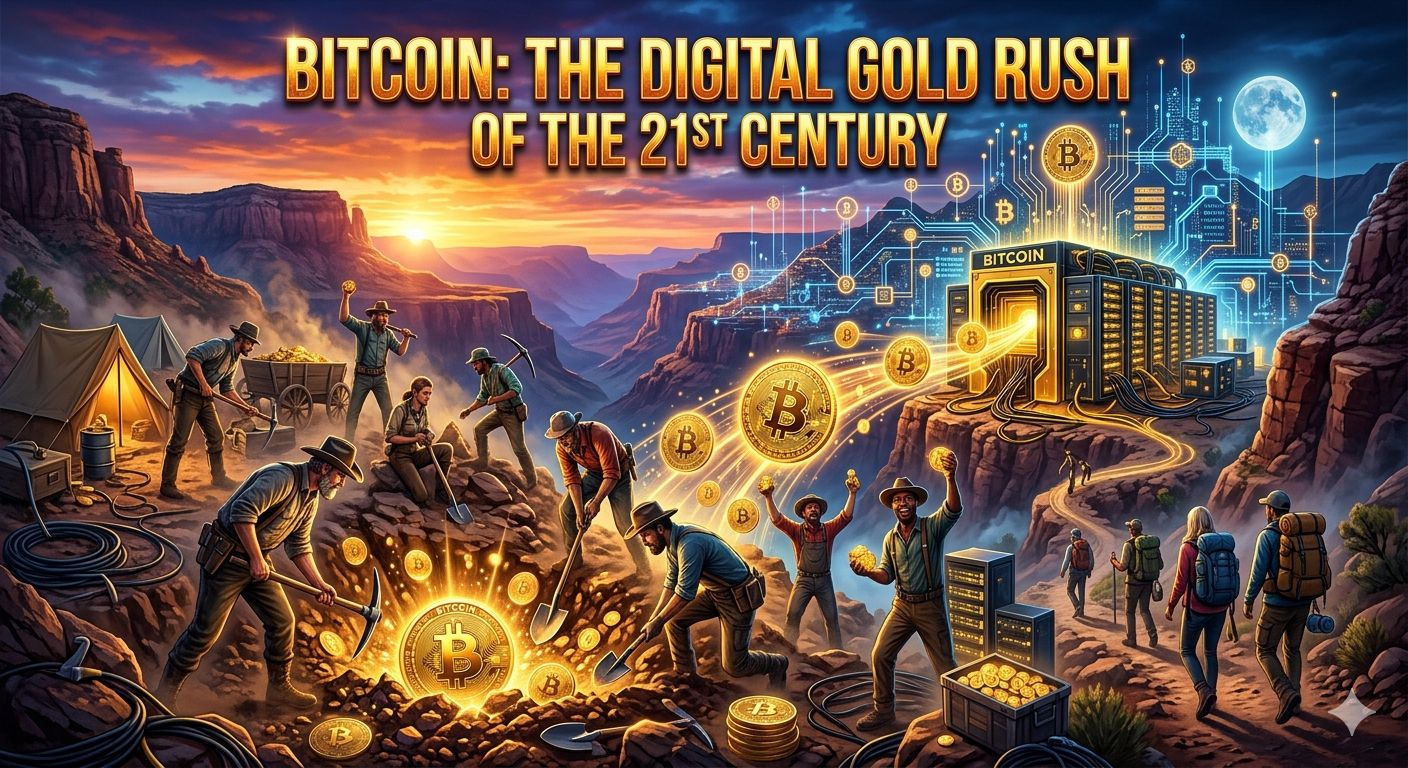
 In December 2024, Bitcoin did something that seemed impossible just a few years ago—it crossed the 100,000 threshold for the first time in history, eventually reaching an all-time high of 126,198 by October 2025 . What started in 2009 as an experimental digital currency traded for fractions of a penny has evolved into a 2.9 trillion cryptocurrency market that has captured the attention of Wall Street, governments, and everyday investors alike . But what exactly is Bitcoin, and why does it inspire such passionate—and polarized—opinions?
What Is Bitcoin?
Bitcoin (BTC) is the world's first decentralized digital currency, created by the mysterious pseudonymous figure Satoshi Nakamoto. Unlike traditional money issued by central banks, Bitcoin operates on a technology called blockchain—a public ledger distributed across millions of computers worldwide that records every transaction transparently and permanently . This decentralization means no single government, bank, or corporation controls Bitcoin. Instead, the network is maintained by a global community of users and miners who validate transactions through a process called proof-of-work .
The genius of Bitcoin lies in its mathematical scarcity: only 21 million Bitcoins will ever exist, with the final coin expected to be mined around the year 2140 . This fixed supply stands in stark contrast to fiat currencies, which central banks can print in unlimited quantities, making Bitcoin an intriguing proposition for those concerned about inflation and currency debasement.
---
The Case for Bitcoin: Compelling Advantages
1. Inflation Protection and Store of Value
With governments worldwide engaging in unprecedented monetary expansion, Bitcoin's capped supply has attracted investors seeking protection against inflation. Unlike dollars or euros that can be printed at will, Bitcoin's scarcity is programmed into its code. This "digital gold" narrative has gained traction as institutional investors increasingly view Bitcoin as a hedge against currency devaluation .
2. Financial Inclusion for the Unbanked
Over one billion adults globally have smartphones but lack bank accounts . For these individuals, Bitcoin offers a revolutionary solution: the ability to save, invest, and transfer money using just a mobile wallet app. No passport verification, no minimum balances, no banking hours—just immediate access to the global financial system. In regions with unstable currencies or limited banking infrastructure, Bitcoin can be a lifeline .
3. Speed and Cost-Effective Global Transfers
Traditional international money transfers can take days and cost substantial fees. Bitcoin enables near-instantaneous transfers anywhere in the world, often for just a few cents . Whether sending money to family across borders or paying international suppliers, Bitcoin eliminates intermediaries and their associated costs.
4. Decentralization and Censorship Resistance
Bitcoin operates outside traditional financial systems, making it resistant to government interference, account freezes, or payment censorship. This appeals to individuals in countries with capital controls, political instability, or unreliable banking systems . The network's distributed nature—spread across thousands of nodes globally—makes it remarkably resilient and virtually impossible to shut down .
5. Portfolio Diversification
Research suggests Bitcoin can enhance portfolio performance. Over the past decade, Bitcoin has shown low correlation with traditional assets like stocks (0.14 correlation to S&P 500) and bonds (0.13 correlation to high-yield bonds), potentially reducing overall portfolio volatility when added to a diversified investment mix . Some studies indicate that adding even a small Bitcoin allocation to traditional 60/40 equity-bond portfolios could have improved risk-adjusted returns over time .
6. Security and Transparency
Despite common misconceptions, the Bitcoin blockchain itself has never been hacked in its 16-year history . Every transaction is permanently recorded on the public ledger, creating unprecedented transparency. While exchanges have been compromised, the underlying technology remains secure through cryptographic protection and decentralized verification .
---
The Shadow Side: Significant Disadvantages
1. Extreme Price Volatility
Bitcoin's most notorious characteristic is its dramatic price swings. The cryptocurrency has experienced multiple boom-and-bust cycles, including a 64% decline in 2022 and drops of over 30% from recent highs . Daily price movements of 10% or more are not uncommon, making Bitcoin unsuitable for risk-averse investors or those seeking stable wealth preservation .
This volatility creates a paradox: while Bitcoin's price appreciation attracts speculators, it undermines its utility as an everyday currency. Imagine buying a coffee with Bitcoin only to realize the same amount would have bought a laptop tomorrow—this volatility discourages actual spending .
2. Environmental Impact Concerns
Bitcoin mining consumes enormous energy. According to the Cambridge Bitcoin Electricity Consumption Index, if Bitcoin were a country, it would rank as the 24th highest electricity consumer globally and 61st in greenhouse gas emissions as of mid-2025 . This energy intensity—driven by the proof-of-work consensus mechanism—has drawn criticism from environmental advocates and ESG-focused investors .
3. Regulatory Uncertainty and Government Risk
The regulatory landscape remains fragmented and evolving. In the United States, different agencies classify Bitcoin differently—the IRS treats it as property, while the SEC views certain crypto products as securities . While the current Trump administration has signaled support through initiatives like a potential national strategic Bitcoin reserve and the GENIUS Act for stablecoin regulation, future administrations could impose stricter regulations or punitive taxes . This political vulnerability represents a significant risk for long-term holders.
4. Limited Consumer Protections
Unlike traditional banking, Bitcoin offers no safety net. If you lose your private keys, send funds to the wrong address, or fall victim to fraud, there is generally no recourse—no bank to call, no password reset, and no government insurance . The irreversible nature of transactions means chargebacks are impossible, creating risks for consumers accustomed to traditional payment protections .
5. Tax Complexity
In the United States, every Bitcoin transaction can trigger a taxable event. The IRS requires declaration of cryptocurrency transactions on annual tax returns, and using Bitcoin to purchase goods or services creates capital gains tax obligations . This onerous reporting requirement complicates practical use and necessitates meticulous record-keeping of all buy and sell prices.
6. Scalability and Practical Limitations
Bitcoin transactions can be slow and expensive during network congestion. While fees sometimes remain below 1, they have spiked above 100 during peak periods . Transaction confirmation takes approximately 10 minutes on average—hardly practical for buying groceries or coffee . Despite over 15 years of development, Bitcoin remains accepted by relatively few merchants, limiting its everyday utility .
7. Deflationary Design Concerns
Bitcoin's fixed supply creates potential economic problems if it were ever adopted as a widespread currency. Without the ability to expand money supply during recessions, Bitcoin could theoretically trigger destructive deflationary spirals where consumers hoard currency rather than spend it, expecting goods to be cheaper tomorrow . This rigidity was a key reason the gold standard was abandoned—and Bitcoin shares similar limitations.
---
The Verdict: Revolutionary Technology or Speculative Bubble?
Bitcoin represents one of the most fascinating financial experiments in human history. It has created generational wealth for early adopters while destroying fortunes for those who bought at peaks. It offers unprecedented financial freedom to the unbanked while presenting daunting technical and security challenges to newcomers.
For investors considering Bitcoin, the key is understanding what you're actually buying. Unlike stocks that represent ownership in profit-generating companies or bonds backed by government taxation power, Bitcoin's value derives entirely from market sentiment and network adoption . There are no dividends, no cash flows, no intrinsic value—just supply, demand, and belief in its future utility.
As ARK Investment Management's research suggests, when measured by risk-adjusted metrics like the Sortino Ratio (which focuses on downside volatility rather than total volatility), Bitcoin has historically delivered returns that justified its volatility—averaging 76.4% annual returns against 44.1% volatility over the past 14 years . However, past performance guarantees nothing, and Bitcoin remains a high-risk asset class.
The future of Bitcoin likely depends on three factors: continued institutional adoption, regulatory clarity, and technological evolution. With spot Bitcoin ETFs now available on traditional exchanges like the NYSE, mainstream acceptance is growing . Yet the fundamental tensions remain—between decentralization and regulation, between scarcity and utility, between speculation and currency.
Bitcoin is neither purely good nor purely bad. It is a powerful tool with significant advantages for certain use cases and substantial risks that demand careful consideration. As City National Bank's Bryan Gour aptly noted, we're still in the "Ben-Franklin-tying-a-key-to-a-kite phase of crypto"—the technology is young, the implications are profound, and the future remains unwritten .
For those considering Bitcoin: Start small, understand the technology, secure your private keys meticulously, and never invest more than you can afford to lose. Bitcoin may be the future of money—or it may be a fascinating historical footnote. Either way, it's a revolution worth understanding.
---