
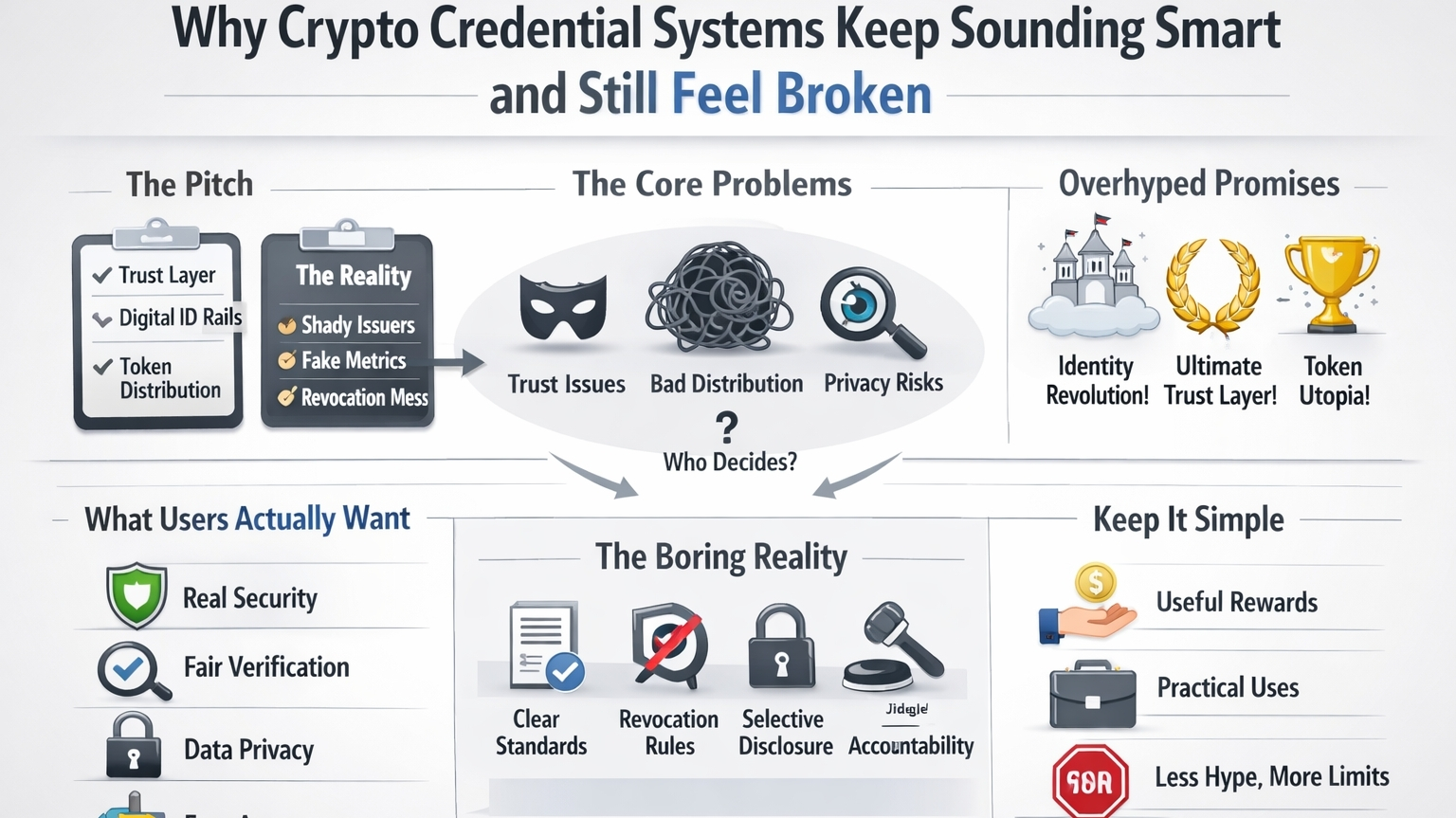
Most of this stuff sounds better in pitch decks than it does in real life. That is the problem.
You hear phrases like credential verification, trust layer, token distribution, digital identity rails, reusable attestations, and it all sounds neat for about five minutes. Then you try to picture an actual person using it, or a real project relying on it, and the whole thing starts wobbling. Fast. Because the pitch is always clean. The reality is always a mess.
The first problem is trust. Everyone keeps acting like if you put a claim onchain, sign it nicely, and wrap it in protocol language, it becomes meaningful by default. It does not. A signed claim is still just a claim. If the issuer is useless, shady, careless, or full of it, then the credential is just organized nonsense. That is the part crypto people keep trying to skip. They want the format to do the hard work. It cannot. Trust comes from who is making the claim and why anyone should believe them. Code does not fix that. It just makes the mess easier to move around.
Then you get the token distribution side, which is somehow even more annoying. The old way was already bad. Snapshot some wallets. Count some activity. Throw tokens around. Hope bots do not eat half of it. Hope whales do not dominate the rest. Hope the people farming fake engagement do not laugh at you afterward. And now the new answer is supposed to be credentials. Great. So instead of dumb wallet metrics, now we get dumb credential metrics unless the system is designed properly, which a lot of them are not. Same mess. New packaging.
And honestly, that is what gets tiring. Crypto keeps reinventing broken systems with fancier names. Airdrops became “targeted distribution.” Bad reputation systems became “portable social trust.” Centralized lists with extra steps became “decentralized identity infrastructure.” You can call it whatever you want. If normal users still have to trust random issuers, leak personal data, deal with confusing wallets, and pray they are not excluded by some invisible rule they never got to read, then the system still sucks.
That is the real issue. Stuff is built for people who like the idea of systems more than the reality of using them.
A global setup for credential verification sounds useful on paper. Sure. In theory, one group could verify something once, and another group somewhere else could reuse that proof. Less repeated checks. Less paperwork. Less manual nonsense. That part makes sense. If someone already proved they completed a course, contributed to a project, passed a compliance check, joined a program, or qualified for a grant, it would be nice if they did not have to start from zero every single time. Nobody enjoys proving the same thing ten times to ten different platforms that do not trust each other.
So yes, the idea has value. But the second you zoom in, the cracks show up.
Who decides which issuers matter?
That is the whole game right there. You can build the cleanest protocol on earth, but if nobody knows which attestations actually count, the thing falls apart. A university credential is not the same as some random Discord community badge. A compliance check from a regulated provider is not the same as a friend vouching for you onchain. A contribution record from a serious project is not the same as fake activity dressed up to look busy. So now you need issuer rankings, trust lists, standards, maybe reputation layers, maybe review systems, maybe revocation systems, maybe dispute processes. And look at that. The “simple trust layer” is suddenly not simple at all.
And revocation is where things get ugly fast. People love issuing credentials because it feels productive. Look, a thing exists now. Great. But what happens when the thing is wrong later? What happens when someone loses eligibility, gets caught cheating, leaves a role, fails a condition, or just should not have the credential anymore? You need updates. You need expiry. You need a way to pull stuff back. You need every downstream app to notice that change. Otherwise the system fills up with stale garbage that still looks valid if nobody checks closely.
This is not a side issue. It is basic. And a lot of systems treat it like an afterthought because talking about revocation is less fun than talking about “the future of trust.”
Then there is privacy. Crypto loves saying privacy matters. Then it turns around and builds systems that leave users exposed in ways that are obvious to anyone paying attention. If every credential becomes some permanent public breadcrumb, then congrats, you built a tracking machine. Maybe a very clever one. Still a tracking machine. People do not need every part of their identity, history, eligibility, and behavior tied together forever just because some protocol wanted to look composable.
This is where a lot of the hype really falls apart for me. The good version of credential systems would let people prove what matters without showing everything else. That is the actual goal. Prove you qualify. Prove you belong. Prove you passed the check. Fine. But do it without dumping your whole life onchain or creating some creepy permanent scorecard that follows you everywhere. If a system cannot do that, then it is not fixing trust. It is just making surveillance sound modern.
And token distribution based on credentials has the same problem. In theory, it should be better than just rewarding whoever had the biggest wallet or the fastest bot. Fair enough. Maybe you want to reward real contributors. Maybe you want to include offchain work. Maybe you want grants, aid, access, or governance rights to go to people who actually meet certain conditions. That is reasonable. Probably better than the random garbage a lot of projects used before.
But now you are making judgment calls. Big ones.
What counts as a real contributor?
Who gets to define legitimacy?
Which communities or institutions get to decide who is eligible?
How do people appeal bad decisions?
What happens when the criteria are biased, sloppy, political, or just plain dumb?
Because once credentials start deciding who gets tokens, money, access, or influence, this stops being some cute technical problem. It becomes governance. It becomes power. It becomes a bunch of people writing rules that affect other people and then pretending it is neutral because there is a protocol involved. It is not neutral. It never was.
That does not mean the whole idea is useless. It means people need to stop talking like a shared credential layer magically solves trust. It does not solve trust. It just gives you a way to package claims and move them around. That can still be useful. Very useful, actually. But only if people stop overselling it.
The strongest case for something like this is not that it will fix identity forever or become the one trust system for the internet or whatever dramatic slogan is trending this week. The strongest case is much simpler. It can reduce repeated verification. It can make certain kinds of contribution easier to recognize. It can help distribute tokens or benefits with more context than raw wallet activity. It can make systems a little less dumb.
That is enough. It really is.
Not every protocol needs to sound like it is rebuilding civilization.
A decent credential setup could help with grants. Rewards. Membership checks. Event participation. Education records. Work history. Compliance proofs. Community roles. Lots of boring stuff that actually matters. Boring is good. Boring means people might use it for real things instead of just yelling about it on X for six weeks and moving on.
But for that to happen, the system has to be built like somebody actually wants it to work. Not like somebody wants it to sound impressive.
That means clear issuer standards. Clear revocation rules. Clear privacy protections. Clear ways to verify what matters without exposing everything else. Clear explanations for users. Clear rules for how distributions happen. Clear ways to challenge bad or outdated credentials. None of this is glamorous. That is exactly why it matters.
And there is another thing people avoid saying out loud. A lot of crypto systems assume users want maximum openness when what they really want is something that does not waste their time. Most people do not care about attestations as a concept. They care whether the system is fair, whether their data is safe, whether they can access what they earned, and whether they have to jump through fifteen stupid hoops to do it. That is it. If your protocol cannot make that better, nobody should care how elegant the architecture looks in a diagram.
Also, not everything should become a credential. That needs to be said more. Crypto has this weird habit of wanting to turn every human action into a permanent onchain artifact. Joined a server. Attended a call. voted in a DAO. completed a task. showed up somewhere once. Fine. But not every tiny signal deserves to become part of a lifelong public profile. Sometimes less data is better. Sometimes friction is good. Sometimes leaving things unrecorded is healthier than forcing them into a machine-readable reputation pile.
Because once these systems get normalized, they do not stay in the harmless toy zone forever. Today it is a community badge. Tomorrow it is grant eligibility. Then governance weight. Then access to services. Then some half-baked social score with better branding. That slope gets slippery real fast if nobody builds in limits.
So yeah, I get why protocols like Sign sound appealing. There is a real problem underneath the hype. The internet does need better ways to verify claims across different systems. Projects do need better ways to distribute tokens than just rewarding whoever gamed the rules best. People do need ways to prove stuff without constantly starting over. Those needs are real.
But the crypto version of solving these problems loves to sprint past the hard parts. It wants the logo, the launch thread, the clean docs, the big idea. It does not always want the boring discipline needed to make the thing trustworthy in practice. And that is why so much of this space keeps feeling half-finished. Smart people. Weak systems. Great language. Bad defaults.
At the end of the day, a credential system is only as good as the people, standards, and safeguards behind it. Not the slogans. Not the token. Not the diagram. If the issuers are weak, the privacy is bad, the revocation is sloppy, and the distribution rules are vague or unfair, then the whole thing is just another crypto machine asking people to trust it for reasons it has not earned.
And people are tired of that.
They should be.
#SignDigitalSovereignInfra @SignOfficial $SIGN
