
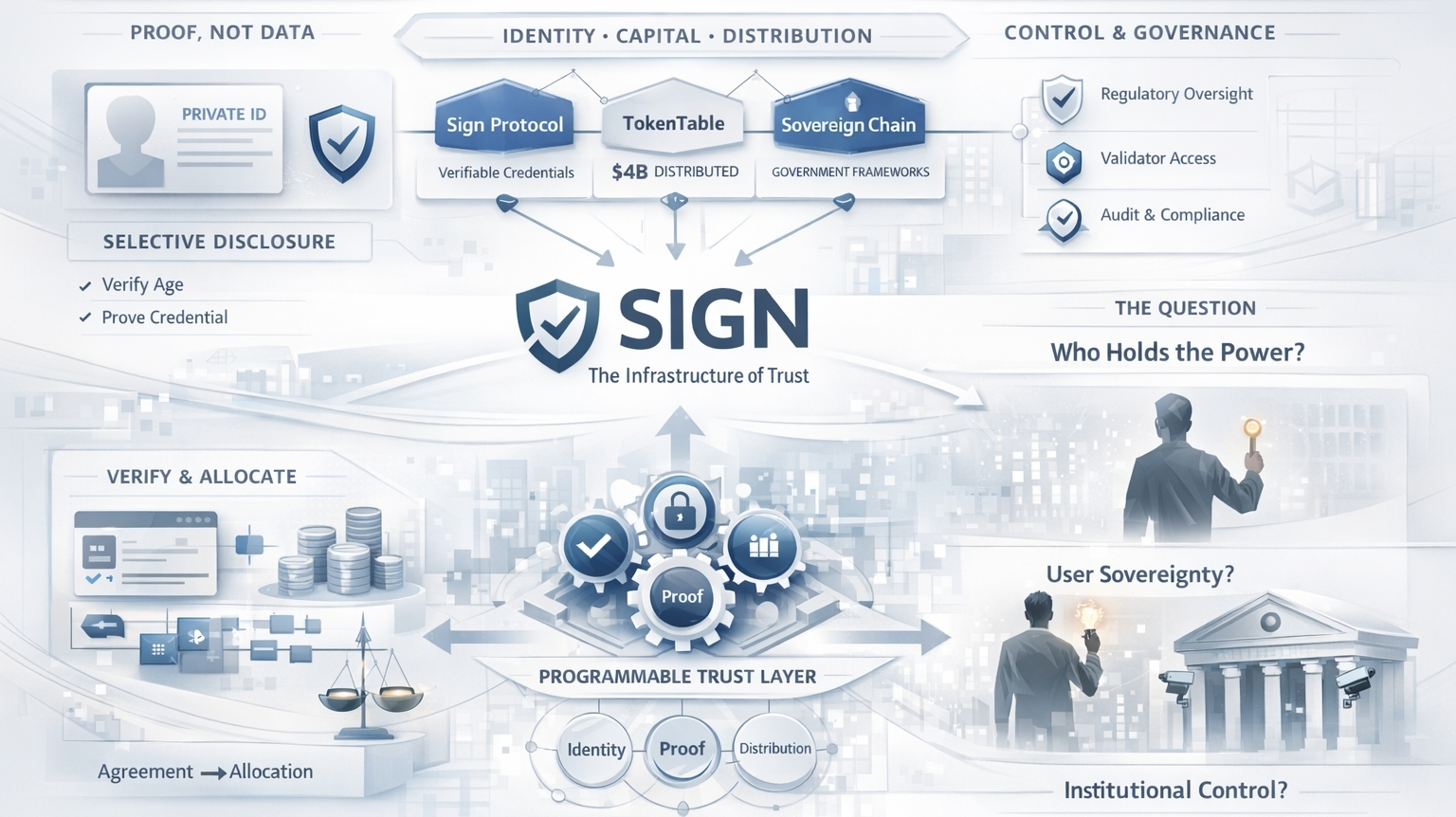
SIGN is one of those rare projects that feels less like a trend and more like future digital infrastructure in motion.
I think a lot of people still read SIGN like it is just an attestation protocol.
That is too small.
From what the project is showing now, SIGN is trying to become a full trust layer for identity, capital, and distribution. Not just a place to stamp credentials, but a system for proving who qualifies, what is true, and what can move. The docs now frame Sign Protocol, TokenTable, and broader sovereign infrastructure as connected parts of one architecture, not separate products loosely sitting under one brand.
In my view, the biggest idea inside SIGN is simple: identity should be about proof, not exposure.
That is the part I keep coming back to.
The protocol docs explicitly talk about selective disclosure, privacy-preserving proofs, and different data placement models, including off-chain and hybrid setups for sensitive information. The sovereign whitepaper goes even further, describing zero-knowledge based verification where users can prove specific attributes without revealing full personal data. That matters because most identity systems today still behave like data vacuum cleaners. SIGN is trying to flip that model.
From my experience, many crypto ecosystems look deep until you inspect them closely.
Then you realize they are just disconnected tools with a shared logo.
SIGN feels more deliberate than that. Sign Protocol handles schemas, attestations, verification, and privacy modes. TokenTable handles large-scale allocation, vesting, and distribution. The docs also position EthSign-style agreement workflows as part of the broader proof system, where commitments can become verifiable evidence. That flow is what makes the project interesting to me. First prove identity. Then prove agreement. Then route value with rules attached.
This is where I think the conversation gets serious.
Proof can be decentralized. Control may not be.
SIGN’s sovereign infrastructure framing clearly tries to preserve national or institutional authority while using cryptographic systems to improve verification and auditability.
The whitepaper talks about citizen data sovereignty and self-sovereign identity principles, but it also makes clear that these systems are meant to operate inside government and regulated environments. So the win is not that power disappears.
The win is that power becomes more constrained by verifiable rules, better audit trails, and less raw data leakage. That is progress, yes. But it is not the same thing as full user ownership of the rails.
What makes SIGN hard to price, in my opinion, is that trust infrastructure always looks boring right before it becomes essential.
The numbers help tell that story.
SIGN’s MiCA whitepaper says the network processed more than 6 million attestations in 2024, while TokenTable distributed more than $4 billion to over 40 million wallets. Those are not tiny experimental stats.
They suggest the team already has real throughput and real operational experience, which matters a lot if the endgame is identity-linked finance and public infrastructure. If AI systems, financial apps and governments all need verifiable authorization, then the project sitting underneath that flow becomes much more important than the market may realize today.
I think SIGN is building in the right direction.
But I do not think the final battle is about technology alone.
It is about who controls the rules around identity once proof becomes programmable. If SIGN succeeds, it could help create a world where people reveal less, prove more, and move through digital systems with far better privacy. But the deeper question will still remain: when identity becomes cryptographic infrastructure, does the user gain real power or do institutions just get a cleaner, smarter way to manage everyone?